Quick answers
History
In American niche circles, Cuir Beluga arrived through Bergdorf Goodman's Guerlain counter and a handful of New York and Los Angeles boutiques that carried the maison's exclusive lines. For a long stretch of the late 2000s and early 2010s, it sat alongside the house exclusives from Chanel and Dior as the soft, vanilla-skewed counter-proposition to the smoky leathers then dominating men's grooming counters. Stateside coverage on Now Smell This and Bois de Jasmin placed it among the most-cited gateway leathers for readers new to the genre.
The composition is the work of Olivier Polge, the French perfumer who would later become Chanel's in-house nose in 2015. In 2005 he was still a Givaudan author, and the same calendar year he also signed Dior Homme, a powdery iris that became one of his most-referenced compositions. Both fragrances share a creamy almond facet that American reviewers quickly identified as a personal signature.
The fragrance was released to coincide with the reopening of Guerlain's flagship at 68 avenue des Champs-Élysées in Paris after a major renovation. It anchored the launch of L'Art et la Matière, a haute-perfumery collection of single-material studies, at a moment when Thierry Wasser had not yet been confirmed as Guerlain's in-house nose.
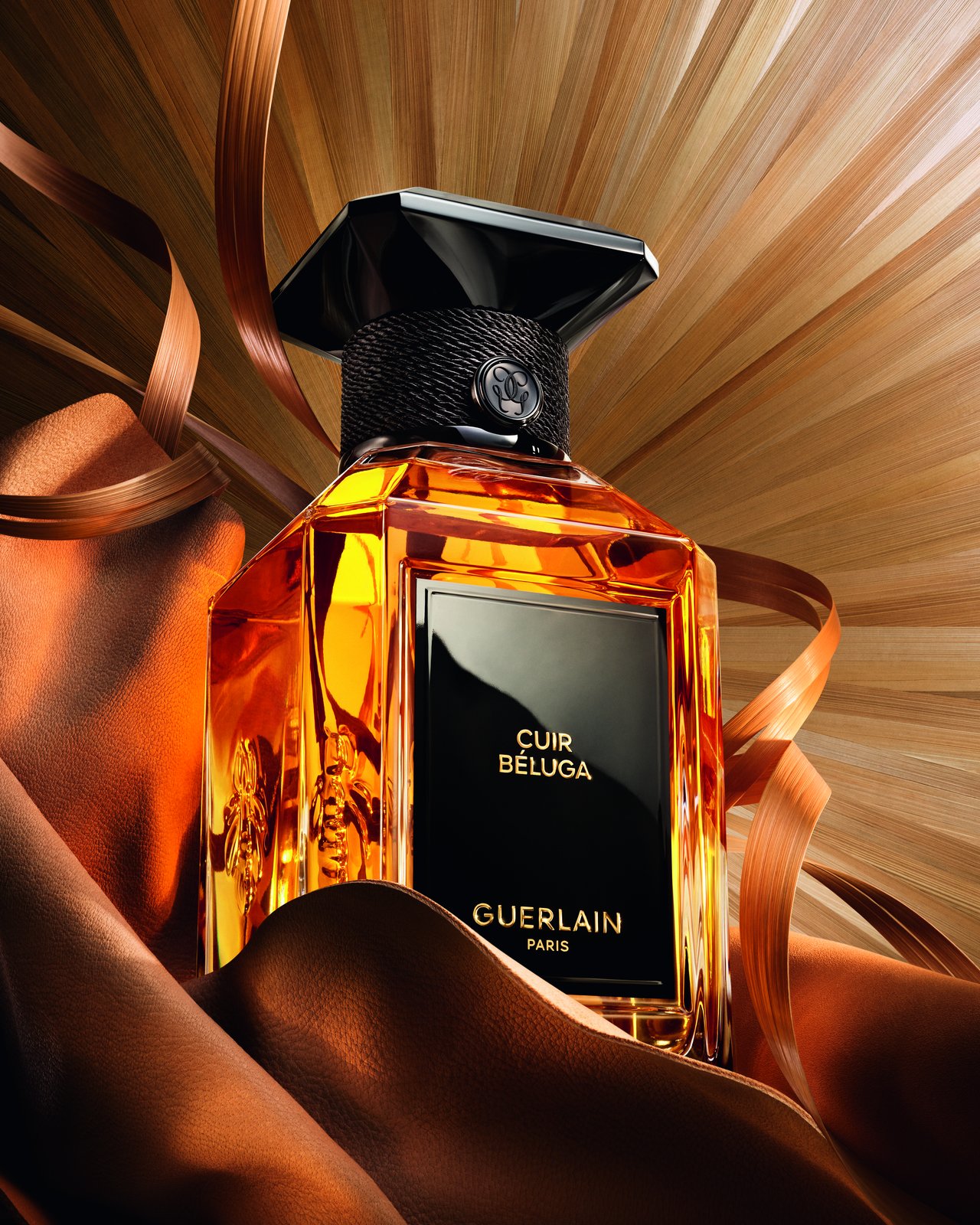
The name points to the white skin of the beluga whale, and to the idea of a soft, precious pale leather. Where Guerlain had already produced a Cuir de Russie in 1872, Olivier Polge swung in the opposite direction. He delivered a luminous reading in which leather sheds tar and smoke and turns into a white suede the maison itself describes as "as enveloping as cashmere" (source: Guerlain). The eau de parfum is housed in the quadrilobe bottle, a Guerlain signature since 1908. Two decades on, it remains in continuous US distribution through guerlain.com, Bergdorf Goodman and Saks Fifth Avenue, with samples on Luckyscent.
Olfactory pyramid
Olivier Polge composed Cuir Beluga as a deliberately short formula, around fifteen ingredients by community counts, which is unusually lean for a Guerlain release. The construction reads as three thin layers that hand off to one another by fade rather than by contrast, so the dry-down feels like a continuation of the heart rather than a separate chapter.
On American skin tones and in indoor climate-controlled offices, the citrus opening typically holds 15 to 30 minutes before the heart settles in. The immortelle-suede heart then runs about 2 to 4 hours, and the heliotrope-vanilla-amber base extends from 5 to 10 hours, sometimes past 12 hours on wool or cashmere. Projection stays close, often described on community boards as "skin-scent generous" rather than room-filling.
Olfactory profile
The olfactory profile of Cuir Beluga sits in an unusual seat. Most contemporary leathers landing on the US market in the mid-2000s leaned smoky, animalic or birch-tar inflected. Cuir Beluga refused all three, and pushed the genre toward powdery vanilla territory instead. The leather accord reads as white suede, smoothed by heliotrope, lifted by vanilla and almond paste, then carried by a soft amber. The Now Smell This editorial framed it as "leather for people who don't think they like leather."
The distinctive signature belongs to the heliotrope. Heliotropin has been a Guerlain house material since the nineteenth century and quietly anchors several of the maison's historic compositions. Olivier Polge moves it from supporting role to lead and lets it talk directly to the suede, which gives the formula its creamy, almost edible density without ever falling into dessert territory. This central use of heliotropin in a leather composition is the single idea that holds the fragrance together.
The resulting character reads as soft and enveloping. Soft, because the writing refuses the sharp angles of traditional leather and favors a powdery roundness. Enveloping, because the vanilla-amber dry-down sustains the sensation of a warm garment held against the skin. On American forums the comparison most often made is with cashmere, the same word the maison itself uses.
A white suede for women and men, as enveloping as cashmere.
Key characteristics
Place in the collection
Cuir Beluga belongs to the founding lineup of L'Art et la Matière, the Guerlain haute-perfumery line opened in 2005. Each composition in the collection is built around a single olfactory family and entrusted to a guest perfumer or to a house nose. Cuir Beluga holds the leather chapter, a position it has kept without revision for twenty years.
Inside the L'Art et la Matière catalog, it sits alongside Angélique Noire, Néroli Outrenoir, Musc Outreblanc and Bois Mystérieux, each tied to a noble material and housed in the historic quadrilobe bottle. Distribution in the United States runs through Guerlain's own counters at Bergdorf Goodman and Saks Fifth Avenue, plus the official US site. Discovery samples circulate through Luckyscent, which has carried the L'Art et la Matière range almost continuously since the late 2000s.
Mapped against the wider American leather canon, Cuir Beluga occupies a middle position. It does not belong with the smoky, dark Russian-leather lineage of Cuir de Russie by Chanel or Tuscan Leather by Tom Ford. It does not belong either with the floral leathers like Bandit by Robert Piguet. It traces a third path, the white vanilla leather, whose influence is audible in several niche releases that followed it after 2005.
When and where to wear it
Cuir Beluga ranks among the most wearable leathers on the American market. Its powdery vanilla softness and moderate sillage make it a workable office fragrance for most of the year, and a comfortable evening choice from October through March. Two sprays cover an evening at the Frick or the Whitney, one spray handles a workday in midtown Manhattan or a winter afternoon in Brooklyn. The dry-down clings remarkably well to wool overcoats, much less so to summer linen.
Wear references
Seasonal fit
| Season | Fit | Critical notes |
|---|---|---|
| Spring | ★★★☆ | Good match for cool days. |
| Summer | ★☆☆☆ | Amber vanilla too dense in open heat. |
| Fall | ★★★★ | Reference season; suede and heliotrope at their best. |
| Winter | ★★★★ | Excellent projection in cold air; superb on cashmere. |
Context fit
| Context | Fit | Recommendation |
|---|---|---|
| Office | ★★★☆ | Soft sillage, fine in a dressed setting. |
| Dressed evening | ★★★★ | Reference context. |
| Intimate dinner | ★★★★ | Enveloping and comfortable. |
| Gallery opening | ★★★★ | Excellent. |
| Sport | ★☆☆☆ | Not suited. |
| Travel | ★★★★ | The drydown holds on wool. |