Quick answers
History
Cierge de Lune is co-founder Karl Bradl and perfumer Fabrice Pellegrin's portrait of the night-blooming cereus, released by Aedes de Venustas in 2016. The French call the cereus cierge de lune, moon altar candle, a literal translation of the Latin Selenicereus grandiflorus. Because the flower opens only after dark and wilts as the sun rises, it is said that Marie-Antoinette summoned the botanical artist Pierre-Joseph Redoute at midnight to capture the cactus species' fleeting beauty.
For his first collaboration with the house, Pellegrin drew on a Madagascan vanilla absolute he calls the truest to the natural ingredient, woodier and more ambery than its Tahitian counterpart, with a tinge of tawny leather. That vanilla forms the heart and reveals a darker side; an airy waft of hedione turns the pod into a cactus blossom, its petals fleshed out by ylang-ylang. Twinkling pink pepper shoots glints of moonlight into the blend, while black pepper threads from mineral, incense-like effects to resinous, dark-chocolate notes, a nod to the incense theme of the line.
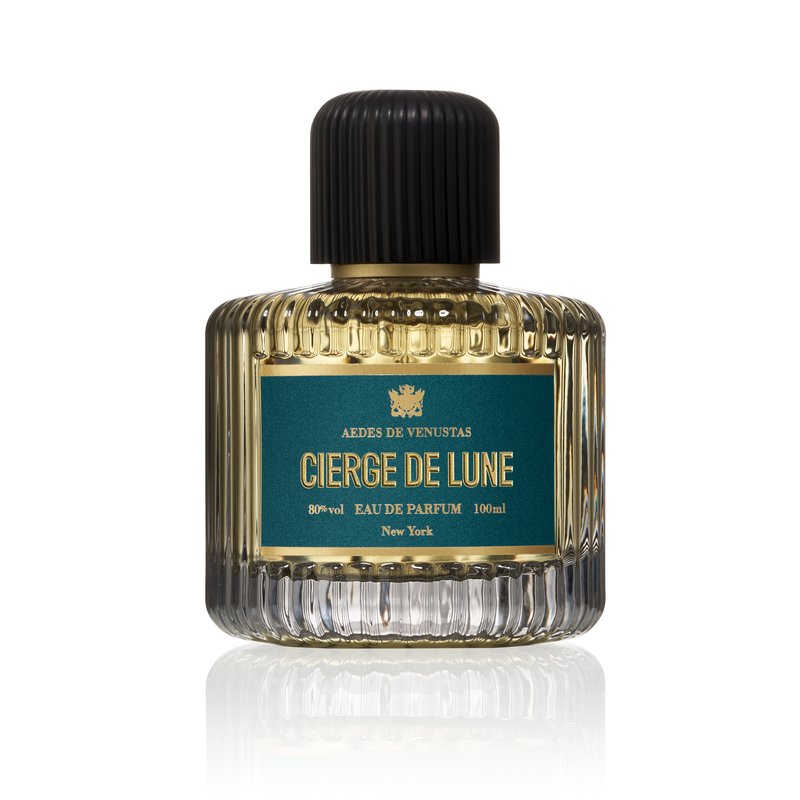
In a final metamorphosis, musky ambrox, underscored by a downy suede accord, turns the nocturnal bloom into a dusky second skin. For the relaunch, Cierge de Lune was transferred into the shared fluted bottle with peacock-blue accents and a matte black insignia cap.
Olfactory pyramid
The house lists the notes as a single palette. The reading below follows the development it describes, from a crystalline, peppered top to the dark vanilla heart and a suede-and-musk base.
The official note list reads: crystalline accord, Madagascar vanilla absolute, ylang-ylang, pink and black peppers, ambrox, suede, incense and musk.
Olfactory profile
Cierge de Lune is a spicy, dusky vanilla rather than a sweet gourmand. The Madagascan vanilla absolute is read through pepper, incense and suede, which strips out the dessert sweetness and leaves something cooler and more nocturnal, closer to a vanilla-amber skin scent than to a bakery.
The distinctive trait is the crystalline, peppered top that keeps the vanilla from turning heavy, so the composition spans a thrilling range from limpid high notes to a deep, spicy purr. It is vanilla for the wearer who wants the note darkened and glamorous.
Key characteristics
When and where to wear
The dusky vanilla of Cierge de Lune is an evening and cold-weather scent above all. It blooms in cool air and intimate settings, where the suede, ambrox and incense read as a second skin rather than a sweet cloud, and it stays close enough to suit close company.
Wear references
Seasonal fit
| Season | Fit | Critical notes |
|---|---|---|
| Spring | ★★★☆ | Peppery flashes lighten the vanilla. |
| Summer | ★★☆☆ | Amber vanilla can feel heavy in strong heat. |
| Autumn | ★★★★ | Ideal season for the suede vanilla and incense. |
| Winter | ★★★★ | The warm suede and ambrox base carries perfectly. |
Context fit
| Context | Fit | Recommendation |
|---|---|---|
| Office | ★★☆☆ | Muted sillage, dose with care. |
| Dressed evening | ★★★★ | Reference context. |
| Intimate dinner | ★★★★ | Preferred setting. |
| Gallery opening | ★★★☆ | Well suited. |
| Sport | ★☆☆☆ | Not suited. |
| Travel | ★★★☆ | Comfortable longevity. |
Similar perfumes
Cierge de Lune belongs to the dark, spicy vanilla register, with neighbours among house siblings and wider niche vanillas.
| Perfume | House · year | Why close |
|---|---|---|
| Grenadille d'Afrique | Aedes de Venustas · 2016 | House sibling from the same year that sets vanilla against dark wood. |
| Tobacco Vanille | Tom Ford · 2007 | A spiced, ambery vanilla reference for wearers cross-shopping the register. |
| Vanille des Afriques Intensivo | Ormonde Jayne | A darker, woody vanilla neighbour for the same nocturnal mood. |
Frequently asked questions
See also
Sources
- Official Aedes de Venustas press kit (June 2026) · Document available on editorial request
- Fragrantica: Cierge de Lune (accessed June 27, 2026)
- Now Smell This: Aedes de Venustas Cierge de Lune coverage (accessed June 27, 2026)
- Basenotes: Cierge de Lune (accessed June 27, 2026)
Content built from the official Aedes de Venustas press kit, received in June 2026.