Quick answers
History
Iris Nazarena is the second Aedes de Venustas perfume, launched in 2013. Ralf Schwieger had long wanted to offer a contemporary interpretation of iris without referencing its most famous expression, Chanel N°19, which he calls the benchmark of iris-based scents and an unsurpassed template since its launch in 1971. He set out to bring transparency to notes that can read as somber, and to land on a beauty that is both mystical and enduring.
The perfume is named for the rare species Iris Bismarckiana, known as Iris Nazarena because it grows mainly in the mountains east of Nazareth. Its uncanny blossom, marked with brown or purple spots and delicate bluish-purple veins, seduced co-founder Karl Bradl the moment he saw it on a postcard, and it became the muse of the composition. The flower itself gives off no scent; it is the root that perfumery reveres, and only after years of growth and drying does it yield its powder, wood and violet character.
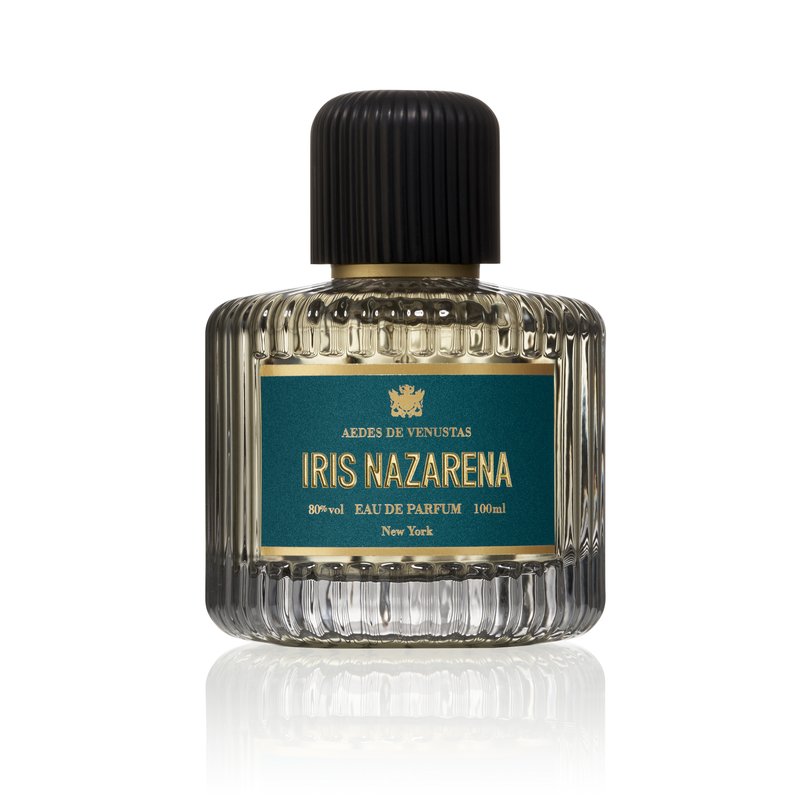
Incense runs as an olfactory thread through much of the Aedes de Venustas line. It ties back to the very origin of perfumery, since the word perfume springs from the Latin per fumare, meaning through smoke. For the relaunch, Iris Nazarena was transferred into the new fluted bottle with peacock-blue accents and a matte black insignia cap, the shared vessel of the reintroduced collection.
Fragrance notes
The palette of Iris Nazarena turns on a mysterious, mineral iris-incense accord, framed by the cold light of ambrette and star anise and by a resinous anchor of juniper, oud and vetiver.
The palette brings together iris, incense, ambrette, juniper berry, star anise, leather, oud, clove, rose de Mai, woods, musk and vetiver. On skin the resinous and smoky facets are the most tenacious.
Scent profile
Iris Nazarena is a woody, incense iris, which sets it apart from the cosmetic, lipstick-powder iris of much classic French perfumery. Where Iris Silver Mist reads as cold, rooty and mineral, and Iris Poudre as a powdery aldehydic floral, Iris Nazarena pushes the root toward resin, leather and sacred smoke.
The signature move is the iris-incense conversation Schwieger describes: the suede-soft petals sketched in a sfumato of brown, purple and white, with the smoke of the altars threading mineral, leather facets through the development. It is an iris for wearers who want the note darkened rather than sweetened.
Key characteristics
When and where to wear
The smoky, rooted character of Iris Nazarena suits cool weather and considered settings. It is an indoor, evening iris more than a fresh daytime one, and it rewards skin contact, so a small dose carries far. Cold air sharpens the incense and the oud; heat blurs them.
How to wear it
Seasonal fit
| Season | Fit | Critical notes |
|---|---|---|
| Spring | ★★★☆ | The green anise and ambrette read well. |
| Summer | ★★☆☆ | Incense and leather can weigh in strong heat. |
| Autumn | ★★★★ | Ideal season for the leathered iris-incense accord. |
| Winter | ★★★★ | The resinous, leathered base carries perfectly. |
Context fit
| Setting | Fit | Usage recommendation |
|---|---|---|
| Office | ★★★☆ | Mineral restraint, for those who enjoy its character. |
| Dressed evening | ★★★★ | Benchmark setting. |
| Intimate dinner | ★★★★ | Preferred setting. |
| Cultural event | ★★★★ | Excellent. |
| Sport | ★☆☆☆ | Not suited. |
| Travel | ★★★☆ | Reasonable staying power. |
Similar perfumes
Iris Nazarena sits at the meeting point of the iris references and the incense register, so its neighbours come from both directions.
| Perfume | House · year | Why close |
|---|---|---|
| Iris Silver Mist | Serge Lutens · 1994 | The reference for a cold, rooty, mineral iris read through the root rather than the powder. |
| Iris Poudre | Frederic Malle · 2000 | A contrasting iris, powdery and aldehydic, useful for placing the darker Nazarena. |
| Aedes de Venustas Signature | Aedes de Venustas · 2012 | House sibling carrying the same incense thread into a different structure. |
Frequently asked questions
See also
Sources
- Official Aedes de Venustas press kit (June 2026) · Document available on editorial request
- Bois de Jasmin: Aedes de Venustas Iris Nazarena coverage (accessed June 27, 2026)
- Aedes de Venustas · official press kit, “IRIS NAZARENA – EAU DE PARFUM” (“Resinous juniper berry, patchouli and vetiver allude to its roots”)