Quick answers
History
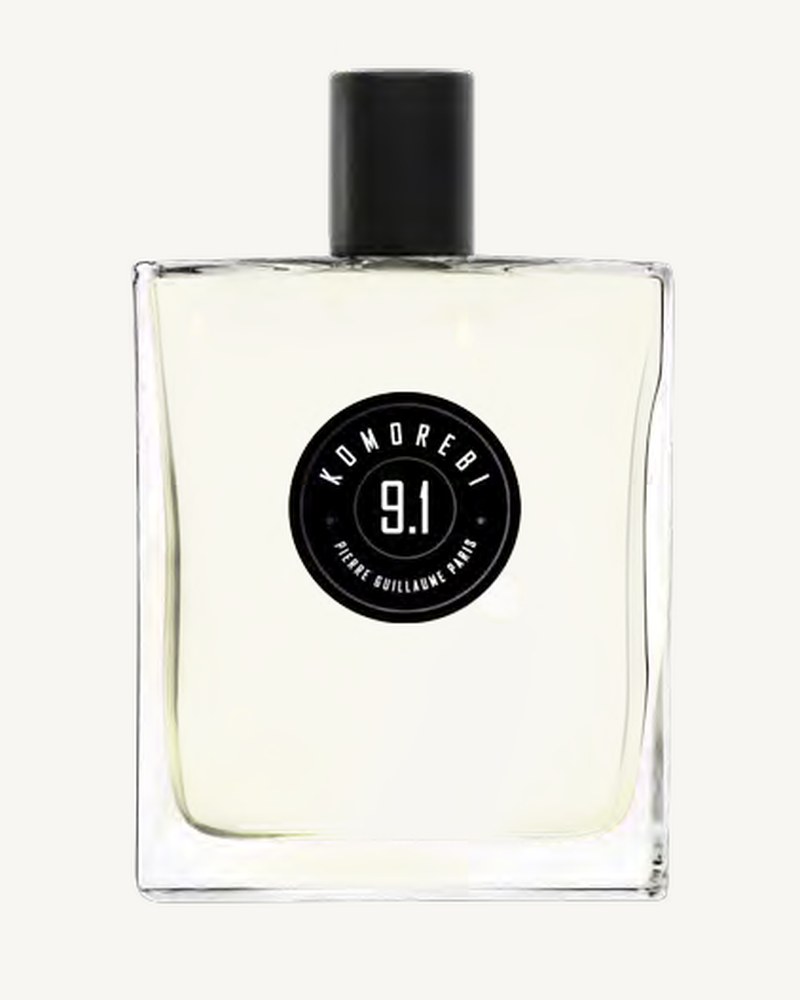
Komorebi is a masculine Japanese noun with no equivalent in our language: it names the light of the sun as it filters through the leaves of trees. Its three kanji spell out tree, escape and light. The word has travelled far beyond perfumery, one of those untranslatable Japanese terms contemporary culture treasures for their poetry, and it is that charge Pierre Guillaume draws on to make the fragrance a link between sky and earth, guided by nature’s most potent symbol, the tree.
Komorebi belongs to the house’s Collection Rework, where Pierre Guillaume revisits his own themes. It is a variation on theme 09, the aromatic floral, opened in 2006 with Yuzu Ab Irato. This time the perfumer writes vegetal poetry: an armful of fresh leaves and plump berries, a romantic walk in the shade of an oak and hazel forest pierced by the sun of a fine summer day.
The composition’s naturalness comes from its airy, green structure. Mint leaves and sap open it with bracing freshness; reseda, delicate yet powerful, forms the heart, lifted by powdery mimosa; juicy blackcurrant adds a fruity, sensual touch before oak and hazel, wrapped in tonka bean absolute, close the trail on a woody warmth.
When it appeared in spring 2018, Komorebi won over the perfume press with its green naturalness. Now Smell This, covering the launch, quoted the house’s image of “the vegetal poetry of an armful of fresh leaves and plump berries”; the scent rode a renewed appetite for luminous greens, away from the gourmands that dominated the moment.
Olfactory pyramid
Komorebi unfolds in three movements, from the biting green of the leaves to a warm wood.
The thread is light: a vegetal freshness that stays alive even in the wood.
Olfactory profile
Komorebi is a luminous green rather than a sharp one. Mint and sap give an immediate freshness, but it never bites: reseda and mimosa round it with a powdery softness, and blackcurrant slips in a fruity note that keeps the composition from turning cold and grassy.
Its signature is the move from green to wood. Where many aromatic florals fade quickly, Komorebi leans on oak and hazel, wrapped in tonka bean absolute, to hold a warm, faintly gourmand base. It is an outdoor scent, a scent of renewal, at ease as soon as the weather turns fine.
I envisioned Komorebi as a sensuous vegetal shade, a scent of rebirth with green, positive vibes…Pierre Guillaume, perfumer
Key characteristics
When and where to wear
Komorebi is a fine-weather, daytime perfume. Its green freshness suits spring and summer, while the woody base lets it carry into mid-season. The trail is clean and bright, accompanying without imposing.
Usage guidance
Seasonal fit
| Season | Fit | Critical notes |
|---|---|---|
| Spring | ★★★★ | Its season. |
| Summer | ★★★★ | The green freshness blooms. |
| Autumn | ★★★☆ | The wood takes over. |
| Winter | ★★☆☆ | A little cool in the cold. |
Setting fit
| Setting | Fit | Recommended use |
|---|---|---|
| Everyday | ★★★★ | Reference use. |
| Office | ★★★★ | Fresh and discreet. |
| Walks | ★★★★ | Its natural ground. |
| Evening | ★★★☆ | In mild weather. |
| Sport | ★★★☆ | Light and bracing. |
Similar perfumes
The green aromatic floral has its neighbours; a few share this leafy freshness.
| Perfume | House · year | Why it is close |
|---|---|---|
| Yuzu Ab Irato | Pierre Guillaume Paris · 2006 | The first reading of theme 09, more citrus, which Komorebi reworks into a green, leafy version within the Collection Rework. |
| Eau de Campagne | Sisley · 1974 | Jean-Claude Ellena’s founding green galbanum, the same crushed-leaf freshness. |
Common questions
See also
Sources
- Official press kit, Komorebi · Pierre Guillaume Paris
- Pierre Guillaume Paris catalogue 2025–26 (English edition)
- Pierre Guillaume Paris, official Komorebi page
- Now Smell This, “Pierre Guillaume / Parfumerie Generale Komorebi” (April 2018)
- Fragrantica, Komorebi 9.1 entry