Quick answers
Background
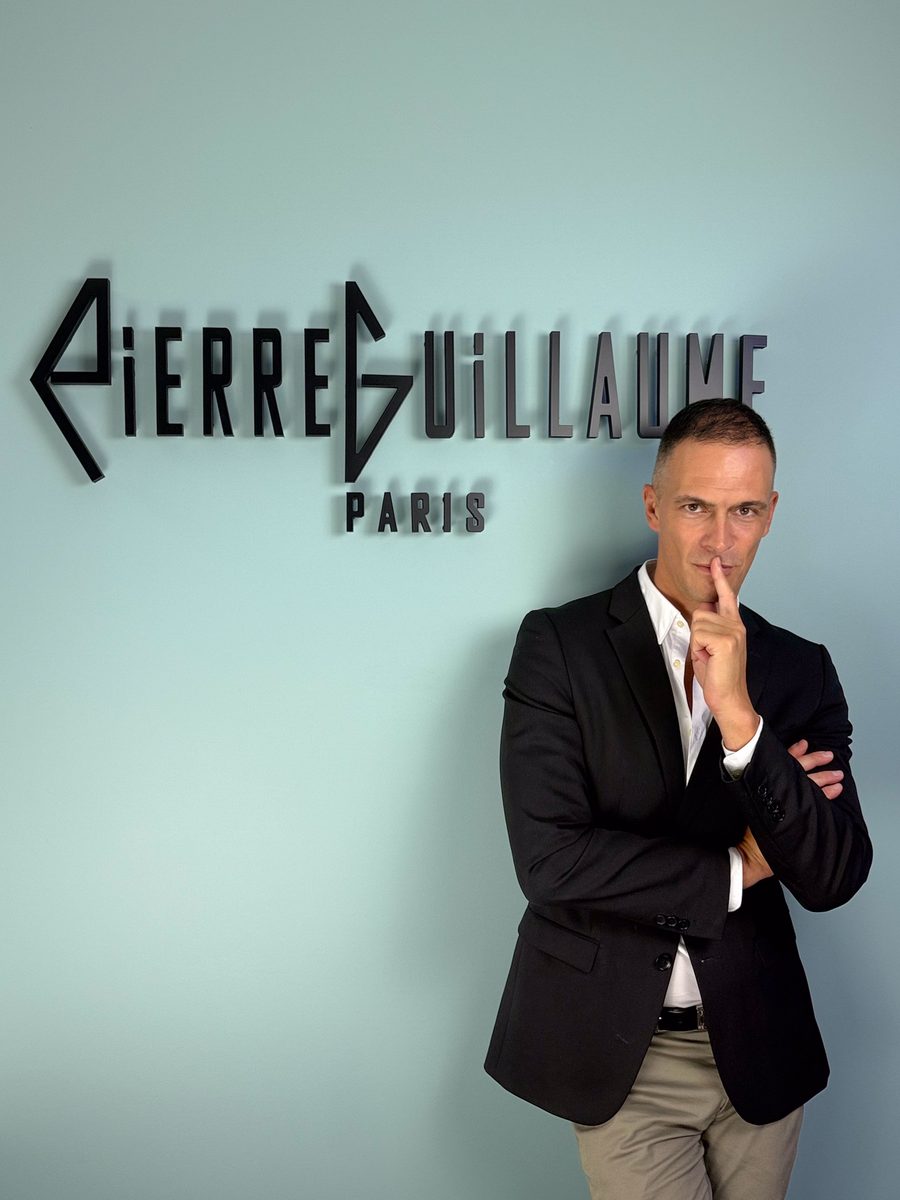
Pierre Guillaume grew up in Auvergne in a family of chemists, collecting essential oils and fragrant materials from childhood, the seed of what would become his perfumer’s palette. His training is scientific: he approached composition as a self-taught perfumer, drawing on a solid grounding in chemistry from the family business rather than the classic perfumery schools.
At the very end of the 1990s he joined the family company as a formulator developing its cosmetics arm. His father’s illness redirected him toward perfume. Around twenty-five he set out to recreate the smell of his father’s cigar cellar; the spicy-tobacco accord that resulted, 02 Cozé, became his first perfume and the founding act of Parfumerie Générale in 2005. This account draws on the 20-Year Dossier 2005-2025 of the house.
Critics noticed quickly. Chandler Burr of the New York Times praised this young French chemist in the mid-2000s. Pierre Guillaume built a chemist’s perfumery in which he designs his own bases, such as the Épicène-Gamma accord of 02 Cozé. He claimed independence early: in 2010 he created Pierre Guillaume Diffusion and his own production tool; a second workshop opened in 2015, then a Manufacture in Auvergne in 2023. According to the house, he is the only perfumer in France to own his production unit, his logistics unit and his own raw-material cellar, which secures complete freedom of composition.
Beyond his main house, Pierre Guillaume widened his territory. In 2009 he launched Huitième Art, an experimental, cinematic line whose name salutes cinema, the eighth art, later folded into his world as the Black Collection. From 2010 he took the artistic direction of Phaedon Paris, a travel-themed house whose trademark he acquired in 2013 and which he composes in his ateliers. He progressively gathered all his work under the Pierre Guillaume Paris label.
The houses of Pierre Guillaume
Pierre Guillaume composes from his Auvergne ateliers. Two houses structure his territory today: Pierre Guillaume Paris, which gathers his collections, and the sister house Phaedon Paris; his Black Collection also continues his former Huitième Art line.
Perfumes
Pierre Guillaume’s creations span Pierre Guillaume Paris, from the Numbered Collection to the Black Collection inherited from Huitième Art, and his sister house Phaedon. A few landmarks:
| Year | House | Perfume | Accord |
|---|---|---|---|
| 2002 | Pierre Guillaume Paris | 02 Cozé | Spicy woody |
| 2003 | Pierre Guillaume Paris | 13 Brûlure de Rose | Fruity floral amber |
| 2005 | Pierre Guillaume Paris | 04 Musc Maori | Soft amber |
| 2006 | Pierre Guillaume Paris | 10 Aomassaï | Amber woody |
| 2007 | Pierre Guillaume Paris | 14.1 Cuir d’Iris | Leather spicy woody |
| 2007 | Pierre Guillaume Paris | 18 Cadjméré | Amber woody |
| 2009 | Pierre Guillaume Paris | 17 Tubéreuse Couture | Floral bouquet |
| 2010 | Pierre Guillaume Paris | Sucre d’Ébène | Sweet wood |
| 2010 | Pierre Guillaume Paris | Manguier Métisse | Fruity wood |
| 2011 | Phaedon | Cendres de Thé | Smoky tea wood |
| 2014 | Pierre Guillaume Paris | Liqueur Charnelle | Aromatic wood |
| 2016 | Pierre Guillaume Paris | 4.1 Le Musc & la Peau | Musky woody |
Signature
Pierre Guillaume’s signature follows from his double culture as chemist and perfumer. He builds his perfumes around bases he formulates himself, like the Épicène-Gamma accord of 02 Cozé, a blend of chilli, clove and nutmeg. That technical command lets him write a perfumery he wants narrative, contemporary and above all wearable.
His repertoire is recognizable by a marked taste for gourmand musks, amber woods and milky, sweet, resinous materials. The numbered-theme system of his main house reflects his method: returning freely to a family of materials, exploring its variations, and signalling lineages with a decimal, as from 04 Musc Maori to 4.1 Le Musc & la Peau.
Perfume is the artistic expression of a science.Pierre Guillaume
Key characteristics
FAQ
See also
To go further, here are related Osmetheca entries: his houses and the materials at the heart of his writing.
Sources
- Pierre Guillaume Paris: official company profile (corporate document)
- Pierre Guillaume Paris: official 2025-26 catalogue (house document)
- Pierre Guillaume Paris: official biography (official site)
- Now Smell This: Pierre Guillaume, Parfumerie Générale
- Basenotes: interview with Pierre Guillaume