Quick answers
History
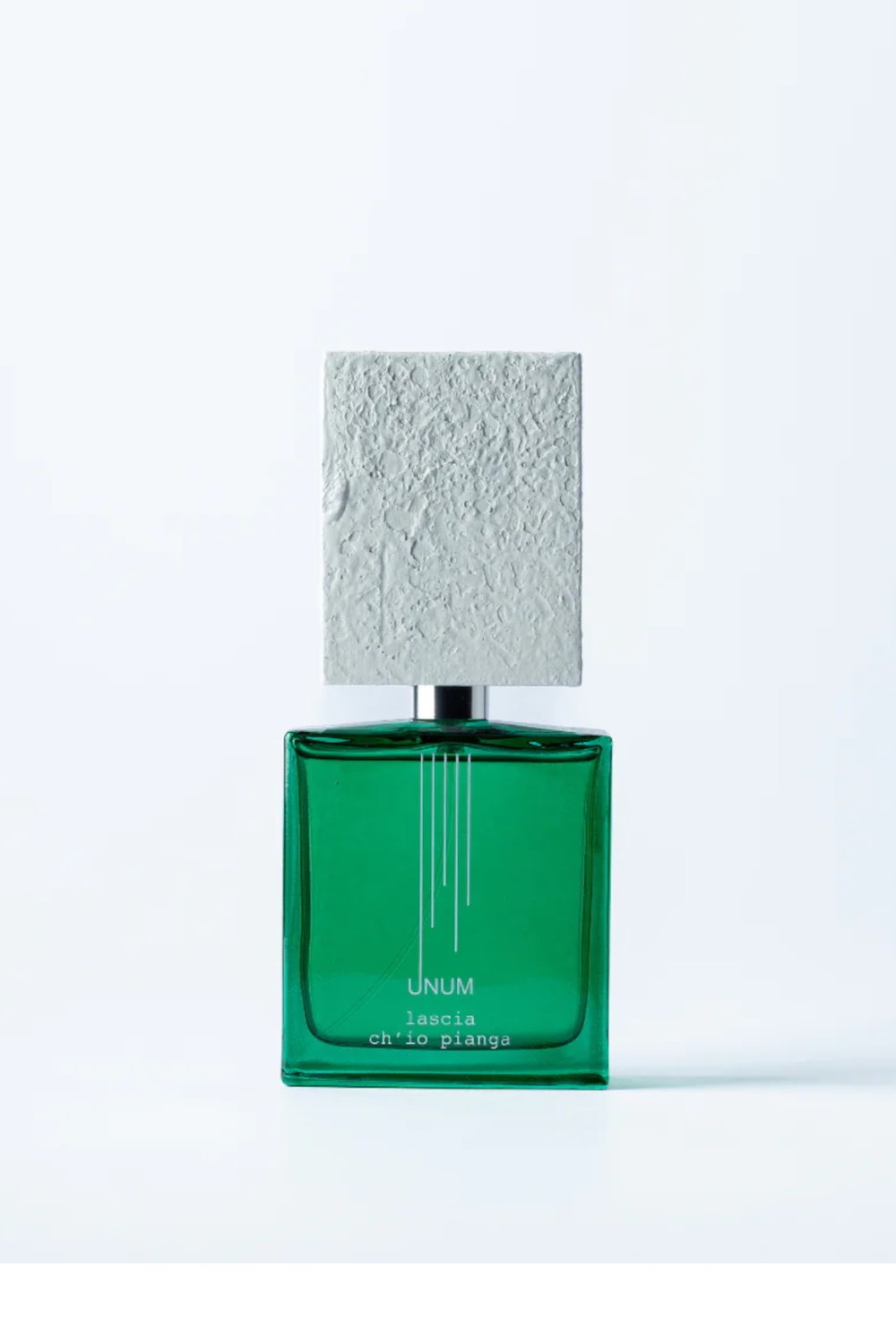
Lascia ch'io pianga is the eleventh fragrance of UNUM, Filippo Sorcinelli's first olfactory line, born in 2013 out of his atelier of sacred vestments. As so often with the house, the initial spark is musical: the bottle's decoration takes up the pentagram, and the name quotes the aria Lascia ch'io pianga, one of the most famous arias by Georg Friedrich Handel, from his opera Rinaldo, premiered in London in 1711.
Yet the house warns that the music is only the genesis. The project opens onto a far wider theme: the conquest of a precious gift that every human being possesses and that, today more than ever, becomes a fundamental value, namely freedom. Sorcinelli wants to recount the difficult conquest of that absolute, far from the many forms of servitude that are fashions, advertising and preconceptions.
The olfactory image is that of a run down a straight road, traced across a symbolically green expanse marked by a moon. That moon accompanies and bathes faces in a warm, enveloping light. We realize how important freedom is, the house says, only when it fails us, and it is through each person's experience that the limit of prejudice is crossed.
The freedom Lascia ch'io pianga sings is not arbitrary, though: it always comes to terms with rights and values. It is that new song which makes one aware of limits, that distant sigh which unties uncertainty and finally points to a vocation. The perfume ranks among the most beloved compositions of the collection; enthusiasts file it among the green florals.
Olfactory pyramid
Filippo Sorcinelli is an organist; he does not conceive his perfumes as a pyramid of volatility but as a score. Lascia ch'io pianga is therefore stated in three movements, subject, counter-subject and tail, as the house publishes them under the heading of harmonic evolution.
The subject is a large white bouquet, where lilac and jasmine give brightness, gardenia and ylang-ylang the opulence, iris the powdery depth. Tuberose and carnation, in the counter-subject, fleshy and faintly spiced, keep the floral freshness from turning sweet. The tail of Tolu balsam and musks closes the whole on an enveloping warmth, that of the moon in the story.
Olfactory profile
Lascia ch'io pianga is a broad, luminous floral, yet never sugary. From the opening, the white bouquet settles in full light: lilac brings its green freshness, jasmine and gardenia their velvet, and iris holds it all together with a powdery depth that keeps it from drifting. This is far from a decorative soliflore; it is a bouquet with structure and matter.
The counter-subject gives the perfume its density. Fleshy tuberose and spiced carnation add flesh and relief, a reminder that the freedom sung here is a conquest, not an ease. That tension between the brightness of the white flowers and the warm flesh of the heart makes the whole character of the perfume.
The base seals the movement. Tolu balsam wraps the flowers in a soft, faintly balsamic resin, while the musks extend the sillage with a discreet, enveloping warmth. Longevity is long, as befits an extrait; the sillage, present without being showy, leaves behind the trace of a bouquet that refuses to close.
“It is the music that moves, that descends like tears to generate the desire for freedom: the aria from Handel's Rinaldo, Lascia ch'io pianga.”Filippo Sorcinelli, on Lascia ch'io pianga
Key characteristics
When and where to wear
Lascia ch'io pianga is a floral for full seasons and full light. Its white bouquet blooms in spring and summer, in daylight as much as evening, on occasions where you want to wear an assured flower. Its Tolu and musk base also lets it hold the shoulder seasons; in deep winter, it warms grey days with a floral heat.
Usage markers
Seasonal fit
| Season | Fit | Critical notes |
|---|---|---|
| Spring | ★★★★ | Its prime season, the bouquet rises in full light. |
| Summer | ★★★★ | The white flower blooms in the heat. |
| Autumn | ★★★☆ | The Tolu base warms the shoulder season. |
| Winter | ★★★☆ | A floral warmth against grey days. |
Context fit
| Setting | Fit | Usage recommendation |
|---|---|---|
| Outing, dinner | ★★★★ | An assured floral, present without shouting. |
| Ceremony | ★★★★ | Luminous and dignified at once. |
| Daytime | ★★★☆ | A clear bouquet, worn without effort. |
| Evening | ★★★★ | The musky base carries the night. |
| Shared office | ★★★☆ | Dose it; the bouquet is broad. |
Similar perfumes
The large white bouquet, structured and warm, has its neighbors; a few share its floral density or its kinship with the house.
| Perfume | House · year | Why it is close |
|---|---|---|
| Rosa Nigra | Filippo Sorcinelli · 2015 | The musky floral of the UNUM collection, a paraphrase of the Assumption; another flower carried by musk, rosier where Lascia ch'io pianga is white. |
| ORGAN #1 · The Chapel of Gladioli | Filippo Sorcinelli · 2026 | The house's church floral, tuberose and orange blossom; a flower held by stone, a close cousin of this bouquet. |
| Carnal Flower | Frederic Malle · 2005 | The great reference for carnal tuberose; to set against the green, powdery breadth of Lascia ch'io pianga. |
Common questions
See also
Sources
- Official Filippo Sorcinelli document, Lascia ch'io pianga sheet (Italian and English editions)
- Filippo Sorcinelli Fragrances 2026 press kit (UNUM collection)
- Filippo Sorcinelli, official Lascia ch'io pianga page
- Fragrantica, Lascia ch'io pianga entry (release year 2022)
- Parfumo, Lascia ch'io pianga entry