Quick answers
History
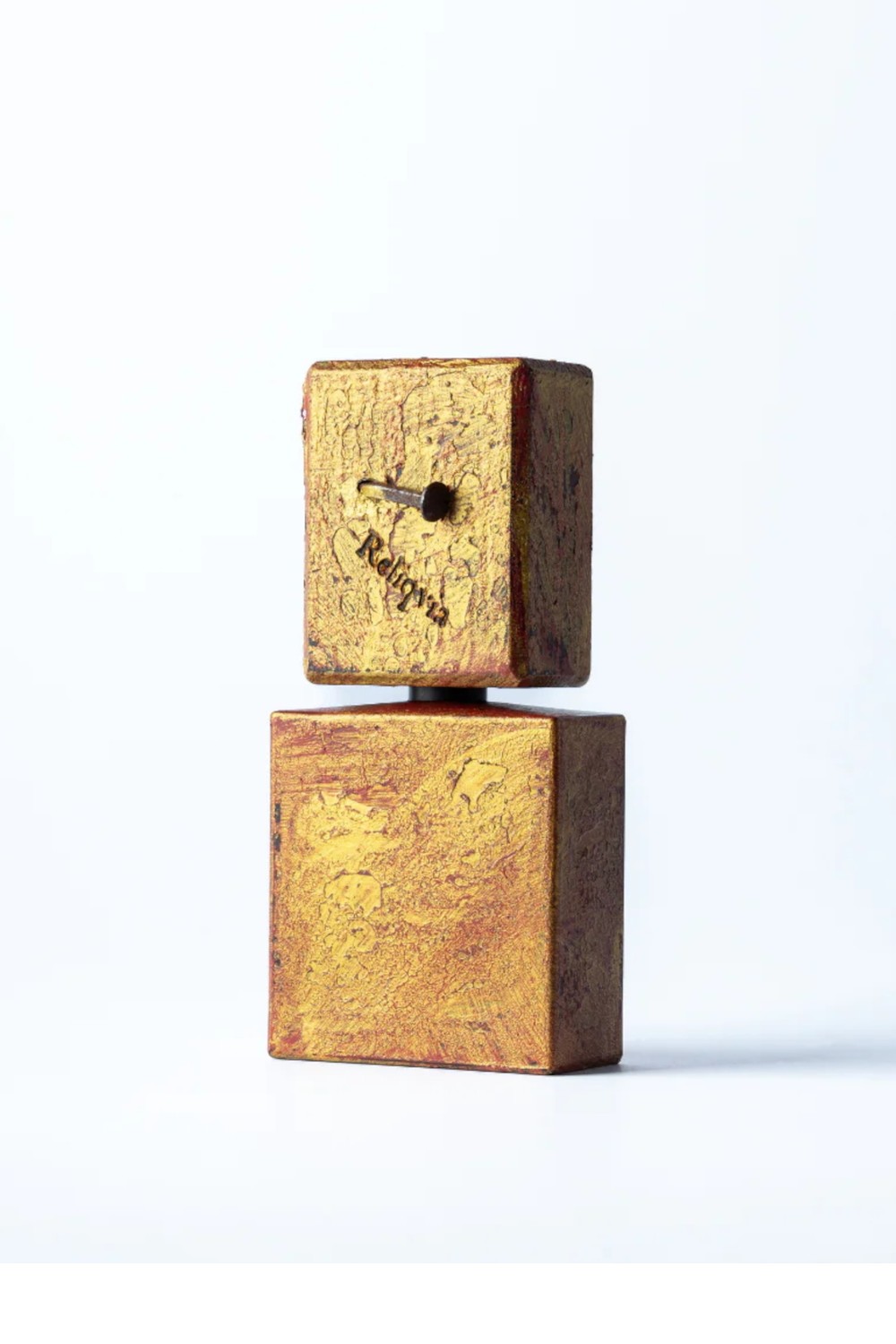
Reliqvia belongs to UNUM, Filippo Sorcinelli's first olfactory line, born in 2013 out of his atelier of sacred vestments. The perfume pays tribute to the chiesa della Croce, the Church of the Cross in Senigallia, an Italian Baroque oratory raised in 1608 by the Confraternity of the Sacrament and the Cross, a brotherhood still active today, of which Sorcinelli is himself a member as organist and artistic director.
The building is a casket of gold and wood: its walls are clad in gilded timber, and it holds a statue of the dead Christ carved from seventeenth-century wood, which tradition unveils only once a year. Above the altar hangs Federico Barocci's altarpiece, the Entombment of Christ, painted in 1582; Barocci designed even its frame, so that painting and setting read as one.
The place is a compact theater of the Baroque: gilded surfaces catch the candlelight, the carved wood absorbs centuries of incense, and every object earns its charge from long liturgical use. Reliqvia translates that architecture into scent, the way a room can carry the memory of everyone who has knelt in it.
Released in 2021 within one of the most uncompromising collections in Italian author perfumery, Reliqvia is no cold, translucent church incense but a dense, earthy smoky-woody incense, where resin meets tobacco and precious woods. The house speaks of the chiodo, the nail of the Passion, and of an incense layered and peated by solemn, sacred years, a deposit of time on stone and wood.
Fragrance notes
Filippo Sorcinelli is an organist; he does not conceive his perfumes as a pyramid of volatility but as a score. Reliqvia is therefore stated in three movements, subject, counter-subject and tail. The subject sets incense and woods; the counter-subject tempers their gravity; the tail smokes and roots the whole in tobacco.
Patchouli and incense lay down a dense, almost mineral mass; cashmere, guaiac and sandalwood thicken it with a precious layer. Orange blossom and the green resins of the counter-subject lighten the gravity without breaking it, while elemi, nutmeg, smoke notes and tobacco leaves close the score on a smoky, lasting warmth, like a deposit of burnt wax.
Scent profile
Reliqvia's subject is the very matter of incense: a smoky, earthy resin, backed by patchouli. There is no deceptive citrus lift; the sweet orange and black currant of the tail barely surface, just enough to keep the resin from setting. You are in the low register, in wood and smoke.
The counter-subject brings the composition's only bright relief. Honeyed orange blossom, Scots pine and lentisk lay down a green, resinous freshness that airs the incense without cooling it, while cloves and amyris hold the warm line. That tension between dense resin and balsamic green gives the perfume its inhabited depth, the depth of a place built of stone and gilded wood.
The tail is the core of the statement: elemi, nutmeg, smoke notes and tobacco leaves layer the incense and peat it. Cured tobacco signs the memory, the deposit of accumulated years. Longevity is long, the sillage present yet recollected, in keeping with a perfume turned toward what remains rather than what seduces.
“I leave what remains…”Filippo Sorcinelli, on Reliqvia
Key characteristics
When and where to wear
Reliqvia is a fragrance for cool seasons and solemn hours. Its smoky, woody density blooms in autumn and winter, in the evening more than the day, in moments of recollection. Present without being intrusive, it suits interiors and evenings; in high summer, its resin asks for a light hand.
How to wear it
Seasonal fit
| Season | Fit | Critical notes |
|---|---|---|
| Spring | ★★★☆ | On evenings that stay cool. |
| Summer | ★★☆☆ | Dense and smoky; dose it lightly. |
| Autumn | ★★★★ | Its prime season, the woody incense settles in. |
| Winter | ★★★★ | The solemn register reaches full measure. |
Context fit
| Setting | Fit | Usage recommendation |
|---|---|---|
| Recollection | ★★★★ | Its primary vocation, a memory worn on the skin. |
| Indoors | ★★★★ | An incense for closed rooms, at home. |
| Cultural evening | ★★★★ | Concert, exhibition: a gravity that accompanies. |
| Intimate evening | ★★★☆ | A smoky warmth, never showy. |
| Shared office | ★★☆☆ | Dense and resinous, dose it with restraint. |
Similar perfumes
Smoky woody incense has its neighbors; a few share its resinous gravity or its memory of a sacred place.
| Perfume | House · year | Why it is close |
|---|---|---|
| LAVS | Filippo Sorcinelli · 2014 | The house's founding incense, in the same UNUM collection; vaster and more aerial than Reliqvia, but the same taste for the sacred. |
| Basilica di Assisi | Filippo Sorcinelli · 2024 | Another tribute to an Italian place of worship; to set against the peated density of Reliqvia. |
| Avignon | Comme des Garçons · 2002 | A reference for cold, translucent church incense; the exact opposite of Reliqvia's smoky, woody warmth. |
Frequently asked questions
See also
Sources
- Official Filippo Sorcinelli document, Reliqvia sheet (Italian and English editions)
- Filippo Sorcinelli Fragrances 2026 press kit (UNUM collection)
- Filippo Sorcinelli, official Reliqvia page