Quick answers
History
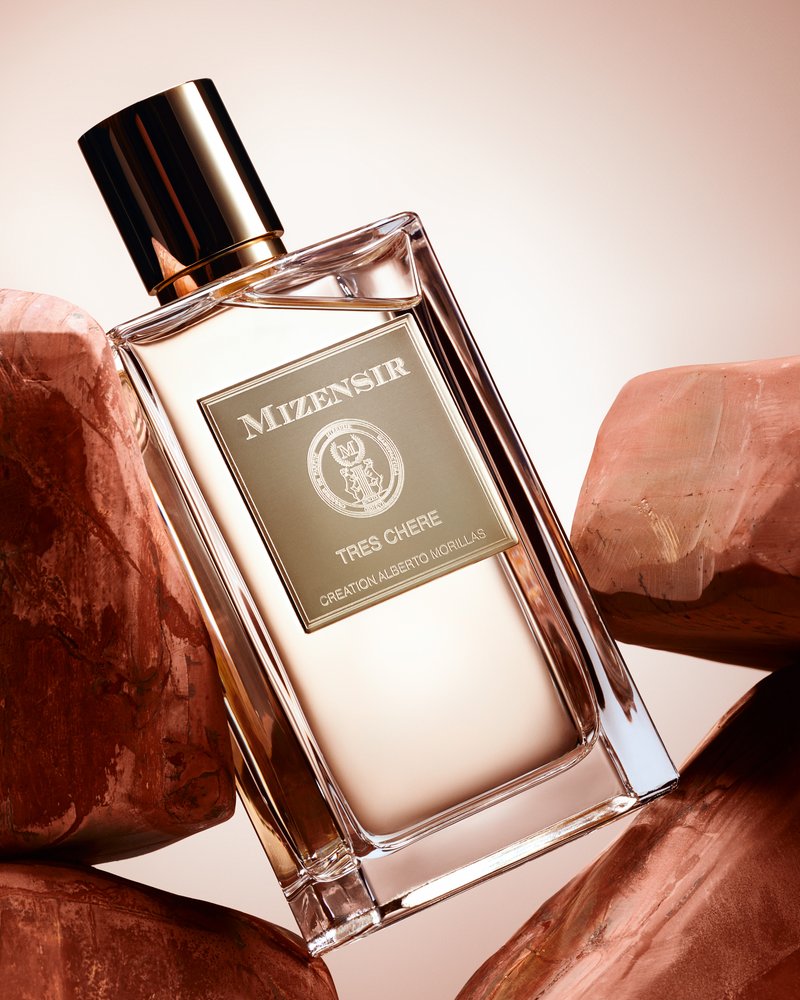
Tres Chere was launched in 2017 by Mizensir, the niche perfume house founded in 1999 in Geneva (Switzerland) by Alberto Morillas and his wife Claudine Morillas. The composition is signed by Alberto Morillas himself, one of the most prolific perfumers of the past forty years, recognized for Acqua di Gio for Giorgio Armani (1996), CK One for Calvin Klein (1994) and Pleasures for Estee Lauder (1995) among several hundred industrial signatures.
Mizensir began in 1999 as an atelier of artisanal scented candles led by Alberto Morillas and Claudine Morillas. The perfume activity was added in 2015, with a series of compositions signed by Alberto Morillas in an author register freed from mass-market constraints. Tres Chere, launched in 2017, belongs to that perfume line and quickly settled in among the most cited references of the catalog.
The narrative inspiration is intimate and personal. Alberto Morillas built Tres Chere around an orange blossom petal extract held at full presence, supported by a modern musky structure with ambroxan and Paradisone®, then closed by bourbon vanilla and Australian sandalwood. The result is a luminous white musky floral, elegant and warm, that reads as a signature gesture rather than a marketed concept.
The reception in the international niche community has been durable. Tres Chere helped position Mizensir as one of the major Swiss niche houses of the contemporary landscape, and it illustrates the creative freedom that Alberto Morillas allows himself in his own house, in contrast with the massive output he signs for the great industrial perfume houses through Firmenich, now dsm-firmenich. The perfume is still distributed.
A personal signature freed from the mass-market brief.
The singularity of Alberto Morillas in the contemporary perfume landscape rests on his dual practice. He signs widely distributed compositions for the great industrial perfume houses through Firmenich, his historic employer, while also signing author compositions for his own niche house Mizensir. Tres Chere belongs to that author side: the technical command of an industrial career combined with the creative freedom of a personal house, where a single material can be held in full presence without commercial compromise.
Fragrance notes
The architecture of Tres Chere articulates its signature materials in a white musky floral construction characteristic of the author register of Mizensir.
Evolution on skin is gradual and luminous. The orange blossom petal opening cedes to a jasmin sambac heart laced with ambroxan and Paradisone®, then to a bourbon vanilla, Australian sandalwood and musk drydown that can hold eight to ten hours on skin. The composition reads as a single sustained floral gesture rather than a sequence of contrasting accords.
Scent profile
The olfactory composition of Tres Chere is organized around orange blossom petal extract, a fractional isolate that carries the smoothest facet of the flower without the green bitterness of full neroli essence. The material is held in full presence from the opening, and jasmin sambac at the heart adds a nocturnal white floral facet to the luminous orange blossom.
The musky structure rests on two contemporary synthetics with documented usage in modern niche perfumery. Ambrox®, the Firmenich captive synthetic introduced in 1950 as a stable substitute for natural ambergris, builds a warm dry amber facet that anchors the floral heart. Paradisone®, a high-purity hedione isomer developed by Firmenich, lifts the jasmin sambac with transparent floralcy and modern radiance. Together they articulate the modern musky character of the composition.
The drydown is built on bourbon vanilla from Reunion (France) and Australian sandalwood (Santalum spicatum), a sustainable Western Australian species cultivated as a contemporary alternative to the protected Indian Mysore sandalwood. Soft musks complete the base. The result is a creamy, slightly sweet finish that holds on skin and lingers on textile into the next day.
The technical signature of Tres Chere is the combination of a single dominant floral material with a modern musky base. The orange blossom petal extract is dosed at full presence, the ambroxan and Paradisone® provide the modern transparent backbone, and the sandalwood vanilla drydown gives the composition its long, warm finish. This construction places Tres Chere in the contemporary white musky floral lineage rather than in the heavier opulent oriental floral tradition.
Key characteristics
The reception of Tres Chere helped consolidate the international reputation of Mizensir as one of the major Swiss niche houses of the contemporary landscape, alongside other Geneva-based author signatures. Together with Solar Blossom (2019) and several other Morillas-signed compositions, Tres Chere anchors the perfume line that Mizensir added to its historic candle catalog in 2015.
Cultural legacy
The distinctive signature of Tres Chere rests on the personal author voice that Alberto Morillas allows himself at Mizensir. Where his industrial compositions for Giorgio Armani, Calvin Klein, Estee Lauder and Bvlgari are calibrated for massive mainstream diffusion, his work at Mizensir is freed from those constraints. Tres Chere illustrates that freedom in a white musky floral that holds a single material (orange blossom petal extract) at full presence within a modern musky architecture.
When and where to wear
Within the floral family, Tres Chere is regarded as a refined, enveloping signature. Its orange blossom, vanilla and sandalwood register suits temperate seasons and dressed-up settings.
How to wear it
Seasonal fit
| Season | Fit | Critical notes |
|---|---|---|
| Spring | ★★★★ | Reference season for the composition. |
| Summer | ★★★☆ | Good fit in mild evenings, the vanilla base may feel heavy in full heat. |
| Autumn | ★★★★ | Excellent. |
| Winter | ★★★☆ | Wearable, the sandalwood vanilla base holds in cooler temperatures. |
Context fit
| Setting | Fit | Wearing recommendation |
|---|---|---|
| Office | ★★★☆ | Acceptable in a refined professional environment. |
| Formal evening | ★★★★ | Reference setting for the composition. |
| Intimate dinner | ★★★★ | Excellent. |
| Gallery opening | ★★★★ | Setting of predilection. |
| Sport | ★☆☆☆ | Mismatched register. |
| Travel | ★★★☆ | Reasonable presence across hours. |
Similar perfumes
Five compositions share a kinship with Tres Chere through the white floral family or the orange blossom signature.
| Perfume | House · year | Why related |
|---|---|---|
| Solar Blossom | Mizensir · 2019 | Same house, also signed by Alberto Morillas; shared white floral orange blossom heart. |
| Fleur d'Oranger | Serge Lutens · 1995 | Niche orange blossom signed by Christopher Sheldrake; same heart material. |
| Carnal Flower | Frederic Malle · 2005 | Niche tuberose signed by Dominique Ropion; same white floral category. |
| Neroli Portofino | Tom Ford · 2011 | Mediterranean neroli composition; shared raw material lineage. |
| Eau d'Hadrien | Annick Goutal · 1981 | French niche hesperidic, kinship through citrus floral register. |