Quick answers
History of the house
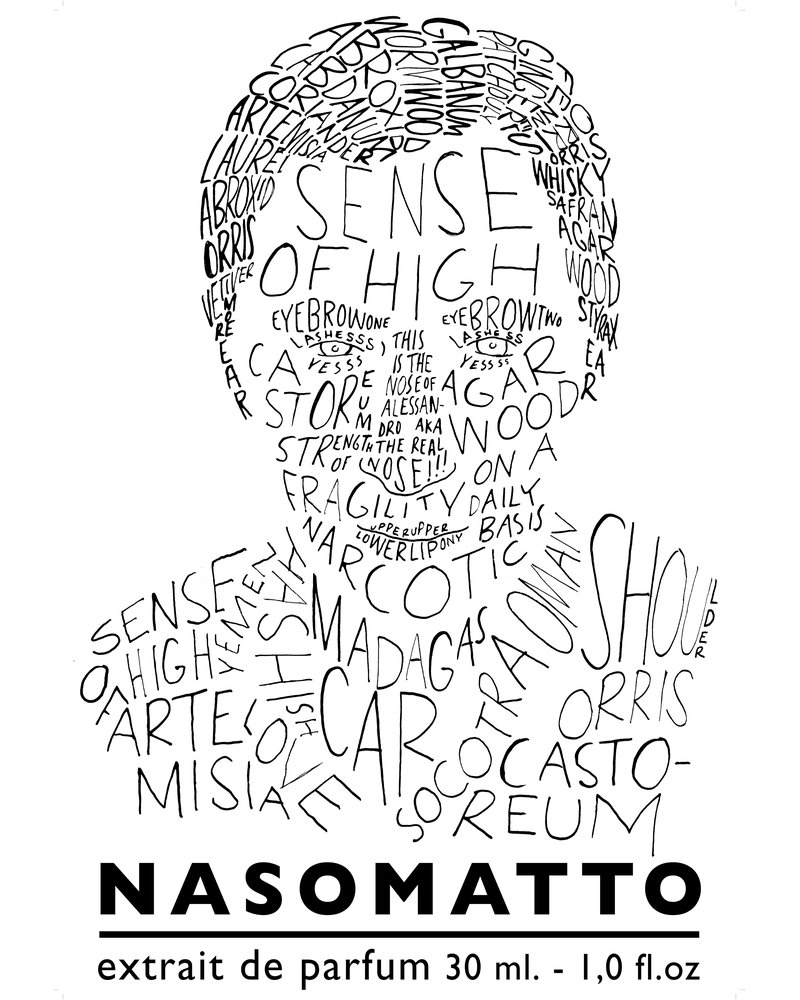
Nasomatto was founded in 2007 in Amsterdam (Netherlands) by Italian perfumer Alessandro Gualtieri. The name is an Italian compound built from naso (nose) and matto (mad), and translates literally as mad nose. The wordmark frames the project from the outset as a provocation: a perfumery laboratory designed to stand outside the codes and briefs of the mainstream fragrance industry.
By the time he founded Nasomatto, Gualtieri had already accumulated a long industry career. Born in Milan (Italy), he trained in 1989 at Haarmann & Reimer in Holzminden (Germany), the historic fragrance and raw materials company that became Symrise after its 2003 merger with Dragoco. He then composed fragrances for Versace, Helmut Lang and Diesel before breaking with the constraints of industrial briefs to develop a personal authorial vision under his own name.
The first Nasomatto series was released in 2008 and comprised Hindu Grass, Duro, Silver Musk, Narcotic Venus and Absinth. Every bottle followed the same brutalist format. The whole packaging is made in Italy. The line was conceived around extrait de parfum packaged in 30 ml editions, and shipped without any official note list.
In 2009, Nasomatto released Black Afgano, the cult composition signed alone by Gualtieri after six years of smoking, scenting, trying and creating. The house states that the perfume took six years to translate the sensation of top-shelf hashish into a wearable composition. Black Afgano became a durable reference of underground niche perfumery and pulled the international visibility of the house.
Summer 2026 update: as of July 2026 the house remains independently owned by Alessandro Gualtieri. On May 28, 2026, Nasomatto released Micodelirio, a 30 ml extrait de parfum built around a mushroom accord, keeping to the concentrated format the house has favored since 2007. The slow release rhythm continues to set Nasomatto apart from group-owned niche brands.
Olfactory signature
Nasomatto writes a brutalist extrait signature, anchored in resinous, animalic and narcotic materials. Recurring building blocks include hashish, oud, incense, tobacco, musks, leather, ambergris and heavy resins. Compositions favor density and impact over transparency, and stand apart from the diffusive Ambroxan-driven aesthetic that defined a portion of contemporary niche perfumery in the late 2010s.
Every Nasomatto release is sold as extrait de parfum, in 30 ml flacons. The extreme concentration translates into a tenacious sillage and a contained projection, closer in behavior to traditional Middle Eastern attar practice than to mainstream Western eau de parfum.
A defining identity marker of the house is the deliberate refusal to publish official note lists. Gualtieri prefers to describe the intent, the inspiration or the emotional charge of a composition, and leaves each wearer to reconstruct the accord. This editorial choice cuts against the dominant practice of niche perfumery, where the top-heart-base pyramid structures product communication, and positions Nasomatto firmly within an author-driven artistic perfumery tradition.
"I like the feeling that I'm losing control and I'm not the only one making the choice. I want my perfumes to have an existence of their own, not being enslaved solely by the meanings I gave."Alessandro Gualtieri (The Nose), Nasomatto Press Presentation
Key characteristics
Notable perfumes
The Nasomatto catalogue gathers around a dozen principal compositions signed by Alessandro Gualtieri since the 2008 launch series, as sole perfumer. Twelve major releases are listed below in chronological order.
The house today
Nasomatto remains an independent perfume house, held by its founder Alessandro Gualtieri with no parent group and no recorded acquisition. The atelier operates from Amsterdam (Netherlands) and the brand controls distribution through a network of selected niche boutiques, including Jovoy, Liquides Confidentiels, Bloom Perfumery, Skins and Luckyscent, without department-store mass channels.
In 2014, Gualtieri founded the sister house Orto Parisi, also based in Amsterdam, with a more corporal and animalic vocabulary built around materials such as ambergris, sweat, leather and resins. The two brands share an atelier and a creative team, while keeping distinct olfactory territories: Nasomatto stays anchored in the brutalist extrait register established in 2007, and Orto Parisi pushes the animalic and skin-driven dimension further. The pairing has become a frequent reference point in international fragrance press for author-driven independent perfumery.
The cultural standing of the house was built without conventional advertising and without celebrity endorsements. Black Afgano circulates as a word-of-mouth reference among niche enthusiasts and is regularly cited in journalist round-ups of the most influential niche compositions of the 2000s. Two decades after the launch series, Nasomatto continues to function as a small, tightly controlled author house, rather than as a scaled lifestyle brand.
Frequently asked questions
Sources
- Nasomatto: official site (accessed 23 May 2026)
- Wikipedia: Nasomatto (accessed 23 May 2026)
- Fragrantica: Nasomatto designer page (accessed 23 May 2026)
- Parfumo: Nasomatto perfumes and information (accessed 23 May 2026)
- Basenotes: Nasomatto brand profile (accessed 23 May 2026)
- Wallpaper: Alessandro Gualtieri interview on Nasomatto and Amsterdam (accessed 23 May 2026)
- Now Smell This: Nasomatto Black Afgano fragrance review (accessed 23 May 2026)