Quick answers
History
Absinth closes out the founding wave at Nasomatto with the most explicitly conceptual register of the five. Alessandro Gualtieri built it out of his Amsterdam (Netherlands) lab as a hallucinatory green aromatic, a 30 ml extrait pitched as a writer's forbidden delight and an escape route into hysteria where the true meaning of life lies. That pitch holds nothing back, and the composition wears the same way.
The composition reads as a literary fragrance in the sense that French writers used to describe absinthe: a green ritual that hovers between intoxication and lucidity.
Absinth is the boldest green aromatic Nasomatto has released. The fragrance reads as a stand-out signature for evening events, jazz clubs, and the kind of cold-weather walks where the green wormwood core lifts cleanly into the air.
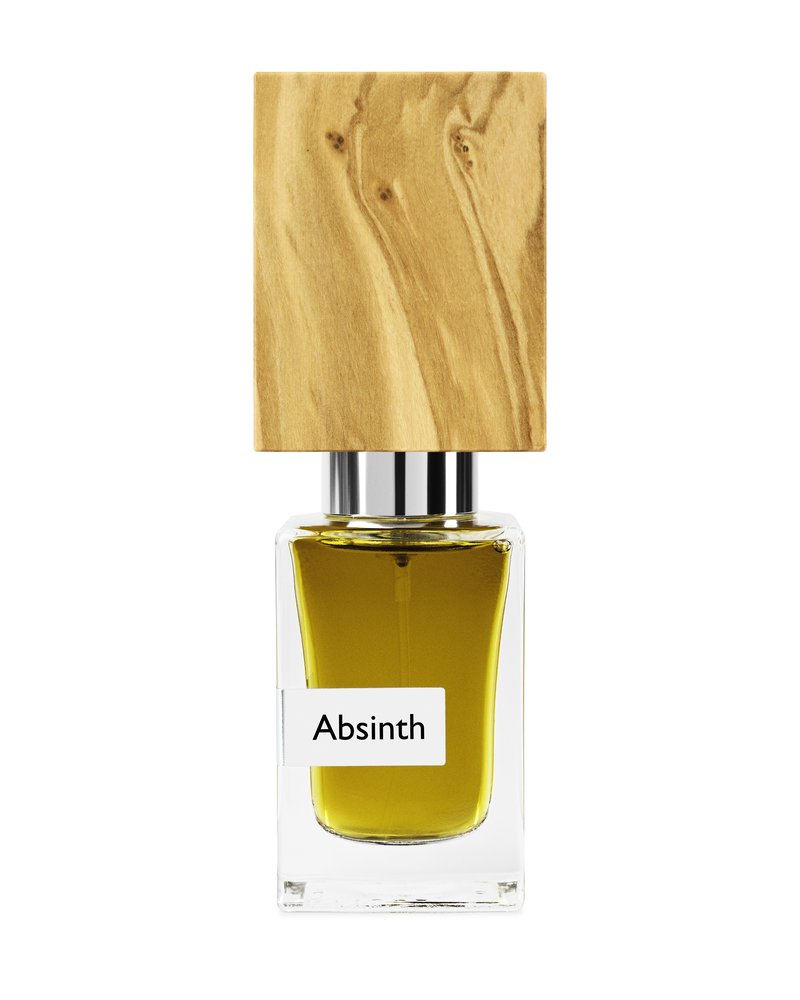
The bottle holds the same line. The cap is carved from olive wood, a Mediterranean hardwood with a warm pale grain, picked by the house for the direct read-back to the absinthe ritual and the bohemian Mediterranean lineage of the composition. US distribution stays selective through Luckyscent, MicroPerfumes for sample sizes, and the official Nasomatto website.
The olfactory experience
Nasomatto refuses to release official notes for any composition. Alessandro Gualtieri treats the raw materials as a closed-door secret, on the principle that naming them gets in the way of how the perfume actually lands. Absinth reads exactly that way on first wear: a green hallucinatory wall that holds together as a literary statement before any one note steps forward to be named.
"Absinth is the most luxurious type of madness. Writer's forbidden delight. Escapism through giggles straight into the center of hysteria where the true meaning of life lies."
The notes and accords are: wormwood, green notes, vetiver.
The bottle carries the same idea into the packaging. The cap is carved from olive wood, a Mediterranean hardwood with a warm pale grain, picked by Nasomatto for the direct line back to the absinthe ritual and the bohemian Mediterranean lineage of the composition.
Scent profile
The olfactory profile of Absinth reads as the textbook green aromatic in the US niche canon. Wormwood sets the character, sharp and bitter, drawn out by green notes, while vetiver gives it a dry footing. It ranks among the most conceptual releases in the Nasomatto catalog.
The signature rests on a refusal to dilute the green hallucinatory register. Where the US niche aromatic segment ran toward polished fougeres and clean vetivers, Absinth takes the opposite road and presents the green register as a literary ritual that does not ask to be liked. That stance holds up in 2026: the composition is one of the most strongly identified absinthe-themed signatures in the niche segment.
For wearers comparing Absinth to other US niche green compositions, the closest matches sit in the same aromatic register: Slumberhouse Pear and Olive for the green-fruit comparison, Chanel Sycomore for the polished vetiver counterpart, and Diptyque L'Eau de Tarocco for the absinthe-bitter green register. Absinth stands apart through its literary hallucinatory positioning that pushes the green aromatic harder than mainstream compositions.
Absinth is the most luxurious type of madness. Writer's forbidden delight. Escapism through giggles straight into the center of hysteria where the true meaning of life lies.Nasomatto press kit
Key characteristics
When and where to wear
Within the green aromatic family, Absinth reads as a literary evening signature. Its wormwood, green notes and vetiver make it a cult favorite for cold-weather wear in the US Northeast, where the green wormwood core lifts cleanly across jazz clubs, late dinners, and the kind of bohemian evening that calls for a literary stand-out. Skip the corporate daytime context: the green wormwood register reads as deliberately polarizing.
How to wear it
Seasonal fit
| Season | Fit | Critical notes |
|---|---|---|
| Spring | ★★★★ | Reference season; the green cut sits cleanly in cool spring air. |
| Summer | ★★★☆ | Workable in cool evenings, harder in full sun where the bitterness sharpens. |
| Autumn | ★★★★ | Strong fit through early autumn; wormwood and vetiver read against damp air. |
| Winter | ★★☆☆ | Green cut reads less clearly in cold dry air. |
Context fit
| Setting | Fit | Wearing recommendation |
|---|---|---|
| Office | ★★☆☆ | Unusual sillage, hard to read in shared open-plan environments. |
| Intimate dinner | ★★★★ | Reference setting; the green bitterness reads at close range. |
| Reading, writing | ★★★★ | Perfect table companion, faithful to the literary register. |
| Formal evening | ★★★☆ | Workable in creative or artistic settings. |
| Sport | ★☆☆☆ | Unsuited. |
| Travel | ★★★☆ | Extrait format travels well; sillage stays discreet in transit. |
Similar perfumes
Five compositions sit close to Absinth through the green aromatic niche register or through the literary-bohemian position.
| Perfume | House · year | Why related |
|---|---|---|
| Duro | Nasomatto · 2007 | Same house, same refusal of the note pyramid, same founding series, aromatic woody register. |
| Black Afgano | Nasomatto · 2009 | Same refusal of the gimmick, radical herbal position around a plant loaded with cultural meaning. |
| Route du Vetiver | Maison Crivelli · 2020 | Modern aromatic vetiver, comparable tense herbal freshness. |
| Vétiver Tonka | Hermès · 2004 | Aromatic vetiver from high perfumery by Jean-Claude Ellena, same dry green axis. |
| Declaration | Cartier · 1998 | Aromatic spicy by Jean-Claude Ellena, same dry structured architecture. |
Frequently asked questions
See also
Sources
- Nasomatto press kit, Absinth press release (received June 2026)
- Luckyscent: Absinth product listing (accessed 11 June 2026)
- NOSE Paris: Absinth product listing (accessed 11 June 2026)
- YouTube, Seldomly Often: longevity and sillage reading
- nasomatto.com: published sizes
- Fragrantica: notes and accords reported for Absinth (accessed 17 September 2026)
Content built from official Nasomatto documents, received in June 2026.