History of the house
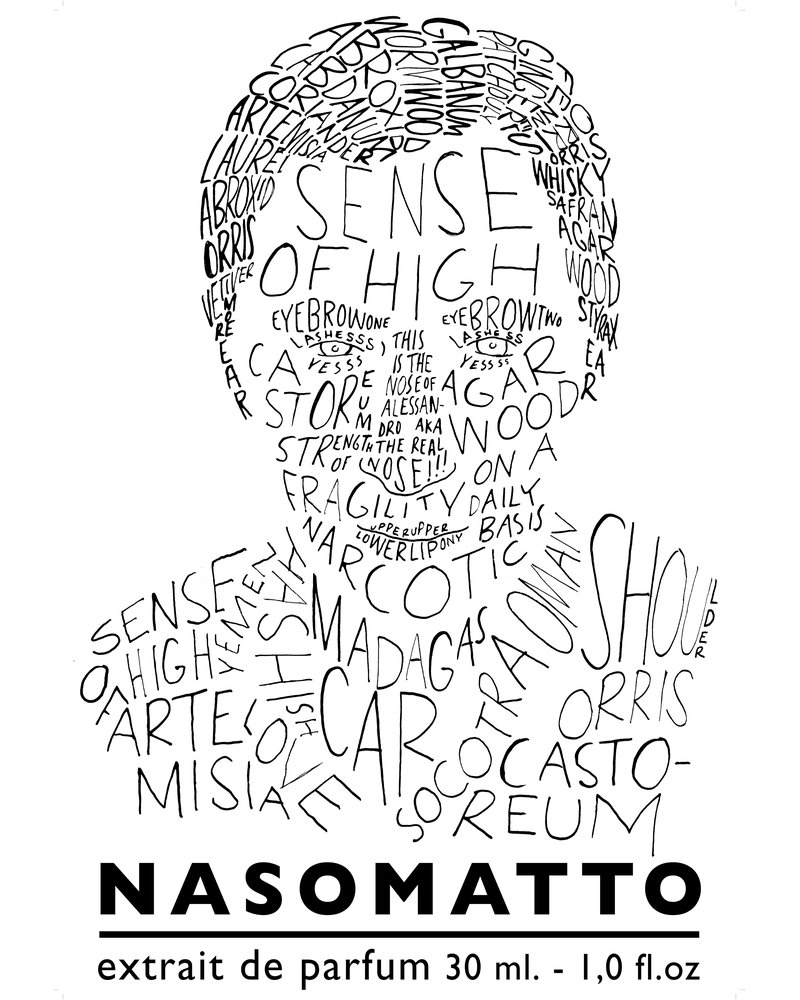
Nasomatto was founded in 2007 in Amsterdam (Netherlands) by Italian perfumer Alessandro Gualtieri. The name is an Italian compound built from naso (nose) and matto (mad), and translates literally as mad nose. The wordmark frames the project from the outset as a provocation: a perfumery laboratory designed to stand outside the codes and briefs of the mainstream fragrance industry (Wikipedia EN, Fragrantica designer page, Wallpaper interview, accessed 2026-05-23).
Gualtieri came to the founding with a long industry background. Born in Milan (Italy), he trained at Haarmann & Reimer in Holzminden (Germany), the fragrance and flavor manufacturer that became Symrise after its 2003 merger with Dragoco. He then composed briefs for Fendi, Versace, Helmut Lang and Diesel before breaking with the constraints of industrial briefs to develop a personal authorial vision under his own name (Wallpaper interview, Fragrantica perfumer profile, Now Smell This, accessed 2026-05-23).
The first Nasomatto series was released in 2008 and comprised Hindu Grass, Duro, China White, Silver Musk, Narcotic Venus and Absinth. Every bottle followed the same brutalist format: a short opaque colored flacon topped with a hand-carved wooden cap, presented without a conventional spray pump. The line was conceived around extrait de parfum at extreme concentration, packaged in 30 ml editions, and shipped without any official note list (Fragrantica designer page, Basenotes brand profile, Parfumo brand page, accessed 2026-05-23).
In 2009, Nasomatto released Black Afgano, the cult composition co-signed by Gualtieri and Italian perfumer Arturetto Landi. The house states that the perfume took several years of research to translate the olfactive impression of high-quality hashish into a wearable composition. The dark resinous accord, articulating cannabis, oud, resins, coffee, tobacco, incense and precious woods, became a durable reference of underground niche perfumery and pulled the international visibility of the house (Now Smell This Black Afgano review, Fragrantica Black Afgano page, Basenotes, accessed 2026-05-23).
Olfactive signature
Nasomatto writes a brutalist extrait signature, anchored in dark, resinous, animalic and narcotic materials. Recurring building blocks include hashish, oud, incense, tobacco, musks, leather, ambergris and heavy resins. Compositions favor density and impact over transparency, and stand apart from the diffusive Ambroxan-driven aesthetic that defined a portion of contemporary niche perfumery in the late 2010s (Now Smell This Nasomatto reviews, Fragrantica designer page, Persolaise commentary, accessed 2026-05-23).
Every Nasomatto release is sold as extrait de parfum, in 30 ml flacons sealed by a hand-carved wooden cap and applied without a conventional spray pump. The extreme concentration translates into a tenacious sillage and a contained projection, closer in behavior to traditional Middle Eastern attar practice than to mainstream Western eau de parfum. The opaque colored glass conceals the juice and reinforces the ritual gesture of application.
A defining identity marker of the house is the deliberate refusal to publish official note lists. Gualtieri prefers to describe the intent, the inspiration or the emotional charge of a composition, and leaves each wearer to reconstruct the accord. This editorial choice cuts against the dominant practice of niche perfumery, where the top-heart-base pyramid structures product communication, and positions Nasomatto firmly within an author-driven artistic perfumery tradition (Wallpaper interview, Now Smell This, Fragrantica designer page, accessed 2026-05-23).
An Italian-Dutch niche perfume house that turns extreme extrait concentrations and refused note lists into a brutalist editorial code.
Key characteristics
Notable perfumes
The Nasomatto catalogue gathers around a dozen principal compositions signed by Alessandro Gualtieri since the 2008 launch series, often in collaboration with Italian perfumer Arturetto Landi. The nine releases below are documented on Fragrantica, Parfumo and Basenotes, with convergent attribution and launch year across the three sources.
| Year | Perfume | Perfumer | Olfactive family |
|---|---|---|---|
| 2008 | China White | Alessandro Gualtieri | Floral woody musky |
| 2008 | Duro | Alessandro Gualtieri | Aromatic woody |
| 2008 | Hindu Grass | Alessandro Gualtieri | Green woody vetiver |
| 2008 | Narcotic Venus | Alessandro Gualtieri | White floral tuberose |
| 2008 | Silver Musk | Alessandro Gualtieri | Musky woody |
| 2008 | Absinth | Alessandro Gualtieri | Aromatic anisic woody |
| 2009 | Black Afgano | Alessandro Gualtieri, Arturetto Landi | Resinous oriental woody |
| 2010 | Pardon | Alessandro Gualtieri | Oriental woody amber |
| 2013 | Baraonda | Alessandro Gualtieri | Leather tobacco woody |
Black Afgano (2009) is the cult composition of the house, an attempt to translate the olfactive impression of high-quality hashish into a wearable extrait, articulating cannabis, oud, resins, coffee, tobacco, incense and precious woods. Pardon (2010) develops an ambery oriental trail built around sandalwood, oud and vanilla, positioned as the gentlemanly companion to Black Afgano. Duro (2008) stages an aromatic woody composition often cited as a study in masculine density. Hindu Grass (2008) writes a green vetiver accord closer to the Indian source material than to the polished Western vetivers of the period. Baraonda (2013) draws its name from an Italian word for tumult and deploys a smoky leather accord articulating tobacco, rum and woods.
The house today
Nasomatto remains an independent perfume house, held by its founder Alessandro Gualtieri with no parent group and no recorded acquisition. The atelier operates from Amsterdam (Netherlands) and the brand controls distribution through a network of selected niche boutiques, including Jovoy and Liquides Confidentiels in Paris (France), Bloom Perfumery in London (United Kingdom), Skins Cosmetics in the Netherlands and Luckyscent in Los Angeles (United States), without department-store mass channels (Wallpaper interview, official site, Basenotes brand profile, accessed 2026-05-23).
In 2014, Gualtieri founded the sister house Orto Parisi, also based in Amsterdam, with a more corporal and animalic vocabulary built around materials such as ambergris, sweat, leather and resins. The two brands share an atelier and a creative team, while keeping distinct olfactive territories: Nasomatto stays anchored in the brutalist extrait register established in 2007, and Orto Parisi pushes the animalic and skin-driven dimension further. The pairing has become a frequent reference point in international fragrance press for author-driven independent perfumery (Fragrantica Orto Parisi page, Persolaise commentary, Now Smell This, accessed 2026-05-23).
The cultural standing of the house was built without conventional advertising and without celebrity endorsements. Black Afgano, in particular, circulates as a word-of-mouth reference across niche communities on Basenotes, Fragrantica and Reddit, and is regularly cited in journalist round-ups of the most influential niche compositions of the 2000s. Two decades after the launch series, Nasomatto continues to function as a small, tightly controlled author house, rather than as a scaled lifestyle brand.
Frequently asked questions
Sources
- Nasomatto: official site (accessed 23 May 2026)
- Wikipedia: Nasomatto (accessed 23 May 2026)
- Fragrantica: Nasomatto designer page (accessed 23 May 2026)
- Parfumo: Nasomatto perfumes and information (accessed 23 May 2026)
- Basenotes: Nasomatto brand profile (accessed 23 May 2026)
- Wallpaper: Alessandro Gualtieri interview on Nasomatto and Amsterdam (accessed 23 May 2026)
- Now Smell This: Nasomatto Black Afgano fragrance review (accessed 23 May 2026)