Quick answers
Biography and career
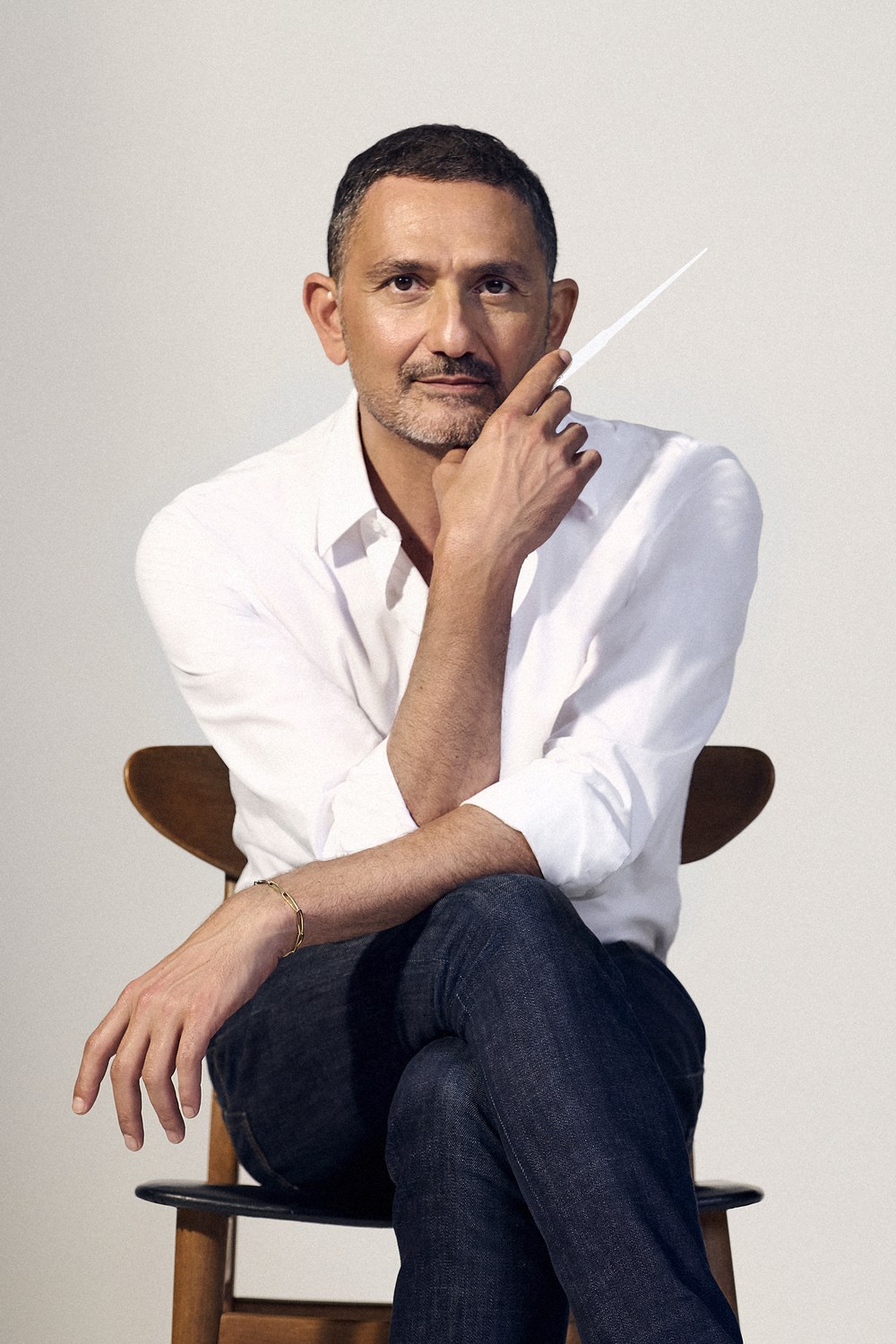
Francis Kurkdjian was born on 14 May 1969 in Paris (France), the son of Armenian parents who had settled in France a generation earlier. In published interviews he has described an early imagined career as a classical dancer, before discovering perfumery in adolescence through a sister's collection of scent samples. That early olfactory contact led him to apply, after a short detour through dance studies, to ISIPCA in Versailles (France), the reference institution for professional perfumery in the country.
Francis Kurkdjian graduated from ISIPCA in 1993 as a perfumer, at the age of twenty-three. He went straight from school to Quest International in Paris (France), a major composition supplier of the period that would later merge into Givaudan. There he was trained inside the industrial brief format, composing for designer briefs from Lancome, Burberry, Acqua di Parma and other clients of the supplier.
His first major commercial release arrived two years after his Quest debut. In 1995, at the age of twenty-five, he signed Le Male for Jean Paul Gaultier, a powdery aromatic fougere built around lavender, mint and vanilla that became one of the best-selling masculine perfumes of the late twentieth century. The launch placed him, very early, among the recognized perfumers of his generation, and gave him the financial autonomy to develop a personal practice on the side.
In 2001, Francis Kurkdjian opened a bespoke perfumery atelier in Paris (France), one of the first contemporary studios of its kind in the city. He composed perfumes on commission for private clients while pursuing his work with the designer brief industry. The same year, he received the Francois Coty Prize, a major French distinction that recognizes a perfumer creator's body of work. At thirty-two, he ranks among the youngest recipients in the prize's history.
The years 2003 to 2009 cemented his designer track record. He co-signed Narciso Rodriguez For Her in 2003 with Christine Nagel, signed Carolina Herrera 212 Sexy in 2004, composed Lancome Hypnose in 2005, and developed perfumes for Burberry, Yves Saint Laurent and others through the decade. This decade of designer work gave him a working knowledge of large industrial briefs: stability constraints, raw material costs, mass production trade-offs. He would later transpose that knowledge into his own house, with the constraints inverted.
In 2009, Francis Kurkdjian cofounded Maison Francis Kurkdjian in Paris (France) with Marc Chaya, a former partner at Ernst & Young and a long-time friend. The house, often abbreviated MFK in press coverage, settled near Place Vendome and chose a premium niche perfumery model from the start: catalog fully signed by Francis Kurkdjian, selective distribution, no creative committee. Seven perfumes launched in the founding year, among them Aqua Universalis and Lumiere Noire pour Femme.
The house released Baccarat Rouge 540 in 2015, after the cristallerie Baccarat had commissioned the original limited edition for its 250th anniversary in 2014. The composition, built on saffron, jasmine, cedar and a woody amber base, turned into a viral phenomenon on TikTok from 2020 onward and remains one of the most identifiable perfumes of the contemporary scene. LVMH acquired a majority stake in Maison Francis Kurkdjian in March 2017 for an undisclosed sum. In 2021, the group named Francis Kurkdjian Senior Vice President of Perfumes at Christian Dior, a position that placed him at the head of perfume creation for the historic house. He keeps the artistic direction of Maison Francis Kurkdjian, where he continues to sign every release.
Alongside his commissioned work and his own house, Francis Kurkdjian has built an artistic dimension that is rare in the profession. He has staged large-scale olfactory installations in emblematic venues, from his first installation “Versailles Off” in 2006 and the nocturnal scented water shows at the Chateau de Versailles (2007 and 2008) to scented concerts at the Philharmonie de Paris, and the exhibition “Perfume, Sculpture of the invisible” that marked thirty years of his creative work at the Palais de Tokyo in 2025. These ephemeral performances, as much as his mainstream successes, place him among the most celebrated perfumers in the world. According to the official site franciskurkdjian.com, he has been a Chevalier des Arts et Lettres since 2008, a French cultural distinction.
Notable perfumes
Francis Kurkdjian's body of work spans three decades, from designer launches through the founding catalog of Maison Francis Kurkdjian. The selection below lists six compositions whose launch year and authorship are and the official maisonfranciskurkdjian.com site, all accessed on 22 May 2026.
| Year | House | Perfume | Accord |
|---|---|---|---|
| 1995 | Jean Paul Gaultier | Le Male | Powdery aromatic fougere |
| 2003 | Narciso Rodriguez | For Her (with Christine Nagel) | Floral musk |
| 2009 | Maison Francis Kurkdjian | Aqua Universalis | Citrus floral |
| 2009 | Maison Francis Kurkdjian | Lumiere Noire pour Femme | Rose patchouli chypre |
| 2014 | Maison Francis Kurkdjian | Baccarat Rouge 540 | Woody floral amber |
| 2015 | Maison Francis Kurkdjian | Oud Satin Mood | Woody floral |
| 2016 | Maison Francis Kurkdjian | Grand Soir | Amber oriental |
Olfactory signature
Francis Kurkdjian's olfactory signature is a luminous-yet-dense writing, built on the polarity between transparency and projection. He talks publicly about the search for an apparent contradiction: a perfume that reads as clear and light on skin while still casting a long, recognizable sillage in the room. The signature took its mature shape from 2009 onward, with the founding of his own house, where he was free to build a coherent catalog around that polarity instead of working brief by brief.
This approach situates him next to, rather than inside, the older school of French perfumery transparency. Edmond Roudnitska, Jean-Paul Guerlain and Jean-Claude Ellena each sought their own version of clarity, through geometric reduction, balm or water respectively. Francis Kurkdjian's version is a transparency that projects: his perfumes stay aerated on skin while broadcasting a strong sillage. The paradox is most legible in Baccarat Rouge 540 (2015), where a saffron, jasmine, cedar and woody amber chord reads as both diaphanous and very loud.
Beyond the writing itself, Francis Kurkdjian has shaped a now-standard economic model for niche perfumery. Maison Francis Kurkdjian, from the 2009 launch, settled on a radical configuration: one signatory for the whole catalog, selective distribution limited to a small set of accounts, communication centered on the craft gesture rather than on celebrity campaigns. The model has since been adopted by many niche perfume houses founded in the following decade. His 2021 appointment at Christian Dior opens a parallel phase, where he steers the maintenance of large heritage perfumes and signs new releases for the prestige line.
This writing belongs to a wider vision the perfumer sums up as an olfactory wardrobe: a territory of sensuality and delicate perfectionism, where each creation is one silhouette among many, chosen according to the mood of the day.
“I dream up my creations like olfactory silhouettes composed of fresh or ambery notes, floral accords or opulent expressions. It is an invitation to choose daily which one to wear, because I like the idea that every woman and man can express a part of themselves through perfume.”Francis Kurkdjian, Perfumer and Artistic Director
Transparency that still projects. The signature stays light on skin while broadcasting a long, recognizable sillage in the room.
Key characteristics
Frequently asked questions
Five questions that recur about Francis Kurkdjian, his training, his houses and the perfumes that anchor his career.
See also
Four Osmetheca resources to extend the reading on Francis Kurkdjian, his house and his peers in contemporary French perfumery.
Sources
- Wikipedia: Francis Kurkdjian (accessed 22 May 2026)
- Fragrantica: Francis Kurkdjian, nose profile (accessed 22 May 2026)
- The Perfume Society: Francis Kurkdjian house profile (accessed 22 May 2026)
- Persolaise: reviews of Maison Francis Kurkdjian releases (accessed 22 May 2026)
- Parfumo: Maison Francis Kurkdjian catalog and dates (accessed 22 May 2026)
- The New York Times: LVMH acquires majority stake in Maison Francis Kurkdjian (accessed 22 May 2026)
- Source N1: Maison Francis Kurkdjian general press release (2025), provided by the Maison
- Source N1: franciskurkdjian.com official site (sections « The Maison » and « The Perfumer »)