Quick answers
History
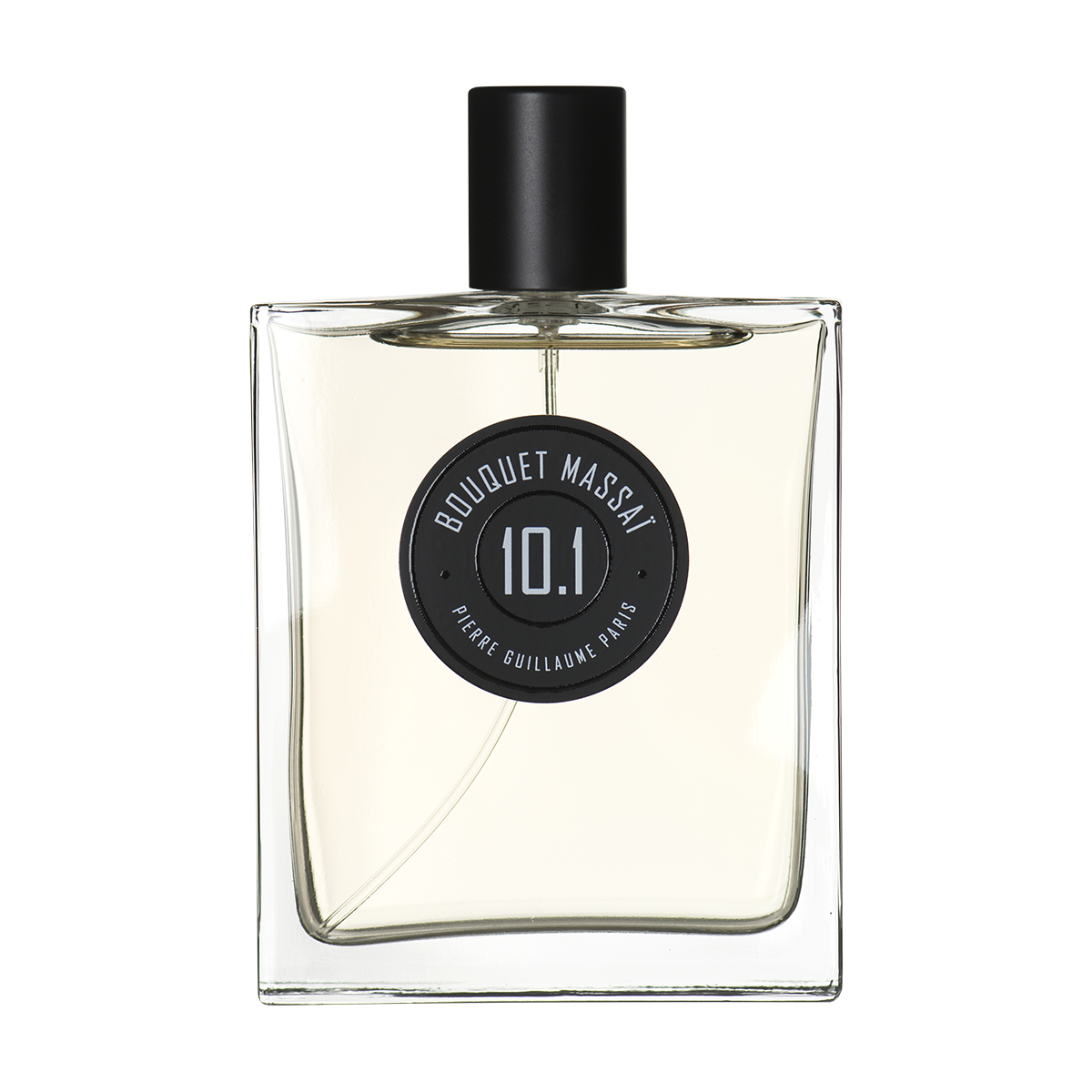
Bouquet Massaï appeared in 2016, as documented in the official Pierre Guillaume Paris catalog, as variation 10.1 of Pierre Guillaume’s theme 10, that of coffee. Please note: Bouquet Massaï 10.1 no longer appears in the house's 2026 catalogue, but it remains listed by Pierre Guillaume Paris (official media page) and is distributed by specialist retailers. It is therefore still available and fully documented.
It proceeds directly from Aomassaï 10, the great hit of 2006: a woody amber built on a coffee-cashmeran accord, which explored olfactory bitterness by treating its components in their roasted, burnt or pyrogenic aspects. Aomassaï was a bushfire, a dark, smoky composition, all incandescence.
The choice of Bouquet Massaï is to brighten that bushfire. The perfumer opens the woody fire of Aomassaï with a floral bouquet, more luminous and solar: peony and magnolia bring the fresh clarity of white flowers, while karo karounde, an intense, fruity African flower, extends the exoticism of the coffee. Tolu balm and sandalwood soften the base, burnishing the bitterness of the original accord with a balsamic, creamy warmth.
Bouquet Massaï thus belongs to what Pierre Guillaume calls his “reworks”, those variations where he revisits a historical opus by adding new facets. Where Aomassaï burns, Bouquet Massaï blooms: the same coffee, the same house signature, but brightened by a solar bouquet that reveals an unexpected side. A documented floriental, still available from specialist retailers.
Olfactory pyramid
Pierre Guillaume does not publish a formal pyramid: the layout below follows the notes documented by the official page and the databases of perfumery, from floral bouquet to woody coffee.
The thread is Aomassaï’s coffee, whose woody bushfire is here brightened and softened by a solar floral bouquet.
Olfactory profile
Bouquet Massaï is a flowered coffee rather than a burnt one. Where Aomassaï cultivates the bitterness and incandescence of the roasted bean, its 10.1 variation brightens it with a bouquet of peony, magnolia and karo karounde, so the coffee is dressed in flowers. It is a luminous, solar floriental, more accessible than the original.
Its signature lies in this marriage of coffee and white flowers: the coffee-cashmeran accord keeps the house’s woody warmth, the floral bouquet brings the clarity, tolu balm and sandalwood soften the whole with a balsamic base. The result is a unisex, enveloping coffee, whose warm, flowered trail wears from mid-season to winter.
The woody bushfire of Aomassaï, brightened and solar, with a bouquet of peony, magnolia and karo karounde.Pierre Guillaume Paris, official page
Key characteristics
When and where to wear
Bouquet Massaï is a mid-season and cool-weather floriental, whose floral bouquet lightens it enough to stay wearable by day. The coffee-cashmeran accord and tolu balm give it an enveloping warmth, ideal from autumn to winter.
Wear references
Seasonal fit
| Season | Fit | Critical notes |
|---|---|---|
| Spring | ★★★☆ | The floral bouquet awakens. |
| Summer | ★★☆☆ | The coffee can weigh in the heat. |
| Autumn | ★★★★ | Ideal season for its flowered coffee. |
| Winter | ★★★★ | The coffee accord and tolu envelop. |
Context fit
| Setting | Fit | Recommended use |
|---|---|---|
| Everyday | ★★★★ | Reference use. |
| Cocooning | ★★★★ | Its warm ground. |
| Evening | ★★★★ | Flowered, enveloping coffee. |
| Office | ★★★☆ | If the trail stays measured. |
| Sport | ★★☆☆ | Too warm for exertion. |
Similar perfumes
Pierre Guillaume’s flowered coffee speaks first to the opus it proceeds from, then to the great coffees of niche perfumery.
| Perfume | House · year | Why it is close |
|---|---|---|
| Aomassaï 10 | Pierre Guillaume Paris · 2006 | The founding opus of theme 10 that Bouquet Massaï reworks: a woody amber coffee built on the coffee-cashmeran accord, dark and burnt. Where Aomassaï burns, Bouquet Massaï blooms. |
| Black Afgano | Nasomatto · 2009 | A dark, smoky resinous woody from niche perfumery, another reading of bitterness and incandescence. Bouquet Massaï offers a version brightened by a floral bouquet. |