Quick answers
History
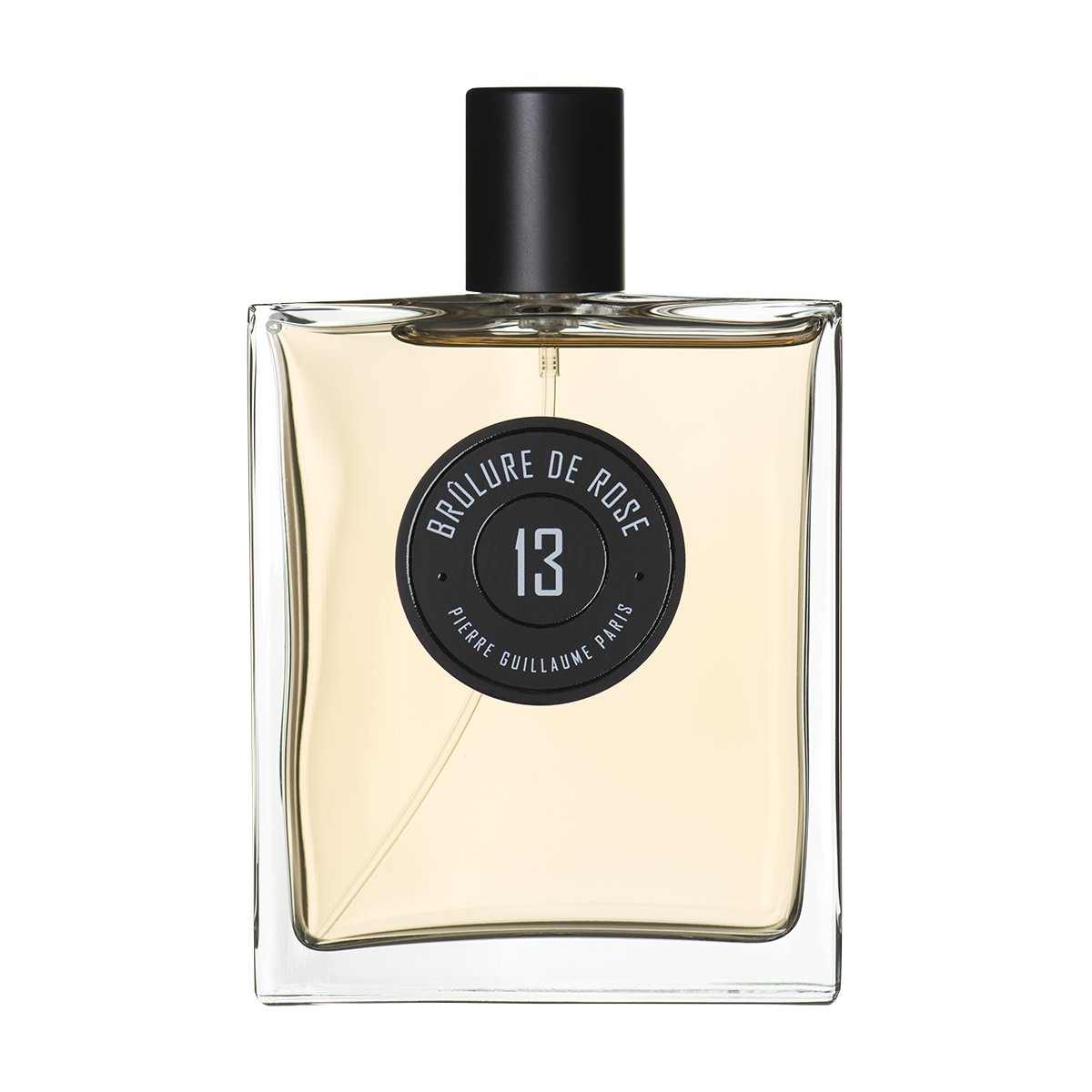
Brûlure de Rose opened Pierre Guillaume’s theme 13 in 2003 the theme of rose, which the house labels “Rose[s]”. The choice is stated at once: to read rose not as a tender flower but as molten metal, a steel rose heated white-hot.
Where rose too often sinks into jam or soap, Brûlure de Rose hardens and ignites it. The perfumer makes it a burning rose, set on an incandescent ambery base, whose metallic heat cuts against the expected softness of the flower. It is a rose of character, conceived, the perfumer says, for all those who are adverse to roses.
The fruity opening of litchi and raspberry brings a juicy acidity that avoids the sugary; the heart lets the rose assert itself, held by that fruity freshness; the base of rosewood, sandalwood and amber lays down the burning warmth that gives the fragrance its name. The composition moves like an ember, incandescent and racy.
The name states the intent: a burning rose. Brûlure de Rose is thus the origin of theme 13 at Pierre Guillaume, extended since by two variations, La Nymphe & Le Poète 13.1, fresher and romantic, and Métarosme 13.2, mineral and spicy, proof that the house’s rose is still thought from this founding ember.
Olfactory pyramid
Pierre Guillaume does not publish a formal pyramid: the layout below follows the progression described in the catalogue, from tart fruit to burning ambery base.
The thread is the rose, heated white-hot by the amber to evoke molten metal.
Olfactory profile
Brûlure de Rose is a rose of character rather than a tender one. The perfumer hardens and ignites it, so that it reads like molten metal, a steel rose set on an ambery ember. It is an incandescent rose, racy and dark, far from soapy or jammy roses.
Its signature lies in the contrast between the fruity acidity of the opening and the burning warmth of the base. Litchi and raspberry bring the juice, amber and sandalwood bring the fire, the rose holds the middle, metallic and upright. The trail is warm and assertive, which makes it a unisex rose, cut for mid-season and the evening, even for those who dislike rose.
A burning rose, for all those who are adverse to roses.Pierre Guillaume Paris, catalogue 2025-26
Key characteristics
When and where to wear
Brûlure de Rose is a rose of character, at its best in mid-season and cool weather, when amber and sandalwood unfold their burning warmth. Its fruity acidity keeps it bright, which makes it wearable by day as much as at dinner.
Wear references
Seasonal fit
| Season | Fit | Critical notes |
|---|---|---|
| Spring | ★★★★ | Litchi and raspberry bloom. |
| Summer | ★★★☆ | The amber can weigh in strong heat. |
| Autumn | ★★★★ | Ideal season for its burning rose. |
| Winter | ★★★★ | Amber and sandalwood warm it. |
Context fit
| Setting | Fit | Recommended use |
|---|---|---|
| Everyday | ★★★★ | Reference use. |
| Dates | ★★★★ | Racy and assertive. |
| Office | ★★★☆ | If the trail stays measured. |
| Evening | ★★★★ | Its incandescent ground. |
| Sport | ★★☆☆ | Too warm for exertion. |
Similar perfumes
Pierre Guillaume’s rose speaks first to its own variations, then to the great ambery roses of niche perfumery.
| Perfume | House · year | Why it is close |
|---|---|---|
| La Nymphe & Le Poète 13.1 | Pierre Guillaume Paris · 2013 | The romantic variation of theme 13: a fresh, sensual tea rose, orangewood, cistus and peach. Where Brûlure de Rose ignites the rose, La Nymphe & Le Poète returns it to the 19th century and to poetry. |
| Métarosme 13.2 | Pierre Guillaume Paris · 2026 | The mineral variation of theme 13: a rose-meteor accord around the house’s Obsidial, sequoia wood. Another reading of the hardened rose, more mineral than burning. |
Common questions
See also
Sources
- Pierre Guillaume Paris catalogue 2025–26 (English edition)
- Pierre Guillaume Paris, official Brûlure de Rose page
- Fragrantica, Brulure de Rose 13 entry