Quick answers
History
Copal Azur was brought to life by Bertrand Duchaufour for Aedes de Venustas in 2014. Its muse is copal, the Mayan incense, and its setting is sacred Tulum: Mayan incense rising from age-old temples, sea spray, and the jungle where the jaguar lurks. Incense runs as an olfactory thread through much of the Aedes line, tied to the Latin per fumare, through smoke, at the origin of perfumery, and few perfumers were better placed than Duchaufour to carry incense from the church into the seaside jungle.
Copal's name means incense in Nahuatl, and like frankincense in ancient Egypt or Greece it was burned by the Mayans and Aztecs to feed the gods; it is still used in Mexico for spiritual purposes today. Because copal resin cannot be used as a perfume ingredient, the house uses three different extractions of frankincense to conjure it, an extravagant 30 percent of the formula. Co-founder Karl Bradl was drawn to the scent while cycling the Yucatan coast toward the Sian Ka'an reserve, whose name translates as Gate to Heaven.
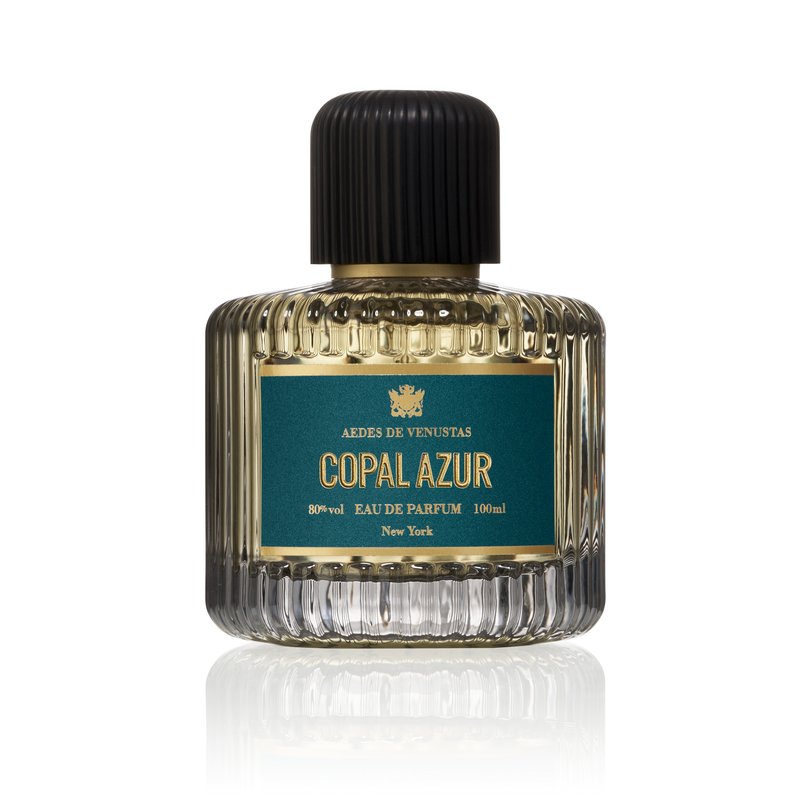
For the relaunch, Copal Azur was transferred into the shared new vessel: a fluted glass bottle with peacock-blue accents and a matte black insignia-stamped cap. The composition itself is unchanged, an iconoclastic incense at its core.
Fragrance notes
Copal Azur holds in a palette centered on incense, three frankincense extractions for a third of the formula: ozonic sea spray and a flash of green on one side, a mineral cliff at the centre, patchouli and myrrh undergrowth and ambery embers on the other.
The palette brings together copal, ozone, salt, frankincense, resin, cardamom, patchouli, myrrh, tonka bean and amber. The almond-scented tonka and amber round the embers of the copal at the close.
Scent profile
Copal Azur is a resinous incense with a marine, open-air twist. It belongs to the contemporary incense register, but where Avignon reads as austere church smoke and Wazamba as dry woody incense, Copal Azur sets the incense against ozone and salt, which gives it a beachy, sunlit quality that is rare in the category.
The distinctive trait is the contrast between the towering, mineral incense and the cool marine top: hypnotic and spiritual, but also forceful and transporting. It is incense reimagined for a coast rather than a cathedral.
Key characteristics
When and where to wear
Copal Azur is unusual among incense scents in that its marine top makes it wearable in warmer weather, where most incense fragrances stifle. It works for daytime in heat and for cool evenings alike, and its forceful opening means a light hand is wise in close company.
How to wear it
Seasonal fit
| Season | Fit | Critical notes |
|---|---|---|
| Spring | ★★★★ | The saline, green incense is ideal here. |
| Summer | ★★★★ | Its ozonic freshness handles heat very well. |
| Autumn | ★★★☆ | The resinous amber base gains amplitude. |
| Winter | ★★★☆ | The incense carries well; the marine facet fades. |
Context fit
| Context | Fit | Recommendation |
|---|---|---|
| Office | ★★★★ | Fresh and discreet. |
| Dressed evening | ★★★☆ | Acceptable on a summer evening. |
| Lunch | ★★★★ | Very well suited. |
| Outdoors | ★★★★ | Preferred setting. |
| Sport | ★★★☆ | Workable with a light hand. |
| Travel | ★★★★ | Ideal in a warm climate. |
Similar perfumes
Copal Azur belongs to the contemporary incense register, with a marine angle that connects it to both house siblings and wider niche references.
| Perfume | House · year | Why close |
|---|---|---|
| Aedes de Venustas Signature | Aedes de Venustas · 2012 | Same nose, the incense thread in its first house expression. |
| Wazamba | Parfum d'Empire · 2009 | A dry woody-incense reference for wearers cross-shopping the register. |
| Bois d'Ascese | Naomi Goodsir · 2012 | A smoky-resin neighbour for those drawn to the incense core. |
Frequently asked questions
See also
Sources
- Official Aedes de Venustas press kit (June 2026) · Document available on editorial request
- Now Smell This: Aedes de Venustas Copal Azur coverage (accessed June 27, 2026)