Quick answers
History
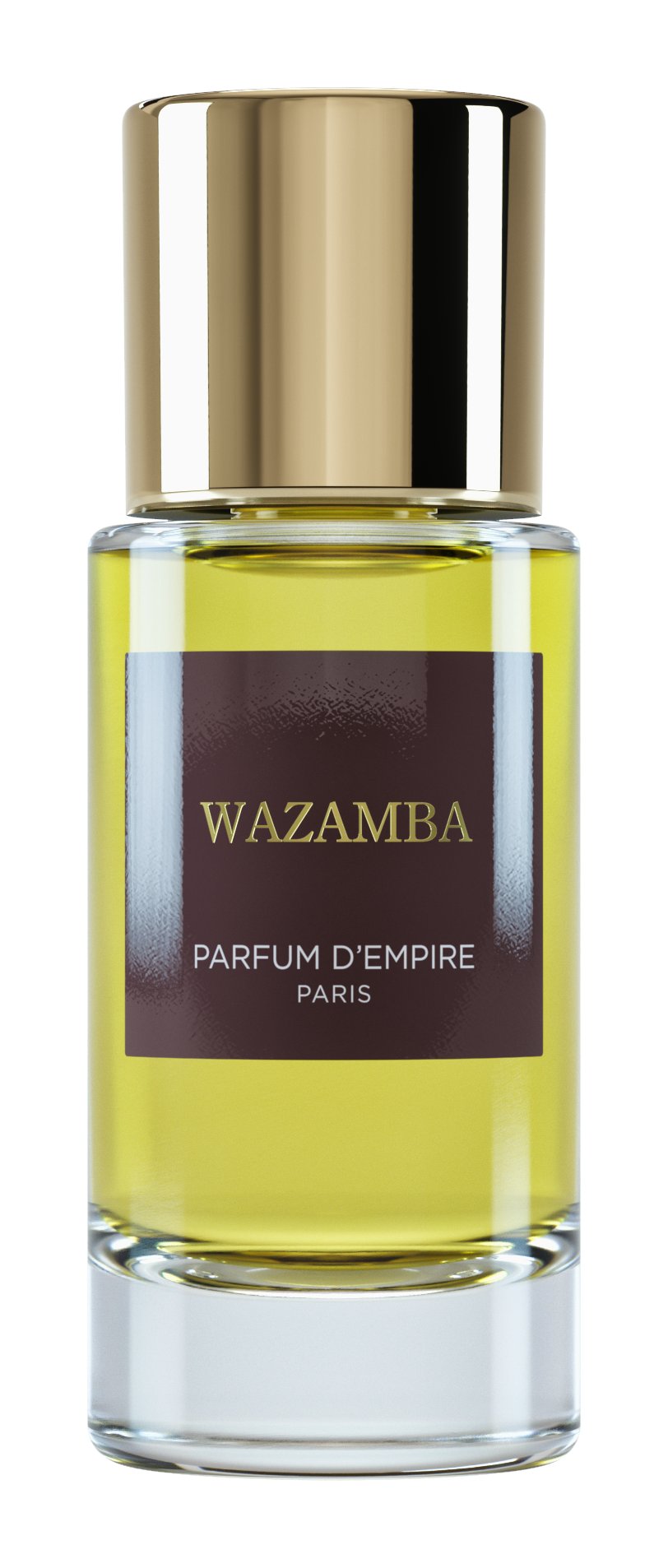
The name Wazamba comes from a musical instrument, a sistrum used in ritual ceremonies of West Africa. Wazamba, released in 2009 by Parfum d’Empire, translates that ritual dimension into a niche bottle: incense, myrrh, fruity apple and sacred woods. Marc-Antoine Corticchiato, who founded the Paris house in 2003 and signs every release, built the composition as a tribute to the resins and woods burned in rituals across different cultures.
The composition pivots on incense, the pillar of the creation, supported by myrrh and opoponax. Incense from Somalia delivers deep, aromatic vibrations. Myrrh from Kenya and opoponax from Ethiopia unfold their licorice-resin facets. Sandalwood from India and cypress from Morocco wrap the accord in creamy, earthy notes. The forbidden apple, treated as an accord rather than a gourmand note, opens the composition with a fruity flash that fades quickly to let the liturgical heart take over. That apple has been argued over for years, as the best part of the fragrance or as a gimmick. Both camps have a point.
The bottle is the standard Parfum d’Empire flacon, a Pochet du Courval glass cylinder engraved with the house laurel crown, available in 50 ml and 100 ml eau de parfum. It is one of the small handful of Parfum d’Empire releases that has remained continuously in the catalog without a reformulation flag from the IFRA framework, which suggests the formula leans on raw materials still inside compliant thresholds.
Fragrance notes
The architecture moves from a bright incense-cypress-apple top to a dense smoke-and-resin heart, then drops into a sacred woody base.
Skin evolution unfolds from a 15 to 30-minute top, a 2 to 4-hour resinous heart, and a woody base that holds for 8 to 10 hours depending on skin.
Scent profile
The olfactory signature of Wazamba sits between two traditions of incense in niche perfumery. The first is the austere Catholic incense of Avignon (Comme des Garçons, 2002), pure smoke read as solemn ritual. The second is the smoky-resin school of Naomi Goodsir (Bois d’Ascèse, 2013) and L’Artisan Parfumeur (Passage d’Enfer, 1999). Corticchiato lands between the two: less monastic than Avignon, more rounded than Bois d’Ascèse.
The distinctive trait is the absence of sweet ambery softness. Where many US-distributed incense niche releases such as Tom Ford’s Sahara Noir (2013) or Diptyque’s Eau Duelle (2010) bring a vanilla-amber roundness to the resin core, Wazamba stays dry, woody and almost smoky-bitter through the drydown. This is the choice that pushed it to cult status with American niche reviewers who valued its refusal to soften.
The woody, resinous scent of sacred rituals.Parfum d’Empire
Key characteristics
When and where to wear
Wazamba is, within the grammar of niche incense woods, a fragrance known as contemplative and autumnal. Its resinous signature makes it a scent for indoors, the late day and the cold season.
How to wear it
Seasonal fit
| Season | Fit | Critical notes |
|---|---|---|
| Spring | ★★☆☆ | Too dense for rising temperatures. |
| Summer | ★☆☆☆ | Reads too heavy in the heat. |
| Autumn | ★★★★ | Reference season. |
| Winter | ★★★★ | Excellent in dry cold. |
Context fit
| Context | Fit | Recommended use |
|---|---|---|
| Office | ★★☆☆ | Sillage can feel heavy in a closed room. |
| Intimate evening | ★★★★ | Reference setting. |
| Reading | ★★★★ | Contemplative. |
| Travel | ★★★☆ | Very wearable in the cold season. |
| Sport | ★☆☆☆ | Unsuited. |
| Gallery opening | ★★★☆ | Wearable, an assertive signature. |
Similar perfumes
Six perfumes share a kinship with Wazamba through the amber woody sub-family.
| Perfume | House · year | Why related |
|---|---|---|
| Avignon | Comme des Garçons · 2002 | The reference liturgical incense, from the Incense series. |
| Bois d’Ascèse | Naomi Goodsir · 2012 | Contemplative smoky woody, a shared austerity. |
| Black Aoud | Montale · 2006 | Dense resinous wood, a close register. |
| Cuir Ottoman | Parfum d’Empire · 2006 | Another resinous signature by Marc-Antoine Corticchiato. |
| Patchouli Impérial | Parfums de Marly · 2012 | Contemporary resinous woody, with a cedar finish. |
| Tolu | Ormonde Jayne | Incense and resins, a balsamic kinship with Tolu. |
Frequently asked questions
See also
Sources
- Parfum d’Empire official site, Wazamba product page (accessed June 7, 2026)
- Parfum d’Empire official documents, Wazamba press kit (olfactory pyramid verified September 11, 2026)
- Now Smell This: Wazamba review (accessed June 7, 2026)