Quick answers
Biography and career
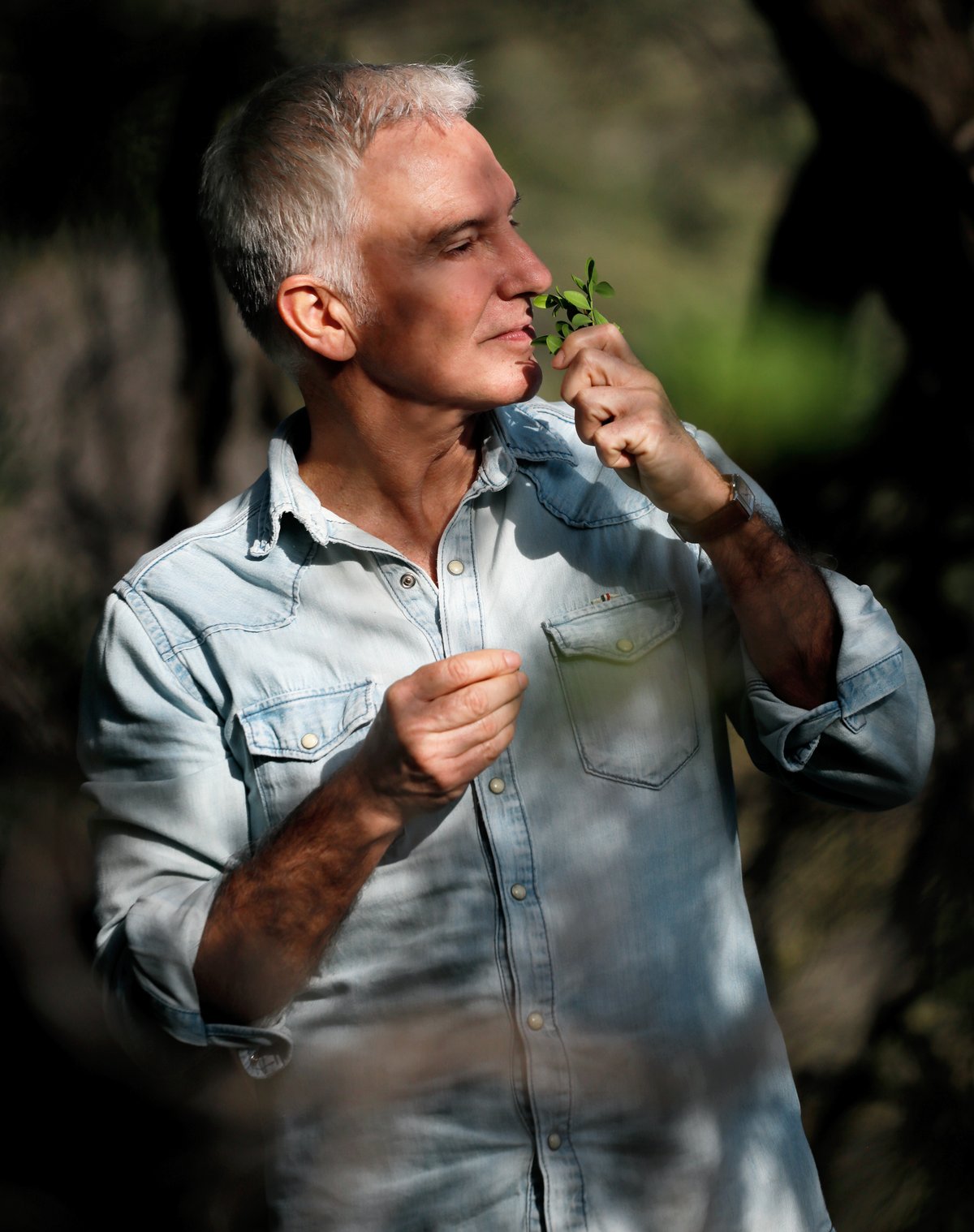
Marc-Antoine Corticchiato is a French perfumer of Corsican descent. He was born in Morocco to a Corsican family, and grew up between his parents' citrus groves near Azemmour (Morocco) and the family village of Cuttoli-Corticchiato in the Corsican maquis (France). The childhood landscape, split between North African orchards and Mediterranean scrubland, sits at the source of his later olfactory vocabulary.
A competition horseman from the age of eight, Marc-Antoine Corticchiato first considered an equestrian career before turning to science. He defended a doctorate in organic chemistry on a new analytical method for aromatic plant extracts using carbon-13 nuclear magnetic resonance, with results published in international scientific journals. He then completed his training at the ISIPCA in Versailles (France), the international school of perfumery, cosmetics and aromatic food.
Before founding his own house, Marc-Antoine Corticchiato spent several years in a research laboratory dedicated to the analysis of aromatic plants and extraction methods. He dissected raw materials, studied isolates and reconstitutions, and built a precise reading of natural extracts. He then joined a Parisian perfume laboratory, where he worked on industrial briefs before deciding to combine theory and practice under his own name.
In 2003, as documented in the Parfum d'Empire training book, Marc-Antoine Corticchiato founded Parfum d'Empire in Paris (France). The house opened with Eau de Gloire, a Corsican cologne built on maquis notes of immortelle, myrtle and cistus. Ambre Russe, an olfactory tribute to Tsarist Russia, followed in 2005. From that founding moment on, he has been the sole signatory of every Parfum d'Empire release, a configuration that is rare in French niche perfumery, where most houses rotate briefs across several perfumers.
Marc-Antoine Corticchiato received the Fifi Award for best niche fragrance of the Fragrance Foundation France two years in a row, in 2015 for Corsica Furiosa and in 2016 for Tabac Tabou, both signed for Parfum d'Empire. It was the first back-to-back niche win in Fragrance Foundation France history.
Notable perfumes
The catalog signed by Marc-Antoine Corticchiato for Parfum d'Empire counts around twenty-five compositions since 2003. The selection below lists eleven perfumes drawn from the Parfum d'Empire catalog.
| Year | House | Perfume | Accord |
|---|---|---|---|
| 2003 | Parfum d'Empire | Eau de Gloire | Aromatic citrus |
| 2005 | Parfum d'Empire | Ambre Russe | Soft amber |
| 2006 | Parfum d'Empire | Iskander | Floral chypre citrus |
| 2006 | Parfum d'Empire | Cuir Ottoman | Floral leather |
| 2008 | Parfum d'Empire | Aziyadé | Spicy fruity oriental |
| 2009 | Parfum d'Empire | Wazamba | Amber woody |
| 2009 | Parfum d'Empire | 3 Fleurs | Floral bouquet |
| 2014 | Parfum d'Empire | Corsica Furiosa | Green chypre |
| 2015 | Parfum d'Empire | Tabac Tabou | Tobacco leather |
| 2017 | Parfum d'Empire | Le Cri | Musky floral |
| 2021 | Parfum d'Empire | Mal-Aimé | Aromatic woody |
| 2023 | Parfum d'Empire | Ruade | Leather |
Olfactory signature
Marc-Antoine Corticchiato signs a narrative, Mediterranean perfumery, grounded in the natural materials he studied for years in the laboratory. His compositions articulate the Corsican maquis (immortelle, myrtle, cistus), Mediterranean citrus, heavy resins (frankincense, labdanum, benzoin), leathers and white flowers. The palette refers to precise geographies rather than abstract codes, and natural extracts dominate the formulas.
His writing proceeds by olfactory narratives. Each perfume develops a cultural or geographical fiction: Tsarist Russia for Ambre Russe, the Sublime Porte for Cuir Ottoman, the empire of Alexander the Great for Iskander, native Corsica for Eau de Gloire and Corsica Furiosa, Africa for Wazamba, the Mediterranean basin for Azemour Les Orangers. This method sets the perfumer apart from authors who favor pure abstraction or a mineral reading of a single raw material.
The natural-to-synthetic ratio leans openly toward natural materials. Marc-Antoine Corticchiato claims a long practice with plant extracts, inherited from his organic chemistry doctorate dedicated to the carbon-13 NMR analysis of aromatic plants. This dual culture, scientific and creative, allows him to revisit classical materials such as frankincense, leather and amber with a documentary precision that remains rare in contemporary niche perfumery.
Parfum d’Empire creations reveal themselves on the skin.Marc-Antoine Corticchiato
Key characteristics
Current work
Marc-Antoine Corticchiato has kept his role as sole perfumer and creative director of Parfum d'Empire since 2003. The house operates as an independent French business out of Paris (France), with no documented acquisition by a luxury group and no outside investor publicly disclosed. New launches average one to two per year, an artisanal pace that matches the founder-perfumer model.
In parallel, Marc-Antoine Corticchiato teaches at ISIPCA, the same school where he completed his perfumery training, and now passes on his dual culture of chemistry and composition to younger students. He has also set up an essential-oil production unit in Madagascar, to source naturals he considers comparable to the best available qualities for his own perfumes.
Beyond Parfum d'Empire, Marc-Antoine Corticchiato has composed for other independent houses, including Chicago High for Vilhelm Parfums, which won best niche fragrance at the 2021 Accademia del Profumo awards. The core of his output, however, remains the Parfum d'Empire catalog, which counts roughly twenty-five references and continues to expand on the founding axis of historical and geographical narratives.
Frequently asked questions
Five questions that come up repeatedly about Marc-Antoine Corticchiato and his practice at Parfum d'Empire, with their factual answers.
See also
Four Osmetheca resources to extend the reading on Marc-Antoine Corticchiato, Parfum d'Empire and contemporary French niche perfumery.
Sources
- Fragrantica: Marc-Antoine Corticchiato, nose profile (accessed 22 May 2026)
- Parfum d'Empire: Marc-Antoine Corticchiato, official biography (accessed 22 May 2026)
- Parfum d'Empire: official site of the house (accessed 22 May 2026)
- Parfumo: Marc-Antoine Corticchiato, perfumer entry (accessed 22 May 2026)
- Wikipedia: Marc-Antoine Corticchiato (accessed 22 May 2026)
- Cafleurebon: interview with Marc-Antoine Corticchiato (accessed 22 May 2026)
- Faurar: Marc-Antoine Corticchiato, the eminent nose, interview (accessed 22 May 2026)
- Corse-Net Infos: Tabac Tabou, FiFi Awards 2016 (accessed 22 May 2026)
- Fumerie Parfumerie: AMA Answers from Marc-Antoine Corticchiato (accessed 22 May 2026)