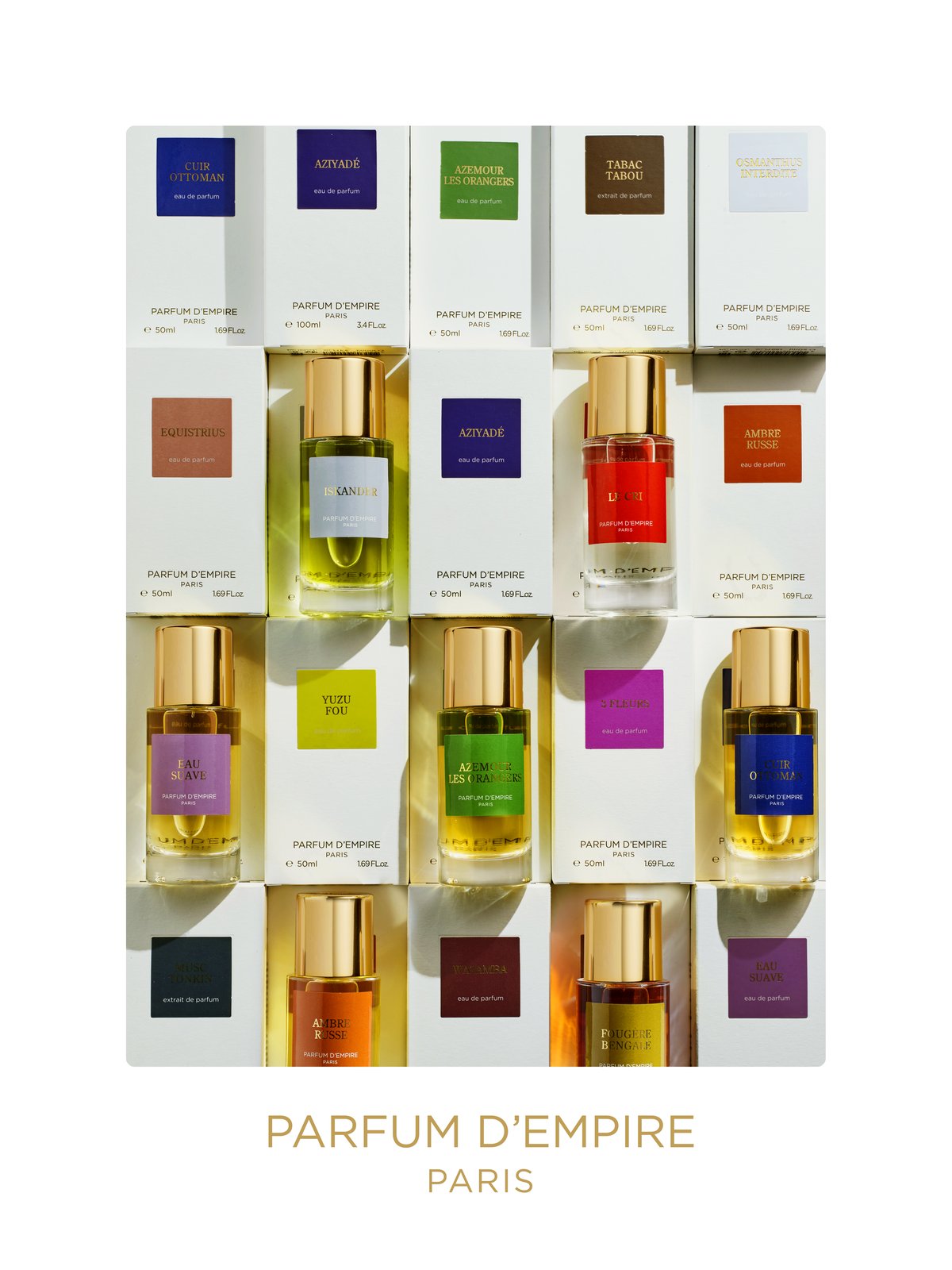
Warm golden light, poetic luxury perfumery atmosphere

House · French niche, founder-perfumer model

Parfum d'Empire

Parfum d'Empire is a French niche perfume house founded in Paris in 2003 by Marc-Antoine Corticchiato, a Grasse-trained chemistry doctor who composes every fragrance himself. Wazamba (2009) is the brand's best-selling reference in the American niche community.
Founded · 2003, Paris (France)
Founder · Marc-Antoine Corticchiato
Ownership · Independent, no outside investors
Catalog size · Around 20 fragrances over 20 years
Hallmark style · Oriental amber, leather, incense

History of the house

Parfum d'Empire sits in a small subset of French niche houses that have remained 100 percent independent for more than twenty years, with no outside investors and no conglomerate buyout. Marc-Antoine Corticchiato founded the brand in 2003 in Paris (France) and continues to compose every fragrance himself, making him a founder-perfumer rather than a perfume editor commissioning outside authors. Among American niche enthusiasts, this single-author profile gets compared to Olivier Durbano, Maria Candida Gentile and the late Mona di Orio.

US distribution today runs through the specialist niche channel rather than department-store prestige. Stockists include Twisted Lily in Brooklyn (USA), Lucky Scent in Los Angeles (USA), Aedes de Venustas in New York (USA), Min New York in Manhattan and Olfactif sample subscriptions. The brand is not stocked at Saks, Bergdorf, Sephora or Ulta. Pricing sits at typical European niche levels, around 175 to 250 dollars for 100 ml.

Marc-Antoine Corticchiato is a French perfumer of Corsican heritage. He holds a doctorate in organic chemistry from the University of Nice (France), specializing in plant-derived aromatic raw materials. He completed his perfumery training at ISIPCA in Versailles (France) and then Grasse. Before founding Parfum d'Empire at age 40, he worked as a contract perfumer and formulator for several French houses, including Christian Dior briefs. This dual background, chemistry research and Grasse perfumery, structures his compositional approach (source: ParfumdEmpire.fr).

The Parfum d'Empire editorial concept ties each fragrance to a historical empire or major olfactive culture. Ambre Russe references Russian imperial orientalism. Cuir Ottoman evokes Istanbul leather. Aziyade references Pierre Loti's novella set in Constantinople (now Istanbul, Turkey). The opening 2003 collection released four fragrances, with launches spaced thereafter at roughly one new fragrance per year. The cult release, Wazamba, arrived in 2009 and combined frankincense, myrrh, guaiac wood and green apple in a balance American niche reviewers had not previously encountered.

The economic model rests on independence. No outside investor capital, no conglomerate ownership, no marketing budget for paid placements or influencer campaigns. Marc-Antoine Corticchiato splits his time between Paris and Grasse, running both the creative work and the company direction. The deliberate pace, one to two new fragrances per year against four to six at competitor niche brands, reflects the founder-perfumer constraint and the brand's editorial discipline. Parfum d'Empire has won the Prix Francois Coty in 2014 from the Osmotheque, recognizing the founder-perfumer contribution to contemporary perfumery (source: Persolaise).

Olfactive signature

The Parfum d'Empire scent profile is built on densely-used natural raw materials, leather and amber accords played without disguise, and explicit cultural narration. Marc-Antoine Corticchiato draws on white-flower absolutes, frankincense, tobacco, immortelle, leather and ambergris. The material density distinguishes the line from lighter, more transparent niche houses and from the synthetic-dominant fashion-fragrance category.

Wazamba (2009) is the clearest reference point in the American niche community. The composition layers Ethiopian frankincense, myrrh, guaiac wood, juniper berries and green apple in a balance between heavy resins and crisp fruit that critics have described as deliberately surprising. Tabac Tabou (2013) built a tobacco-immortelle-hay structure that influenced the 2010s tobacco niche register. Cuir Ottoman (2003) remains a top-three reference for the leather floral-fruity category alongside Tabac Blond (Caron, 1919) and Cuir de Russie (Chanel, 1924) (source: Bois de Jasmin).

Three traits define the brand in the United States niche conversation:

  • Founder-perfumer continuity, Marc-Antoine Corticchiato has signed 100 percent of compositions across twenty years, an editorial consistency no perfume-editor brand can replicate.
  • Empire cultural narration, every fragrance references a precise historical setting (Russian, Ottoman, Indian, Mediterranean), a readable editorial grid that performs well in long-form American niche reviews.
  • Strict independence, no outside investors, no group ownership, deliberate slow pace of one to two launches per year, fidelity to the original 2003 catalog.

Key characteristics

Hallmark notes
Frankincense, myrrh, immortelle, tobacco, leather, ambergris, guaiac wood
Reference fragrances
Wazamba (2009), Cuir Ottoman (2003), Tabac Tabou (2013), Aziyade (2003)
Olfactive families
Oriental amber, leather, frankincense, ambery tobacco
US retail
Twisted Lily (Brooklyn), Lucky Scent (LA), Aedes de Venustas (NYC), Min New York

Notable perfumes

The Parfum d'Empire catalog includes around twenty fragrances, all signed by Marc-Antoine Corticchiato. The selection below tracks the founding 2003 launches and the cult releases most-cited in American niche reviews over the following two decades.

YearPerfumePerfumerCategory
2003Cuir OttomanMarc-Antoine CorticchiatoFloral leather
2003Ambre RusseMarc-Antoine CorticchiatoOriental amber
2003AziyadeMarc-Antoine CorticchiatoSpicy oriental
2009WazambaMarc-Antoine CorticchiatoFrankincense woody fruity
2013Tabac TabouMarc-Antoine CorticchiatoTobacco immortelle
2017Mal-AimeMarc-Antoine CorticchiatoHoneysuckle
2020Le Cri de la LumiereMarc-Antoine CorticchiatoPowdery rose

Frequently asked questions

Who is Marc-Antoine Corticchiato?01
Marc-Antoine Corticchiato is a French perfumer of Corsican heritage. He holds a doctorate in organic chemistry from the University of Nice (France), specializing in plant-derived aromatic raw materials. He completed his perfumery training at ISIPCA in Versailles (France) and then Grasse. Before founding Parfum d'Empire in 2003 in Paris (France) at age 40, he worked as a contract perfumer and formulator for several French houses. He has composed 100 percent of the Parfum d'Empire catalog over twenty years and won the Prix Francois Coty in 2014.
What does founder-perfumer mean?02
Founder-perfumer describes a house where the same person founded the company, composes every fragrance in the catalog, and runs the artistic direction. It is the opposite of the perfumer-editor model used by Frederic Malle, which commissions outside named perfumers. Other founder-perfumer brands include Olivier Durbano (Maison Olivier Durbano), Maria Candida Gentile and historically Mona di Orio (until her death in 2011). The model guarantees editorial consistency over time but limits stylistic diversity within the catalog.
Where can American customers buy Parfum d'Empire?03
Parfum d'Empire is distributed in the United States through specialist niche retailers, not department-store prestige. The main stockists are Twisted Lily in Brooklyn (USA), Lucky Scent in Los Angeles (USA), Aedes de Venustas in New York (USA), Min New York in Manhattan and the Olfactif subscription service. Parfum d'Empire does not maintain a direct US web store. Pricing sits at typical European niche levels, around 175 to 250 dollars for 100 ml. Sample sizes are available through Lucky Scent and Surrender to Chance.
Why is Wazamba (2009) a cult niche fragrance?04
Wazamba was composed by Marc-Antoine Corticchiato for Parfum d'Empire in 2009. The composition combines Ethiopian frankincense, myrrh, guaiac wood, juniper berries and green apple in a balance between heavy resins and crisp fruit. American niche reviewers, including those at Now Smell This and Bois de Jasmin, identified Wazamba as a turning point in the 2010s frankincense niche register. The fragrance regularly appears in Fragrantica top-niche-masculine lists and has been the brand's best-selling reference for more than a decade.
How does Parfum d'Empire compare with Frederic Malle?05
Both are French niche houses founded in Paris in the early 2000s, but the editorial models are opposites. Frederic Malle is a perfumer-editor: he commissions outside named perfumers and prints their byline on each bottle. Marc-Antoine Corticchiato is a founder-perfumer: he composes every fragrance himself. Frederic Malle was acquired by Estee Lauder Companies in 2014 and now operates inside a corporate group. Parfum d'Empire remains 100 percent independent and family-run. Both share a commitment to high natural-absolute concentrations.
Is Parfum d'Empire still independent in 2026?06
Yes. Twenty years after its 2003 founding, Parfum d'Empire remains 100 percent independent with no outside investors and no conglomerate ownership. Marc-Antoine Corticchiato continues to split his time between Paris and Grasse (France) running both the creative work and company direction. The brand's independence translates into a deliberate slow pace of one to two new launches per year, a fidelity to the original 2003 catalog, and no paid marketing or influencer placements. The economic model is sustainable but small-scale.

Sources

Published June 6, 2026 · Updated June 6, 2026 · Last fact check: June 6, 2026 · Osmetheca Editorial Team