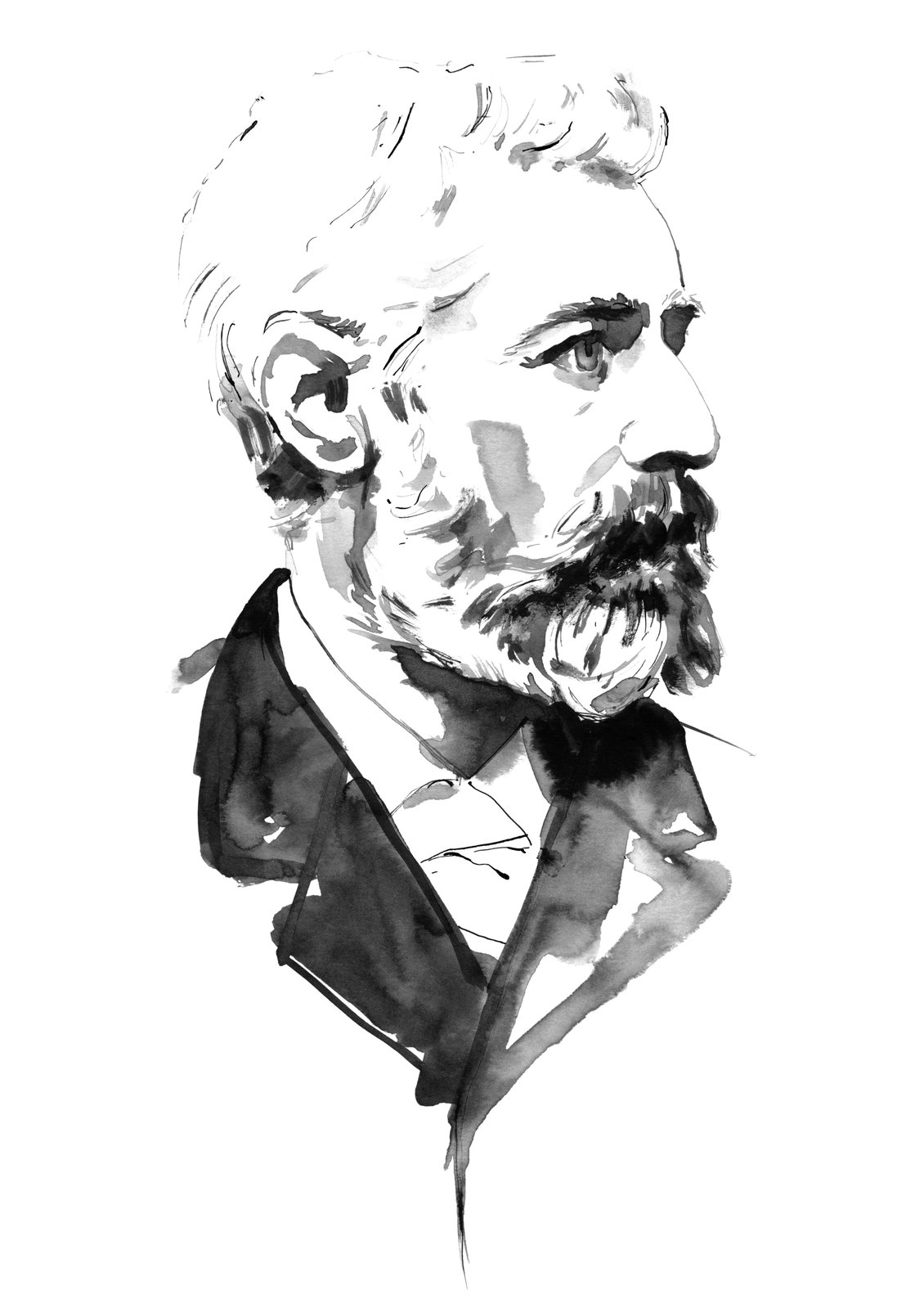
Quick answers
Training and career
Aime Guerlain was born in 1834 in France. He was the elder son of Pierre-Francois-Pascal Guerlain (1798-1864), founder of the Guerlain house in Paris (France) in 1828. His training was artisanal and familial. He learned composition at his father's side, in the boutique at 15, rue de la Paix, then in the house laboratory in Paris (France). This direct workshop transmission, without formal schooling, was the rule for European perfumers of the mid-nineteenth century, before the applied chemistry curricula opened in Grasse (France) and Paris (France) during the 1880s and 1890s.
At the death of Pierre-Francois-Pascal in 1864, the house passed to his two sons. Aime took artistic direction from that date and became master perfumer at the age of thirty. His younger brother Gabriel Guerlain (1841-1933) took commercial and administrative direction. This split of roles, perfumer on one side and manager on the other, shaped the second Guerlain generation and would remain a model for the generations that followed.
His career ran for nearly forty years. Aime composed several recognizable perfumes of the late nineteenth century for the house, including Fleur d'Italie (1884), Rococo (1887), Jicky (1889) and Eau de Cologne du Coq (1894). Jicky remains his most cited work and the composition that fixed his place in the history of Western perfumery. Aime worked in a context of technical change. The organic chemistry of the second half of the nineteenth century delivered new molecules to perfumers in close succession: coumarin synthesized by William Henry Perkin in 1868, vanillin isolated by Ferdinand Tiemann and Wilhelm Haarmann in 1874, heliotropin around 1869. These materials, still unfamiliar in fine perfumery, opened a repertoire that Paul Parquet drew on for Fougere Royale at Houbigant in 1882 and that Aime Guerlain picked up in turn for Jicky seven years later.
From 1890 onward, Aime Guerlain trained his nephew Jacques Guerlain (1874-1963), Gabriel's son. Childless himself, he chose this young apprentice as his successor from the age of sixteen. Between roughly 1897 and 1899, uncle and nephew shared composition duties. Jacques then took over as the third master perfumer of the house and would sign L'Heure Bleue (1912), Mitsouko (1919) and Shalimar (1925).
Aime Guerlain died in 1910, at the age of 76. The Guerlain house remained one of the great Parisian perfumery addresses, and the transition to Jacques had already been in place for more than ten years, which secured a rare editorial continuity for the industry of that time.
Notable perfumes
The work attributed to Aime Guerlain spans about thirty years. Below are four creations identified as his own, including Jicky, which remains one of the few late nineteenth century perfumes still sold in 2026.
| Year | House | Perfume | Olfactory family |
|---|---|---|---|
| 1884 | Guerlain | Fleur d'Italie | Classic floral |
| 1887 | Guerlain | Rococo | Powdery floral |
| 1889 | Guerlain | Jicky | Oriental fougere lavender-vanilla |
| 1894 | Guerlain | Eau de Cologne du Coq | Aromatic citrus |
Olfactory signature
Aime Guerlain is the first perfumer of the house to integrate synthetic raw materials alongside natural absolutes as a deliberate choice. This was not a simple industrial decision but a writing position, and it opened the path to modern perfumery and shaped what the house would later call the guerlinade.
His signature joins three readable traits. First, an amber-vanilla base carried by synthetic vanillin, sweet without weight. Second, a fougere nuance brought by coumarin and linalool, with the feel of cut hay and tonka bean. Third, a discreet animalic envelope built on civet and musks, dosed lightly.
Beyond the palette, Aime Guerlain shifts the role of the perfumer. Before him, French perfumery mostly produced fresh waters and soliflore bouquets. With Jicky, he signs an abstract perfume, one that does not seek to copy a precise flower. This abstraction is one of the historic turning points in Western perfumery.
Several sources present him as one of the architects of modern perfumery, alongside Paul Parquet of Houbigant, who had launched Fougere Royale (1882) with synthetic coumarin seven years before Jicky. Aime Guerlain extended that path by building an entire perfume around synthetic molecules.
According to the autobiographical account from Jean-Paul Guerlain reported by Perfume Shrine, it was with Jicky that the house began to speak of a Guerlain style and of a guerlinade. The accord, later codified by Jacques around bergamot, rose, iris, tonka bean and vanilla, found its first formulation with Aime, who combined aromatic lavender, synthetic vanilla and an amber-civet base in a single composition for the first time.
Key characteristics
Common questions
- Fleur d'Italie (1884), classic floral
- Rococo (1887), powdery floral
- Jicky (1889), oriental fougere lavender-vanilla
- Eau de Cologne du Coq (1894), aromatic citrus
See also
Sources and methodology
- Guerlain: corporate pages, Maison Guerlain and historical Eaux de Cologne (accessed 31 May 2026)
- Wikipedia: Guerlain and Jacques Guerlain (accessed 31 May 2026)
- Wikiparfum: Aime Guerlain perfumer profile (accessed 31 May 2026)
- Smithsonian Magazine: Jicky, the First Modern Perfume (accessed 31 May 2026)
- Fragrantica: Jicky (1889), perfume page and history (accessed 31 May 2026)
- Now Smell This: Jacques Guerlain, successor of Aime (accessed 31 May 2026)
- Escentual: The History of Guerlain (accessed 31 May 2026)
- Bois de Jasmin: Aime Guerlain archive (accessed 31 May 2026)