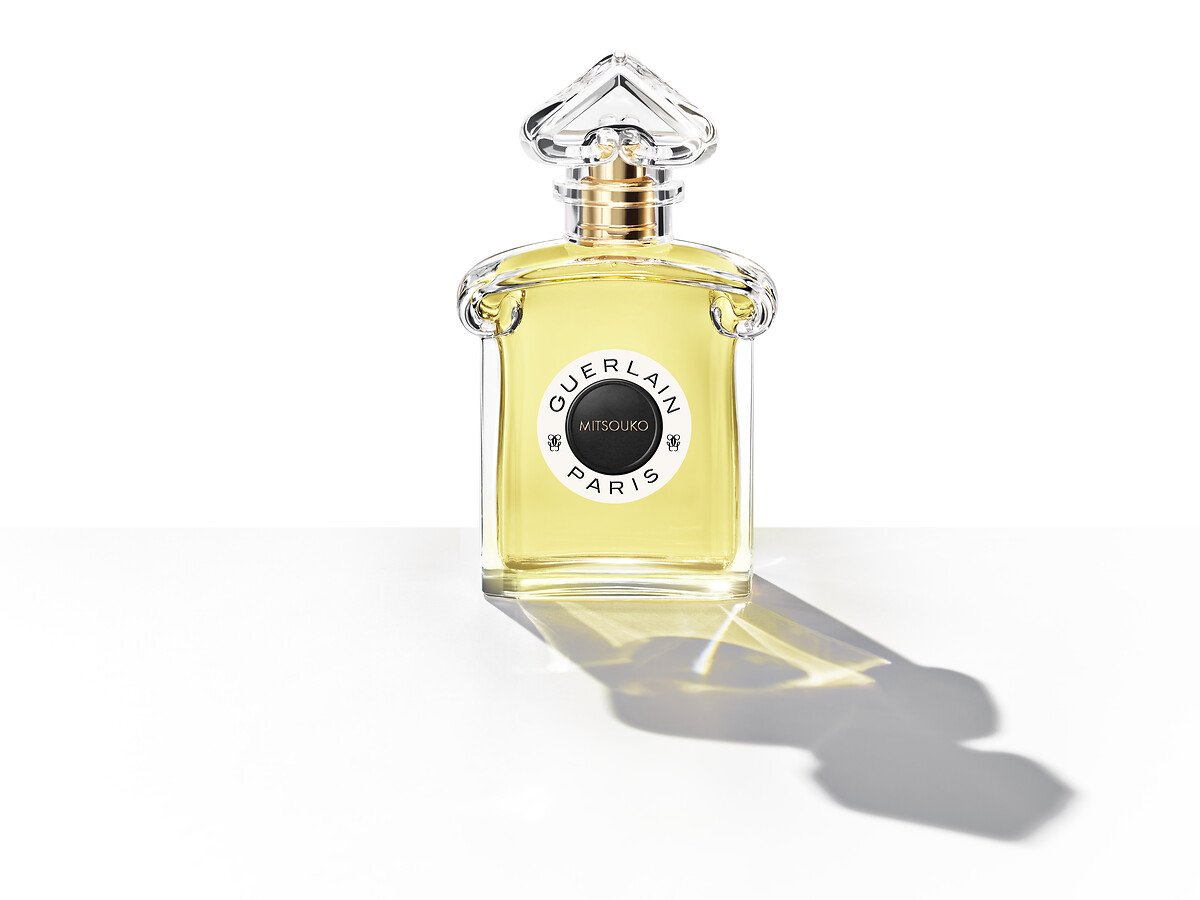
Quick answers
History
Mitsouko was launched in 1919 by Guerlain, the Parisian perfume house founded in 1828, then directed by Jacques Guerlain, third-generation perfumer of the family and one of the most influential composers of the early twentieth century. The release followed Jicky (1889) and L’Heure Bleue (1912), two earlier Guerlain compositions that stand as founding works of modern perfumery.
The name was borrowed from the 1909 novel La Bataille by French author Claude Farrere. In the book, Mitsouko is the heroine, the wife of a Japanese naval officer during the Russo-Japanese War. The literary reference anchored the perfume in the post-1918 fascination with Asia that ran through Parisian intellectual and artistic circles, and gave the composition an explicit narrative frame rather than a purely abstract olfactory identity.
The technical break that Mitsouko introduced rested on the use of gamma-undecalactone, a synthetic peach lactone recently developed by the fragrance chemistry of the period. Jacques Guerlain used it as a central material rather than a trace dosage, giving the heart a powdered fruit signature that did not exist in any previous composition. Layered onto the bergamot, cistus labdanum and oakmoss chypre structure formalized two years earlier by François Coty in his Chypre (1917), this peach heart created the fruity chypre, a sub-family that would shape twentieth-century perfumery.
Commercial reception was immediate and lasting. Mitsouko became one of the major feminine signatures of French haute parfumerie and traveled across the entire twentieth century without ever leaving the catalog. The composition was favored by several intellectual and artistic figures of the period, including Jean Cocteau and Sergei Diaghilev, who reportedly wore it through his Ballets Russes years. Like most classical compositions, the formula was reworked several times to align with IFRA restrictions, particularly on oakmoss, which was originally dosed at high concentration. Mitsouko remains in continuous production today and is the founding fruity chypre, the ancestor from which an entire lineage descends. The olfactory pyramid and profile below describe the version sold today, reworked for IFRA compliance while preserving the original fruity-chypre signature; the 1919 creation is recounted in the History section above.
Fragrance notes
The pyramid below reflects the version currently on the market, where the oakmoss has receded; the 1919 original is described in the History section above. The architecture of Mitsouko is the textbook case of the fruity chypre. Jacques Guerlain signs a classical top, heart and base structure, with a peach lactone in the heart that delivered an unprecedented powdered fruit signature in 1919 and has remained the model of the sub-family ever since.
Evolution on skin is progressive and immediately recognizable to readers of the classical Guerlain canon. The citrus opening fronts the first twenty minutes. The powdered peach and the floral support then settle for several hours over the chypre base. This pyramid built the very template of the fruity chypre, a sub-family that remains active in contemporary niche perfumery.
Scent profile
The olfactory profile of Mitsouko articulates three registers that had rarely been combined with such precision before its release: a citrus brightness in the top, a rounded peach in the heart and a deep oakmoss chypre in the base. The opening sparkles on bergamot and lemon, which yield within minutes to the peach lactone that defines the composition. The peach is neither demonstrative nor gourmand. It is powdered, almost dry, anchored into a floral support of rose, jasmine and ylang-ylang. The transition to the chypre base unfolds across several hours, with an orchestration that remains one of the most subtle in classical French perfumery.
The distinctive signature rests on the use of gamma-undecalactone as a central material, in a period when lactones were used at trace levels. Jacques Guerlain turned this molecule into a heart signature that would go on to define an entire sub-family. The fruity chypre, alongside the ambery oriental opened by Shalimar in 1925, is one of the most durable Guerlain contributions to twentieth-century perfumery. Several major compositions sit in direct descent, from Femme by Rochas in 1944 to Coco Mademoiselle by Chanel in 2001.
The character that results is enigmatic and literary. Enigmatic, because the composition escapes labels: it is neither purely floral, nor purely fruity, nor purely chypre, but a delicate synthesis of all three. Literary, because the house framed the perfume from the start with a narrative anchor, the Farrere novel, the post-1918 mood, the Asian fascination, which made it a fragrance of intellectual personalities for most of the twentieth century.
Mitsouko offers an emotion without precedent in classical perfumery: a lactone that sings, almost evanescent, over a chypre base of unequalled depth.
Key characteristics
When and where to wear
Within the fruity chypre sub-family, Mitsouko is sophisticated and demanding. Its layered structure and chypre depth call for a skin that carries it and a setting that accompanies it.
How to wear it
Seasonal fit
| Season | Fit | Critical notes |
|---|---|---|
| Spring | ★★★☆ | Good fit on cool spring days; the powdered peach reads beautifully. |
| Summer | ★★☆☆ | Chypre base can feel heavy in high heat; dose with restraint or reserve for evenings. |
| Autumn | ★★★★ | Reference season; the fruity chypre comes into full expression. |
| Winter | ★★★☆ | Good projection in cold air; the chypre drydown pairs beautifully with wool. |
Context fit
| Setting | Fit | Wearing recommendation |
|---|---|---|
| Office | ★★★☆ | Acceptable with a discreet spray; sillage reads as sophisticated rather than intrusive at low dosage. |
| Formal evening | ★★★★ | Reference setting; two sprays deliver an immediate signature effect. |
| Intimate dinner | ★★★★ | Excellent in quiet restaurants; the powdered peach dialogues well with refined culinary aromas. |
| Gallery opening, lecture | ★★★★ | The historical intellectual and literary setting of the perfume. |
| Sport | ★☆☆☆ | Mismatched register; chypre density incompatible with perspiration. |
| Travel | ★★★☆ | Compact 50 or 100 ml format. |
Similar perfumes
Five compositions share an olfactory kinship with Mitsouko, either through the fruity chypre sub-family or through the powdered peach signature. None of them are dupes; they are structural cousins.
| Perfume | House · year | Why related |
|---|---|---|
| Chypre | Coty · 1917 | Direct precursor of Mitsouko; same bergamot, cistus labdanum and oakmoss structure that founded the chypre family. |
| Femme | Rochas · 1944 | Fruity chypre signed by Edmond Roudnitska; direct modernization of the Mitsouko lineage with an assumed peach and cumin signature. |
| Coco Mademoiselle | Chanel · 2001 | Fruity chypre signed by Jacques Polge; a contemporary rereading of the Mitsouko lineage. |
| Jicky | Guerlain · 1889 | Earlier in-house ancestor that opened modern perfumery for the Guerlain canon; same French classical tradition. |
| Rochas Femme | Rochas · 1989 reissue | Modern reissue of the 1944 Femme; preserves the peach and cumin signature on a chypre base. |
| Evernia | Ormonde Jayne | Reference chypre, the same oakmoss backbone as Evernia. |
Frequently asked questions
See also
Sources
- Guerlain: official Mitsouko page, “le fond mystérieux de la fragrance allie des notes épicées à celles de sous-bois et de vétiver” and the “Les épices” panel (black pepper, cardamom, pink pepper), page opened in the browser on 15 September 2026
- Bois de Jasmin: classical Mitsouko reference review (accessed 22 May 2026)
- Now Smell This: Mitsouko classical review and reformulation history (accessed 22 May 2026)
- Persolaise: Mitsouko Eau de Toilette review (accessed 22 May 2026)
- Now Smell This: “Guerlain Mitsouko (pour homme)”, review devoted to male wear (accessed 9 September 2026)
- Guerlain: official Mitsouko page, peach accord, spices, patchouli, May rose, jasmine, vetiver and undergrowth (accessed 13 September 2026)