Quick answers
History
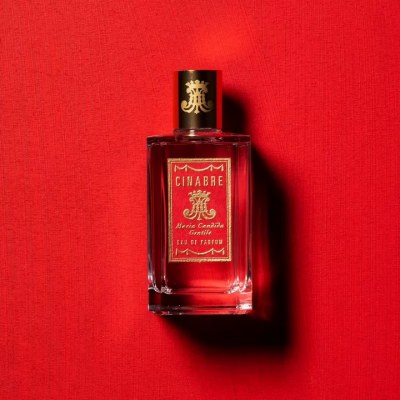
Cinnabar is a deep-red mineral, a mercury sulphide from which alchemists drew vermilion and which they linked to the rubedo, the final stage of transmutation. By giving this name to one of the first fragrances of her house, founded in 2009 Maria Candida Gentile stakes out her ground at once: a perfumery of natural materials steeped in alchemical symbols, where the rose is never a plain ornament but a riddle to decode.
The fragrance reads like a rose that has been warmed. The house describes a rose “gathered and macerated by spagyric methods,” lifted with ginger and black Indian pepper. That approach, slow maceration in alcohol and sometimes in oil, following the lunar cycles, is the signature of the Grasse-trained perfumer who studied at the Rure school. She favors naturals and nature-identical isolates, free of phthalates and synthetic colorants, in a vegan, cruelty-free formula.
The heart of Cinabre rests on a rare material: the Splendens rose, which the house presents as the recreation of a sixteenth-century rose with a myrrh scent. This myrrh-rose, singular and faintly medicinal, joins the Moroccan rose to give the flower an unusual depth. This is far from a fresh rose: here the flower is dense, resinous, almost balsamic, pulled toward the dark by the top spices.
The base seals the amber identity: benzoin and Madagascar vanilla lay a soft, resinous, warm foundation. A reading discrepancy is worth flagging. The house now files Cinabre as amber, spicy, and unisex; some enthusiast databases, Fragrantica among them, first placed it under oriental floral “for women.” The composition, a spicy, resinous rose, in fact supports both readings and wears easily either way.
Olfactory pyramid
Cinabre reads in three movements, from the spicy bite of ginger and pepper to the resinous softness of benzoin and vanilla.
The through-line is a transmuted rose: the flower moves from spicy brightness to amber warmth, like the mineral toward vermilion.
Olfactory profile
Cinabre opens on a spicy bite. Ginger and black pepper give a pungent, bright, almost cutting start that clears the way for the flower and strips it of any sweetness. This is a rose announced by fire rather than by freshness.
The heart reveals the composition’s singular rose. The Splendens rose, with its myrrh facet, yields a dense, faintly medicinal flower, extended by the depth of the Moroccan rose. This is a grown-up, serious rose, far from the gourmand or powdery roses of mainstream perfumery.
The base owns the warmth. Benzoin and Madagascar vanilla wrap the rose in a resinous, balsamic softness that explains the fragrance’s staying power and medium intensity. It is an amber rose of oriental cast, spicy and comforting at once, and its unisex quality plays out precisely in this balance of bite and softness.
Key characteristics
When and where to wear
Cinabre is a cool-season, evening rose. Its spices and amber base come into their own as the air cools, in autumn and winter, and at night more than in broad daylight. The trail stays measured, in line with its medium intensity, while the resinous warmth ensures fine staying power.
Wear references
Seasonal fit
| Season | Fit | Critical notes |
|---|---|---|
| Spring | ★★★☆ | Pleasant on a cool day. |
| Summer | ★★☆☆ | A touch warm in the heat. |
| Autumn | ★★★★ | Its prime season. |
| Winter | ★★★★ | Amber and spice come alive. |
Context fit
| Setting | Fit | Usage recommendation |
|---|---|---|
| Everyday | ★★★☆ | A rose with character. |
| Office | ★★★☆ | Use sparingly, warm base. |
| Outings | ★★★★ | Its natural terrain. |
| Evening | ★★★★ | Spice and resin unfold here. |
| Festivities | ★★★★ | Cool-season amber warmth. |
Similar perfumes
The spicy amber rose has its classics; a few clarify Cinabre’s resinous stance.
| Perfume | House · year | Why it is close |
|---|---|---|
| Rose Poivrée | The Different Company · 2000 | A peppery, cumin-laced rose by Jean-Claude Ellena; the same rose-spice dialogue, here drier and more animalic. |
| Noir de Noir | Tom Ford · 2007 | A truffled, amber rose, warm and dark; a kinship of resinous base, more opulent than Cinabre. |
| Rose Anonyme | Atelier Cologne · 2012 | An amber rose lifted by incense and ginger; close through its rose-spice-resin accord, in a brighter register. |
Common questions
See also
Sources
- Official Maria Candida Gentile site, Cinabre page (Italian and English editions)
- Maria Candida Gentile training dossier, olfactory notes and spagyric method
- Official Maria Candida Gentile presentation, master perfumer
- Maria Candida Gentile, official Cinabre page
- Fragrantica, Cinabre entry (2009)
- Parfumo, Cinabre entry