Quick answers
Biography and career
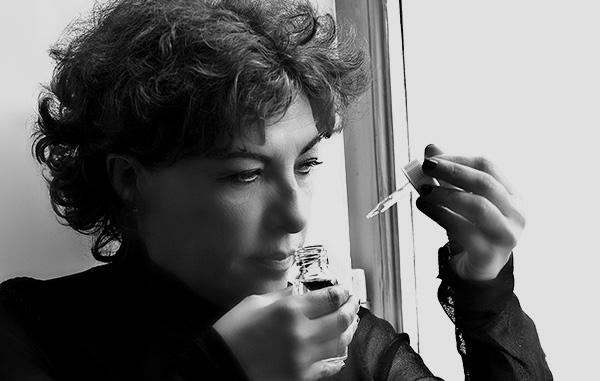
Maria Candida Gentile was born in Sarzana, in Liguria (Italy), and grew up in an ancient garden overlooking the city walls. It was there, beneath an old magnolia tree, that she learned early on to love flowers and plants and to sense, even as a child, the hidden force of nature. Those first fragrant experiments laid down a tactile, botanical sensibility that has never left her.
She later lived in the Valle d’Aosta, among people who held a deep knowledge of plants and of the virtues they carry. From them she inherited an old understanding, shaped by observation, respect and silence, which prepared her for a more structured discipline.
It was during those years that she studied composition in Grasse, between 2000 and 2003, where she specialized under master perfumer Carol André. That training, she says, gave her rigor and method while revealing more clearly the direction of her work and her life. She stands among the first Italian women to graduate from the school, and went on to earn the title of Maître Parfumeur.
Before structuring her own collection, she spent several years composing bespoke fragrances for private clients and for hospitality venues, an apprenticeship in the craft, close to the request, that would later feed her authorial voice.
Approach and method
At the heart of her work lies a precise choice: to compose with natural and nature-identical materials, which she recognizes as living in deep harmony with the person and the natural world. It is a more demanding path, one that calls for experience, sensitivity and time, yet for her it remains the only authentic one. Perfume, then, is neither form nor style, but a subtle presence able to hold memory and to accompany the one who wears it.
Maria Candida Gentile keeps a laboratory in France, in the hills above Grasse, devoted to the transformation of floral materials. She reintroduced older extraction techniques there, including enfleurage, which lets her obtain delicate materials such as violet and tuberose. This artisanal work keeps her close to the living matter of the flower.
She also selects rare raw materials from across the world, from the vanilla of Madagascar to the black tea of Lankaran, each chosen for the integrity of its origin and the purity of its extraction. Through long study she builds accords that nature does not always offer directly, while remaining coherent in her choice of materials.
This natural density, high for the sector, translates into a proportion of essential oils and absolutes of 80 to 98 percent depending on the formula. It steers the writing towards accords that unfold slowly on the skin and foreground materials barely retouched by synthesis.
Activities
The first of Maria Candida Gentile’s activities is the eponymous house she founded in 2010 in Sarzana. She signs the entire collection herself, from the four opening perfumes to the more recent compositions, and runs the house from the Monte d’Armolo atelier, where a former church dedicated to the Virgin has been turned into a showroom.
Alongside it she has developed a bespoke branch, creating fragrances for private clients, artists and members of royal families, among them Princess Caroline of Monaco, Tarak Ben Ammar and Madonna, in an intimate and exacting relationship with the material. She also composes for residences and exceptional places.
She now designs olfactory lines for luxury hotels and five-star establishments, among them the Hotel Il Pellicano, Borgo Egnazia, Borgo San Felice and the Monteverdi in Val d’Orcia. She brings to them the same attention to identity, natural materials and emotional depth that defines her signed collection.
Finally, she passes on her method through her perfumery school, open to a small number of participants. It is less a course than real work, made of material, listening and time, intended for those who wish to deepen their olfactory language with rigour and sensitivity.
Her work reaches well beyond commercial perfumery. Maria Candida Gentile composes with natural and nature-identical materials and took part in an international environmental working group that helped remove certain synthetic molecules, including nitro and polycyclic musks, from perfumery. Michael Edwards included her in Fragrances of the World, and the scientist Luca Turin praised her work as that of a nose able to compose with the heart. Her Lady Day was nominated in the Indie category of the 2013 FiFi Awards, and Lankaran Forest was a finalist in the Independent category of the 2017 Art and Olfaction Awards. She also pursues research into the neuroactive effects of perfume with Professor Joachim Mensing, of the University of Freiburg. She also regularly signs olfactory works for contemporary art, notably with Luca Vitone at the 2013 Venice Biennale and with Pamela Rosenkranz at the Fondazione Prada in 2017.
The catalog opens in 2009 with the four founding perfumes, Sideris, Cinabre, Exultat and Gershwin, a year before the house was founded in 2010. It has grown almost every year since, from Barry Lyndon and Hanbury (2010) to Viridarium (2023).
Notable perfumes
The Maria Candida Gentile collection brings together more than twenty perfumes, from the four founding compositions to the most recent creations, all composed by the perfumer herself from natural materials. Below are the twenty-one compositions that have their own page on Osmetheca, with their year, concentration and olfactory family. The full catalogue is on the collection page.
See the collection page: all Maria Candida Gentile perfumes →
Olfactory signature
Maria Candida Gentile writes an Italian authorial perfumery, marked by the density of natural materials and by a precise thematic repertoire. Her compositions combine Mediterranean citrus, incense, resins, Ligurian flowers, leathers, spices and woods, in proportions where essential oils and absolutes hold a share of 80 to 98 percent.
Her approach claims inspirations drawn from literature, painting, cinema and Mediterranean geography. This stance brings the collection closer to an author’s body of work than to a catalog built around a single olfactory family. Each fragrance begins with a personal exploration, then is composed entirely by her hand.
To compose with natural materials, close to the living matter of the flower, for a perfume that holds memory and emotion.
Key features
Frequently asked questions
See also
Sources
- Direct communication from Maria Candida Gentile to Sabrina Carlier, June 2026 (primary source)
- Maria Candida Gentile: dedicated Madonna bespoke page (official site)
- Italy Deluxe: MCG portrait mentioning Princess Caroline (2013)
- Maria Candida Gentile, Portrait page on the official website (consulted 23 June 2026)
- Maria Candida Gentile: "The artist" page on the official website (accessed 2 October 2026)
- ÇaFleureBon, interview with Maria Candida Gentile (Barry Lyndon)
- Fragrantica, designer page (names and years cross-check)
- Parfumo, house page (names and years cross-check)
- The Fragrance Foundation, 2013 FiFi Awards nominees (Indie category)
- Art and Olfaction Awards, 2017 finalists press release (Lankaran Forest)
- Parfumo: Maria Candida Gentile, 24 perfumes listed with release years (accessed 5 November 2026)