Quick answers
History
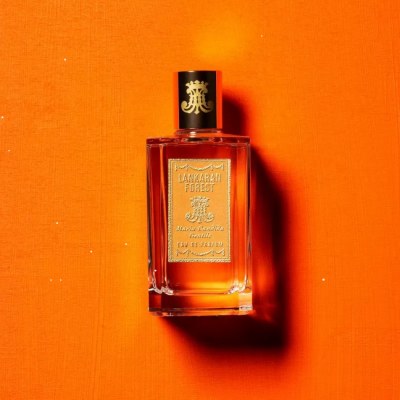
Lankaran Forest is an eau de parfum by Maria Candida Gentile, composed by the house’s founder. Created in 2015 as an edition for the Buta Festival of Azerbaijani arts, it joined the permanent range in 2016. The house files it under the citrus and woody families.
Lankaran Forest was born from a journey. In 2015 Maria Candida Gentile traveled to the shores of the Caspian Sea, to the Lankaran region in southern Azerbaijan, on the Iranian border. There, tea plantations and orange groves lead to a protected forest, the Hyrcanian forest, one of the oldest in the world. The perfumer brought back not so much a landscape as an emotion: the sacred, felt inside an untouched wood where the trees seem to watch over one another.
The fragrance centers on the ironwood tree, Parrotia persica, the emblematic species of the Hyrcanian forest. The house tells how this tree can heal itself by embracing a neighboring tree, an image of plant solidarity the perfumer set out to translate. Around it, she gathers the materials of the place: bitter orange from the groves, black Azerbaijani tea, an accord of lichens and sacred woods. The result is less the forest alone than the whole city of Lankaran, from orchard to tea plant to tree.
Like the entire house, Lankaran Forest belongs to a perfumery of naturalness. Grasse-trained under Professor Carol André, Maria Candida Gentile works with materials of natural origin and practices slow maceration in alcohol. The formula here is vegan and free of phthalates, parabens and synthetic colorants. The house files it under the citrus and woody families; its axis is luminous and woody, dominant in the base of sandalwood, leaves and sacred woods.
The fragrance first appeared as a bespoke edition for the second Buta Festival of Azerbaijani arts, held in London in 2015, before entering the permanent range in 2016. The following year it earned its creator international recognition: Lankaran Forest was a finalist in the Independent category of the 2017 Art and Olfaction Awards. The house gives it as unisex, of medium intensity.
Fragrance notes
Lankaran Forest reads in three movements, from the flash of bitter orange to the sacred depth of sandalwood and woods.
The through-line is the sacredness of the forest: a clear citrus that sinks little by little into a deep, luminous wood.
Scent profile
Lankaran Forest opens on bitter orange, bright and a touch sharp, far from a sweet zest. This citrus top gives at once its light, a clarity that runs through the whole composition without ever cooling it.
The heart tips toward a darker green. Black tea brings its tannic, smoky note, the lichens accord a forest green, damp and mineral. This is the fragrance at its most singular: a forest tea, both bracing and calming, that sets up the sacred-wood imagination.
The base signs the depth. Sandalwood, milky and warm, blends with green leaves and the sacred-woods accord to draw a resinous, enveloping trail. That base explains the fragrance’s staying power, moderate but notable for so clear a composition, and the medium intensity the house claims for it.
Key characteristics
When and where to wear
Lankaran Forest is a shoulder-season, daytime woody. Its bitter-orange top and tea heart keep it airy in warm weather, while the sandalwood and sacred-wood base give it staying power in autumn. The trail stays measured, in line with its medium intensity.
How to wear it
Seasonal fit
| Season | Fit | Critical notes |
|---|---|---|
| Spring | ★★★★ | The citrus top comes alive. |
| Summer | ★★★☆ | Airy, never heavy. |
| Autumn | ★★★★ | Its prime season, the wood takes over. |
| Winter | ★★★☆ | The sandalwood warms it. |
Context fit
| Setting | Fit | Usage recommendation |
|---|---|---|
| Everyday | ★★★★ | Its reference use. |
| Office | ★★★★ | Luminous and discreet. |
| Walks | ★★★★ | Its forest imagination. |
| Evening | ★★★☆ | In a sober woody register. |
| Ceremony | ★★★☆ | The sacred side of the base. |
Similar perfumes
The tea-and-forest woody has its neighbors; a few share its green, sacred imagination.
| Perfume | House · year | Why it is close |
|---|---|---|
| Feuilles de Tabac | Miller Harris · 2000 | A green, tobacco woody of dry leaves; the same forest kinship, without Lankaran Forest’s black tea. |
| Tea for Two | L’Artisan Parfumeur · 2000 | A smoky, spiced black tea; a direct kinship around the tea note, in a more gourmand register. |
| Santal Blanc | Serge Lutens · 2015 | Creamy sandalwood in the base; to extend the woody warmth that signs Lankaran Forest’s foundation. |
| Osmanthe Yunnan | Hermès · 2005 | Yunnan black tea and orange in the opening; the same pairing of tea and citrus, in a floral, fruity register rather than a forest one. |
| Kitrea | Maria Candida Gentile · 2014 | A sunny citrus from the same house and the same perfumer; the same naturalness, turned toward the sea rather than the forest. |
Frequently asked questions
See also
Sources
- Official Maria Candida Gentile site, Lankaran Forest page (Italian and English editions)
- Maria Candida Gentile presentation dossier, creation and inspiration of Lankaran Forest
- Official Maria Candida Gentile presentation, master perfumer (Grasse training, naturalness)
- Maria Candida Gentile, official Lankaran Forest page
- Maria Candida Gentile, official Lankaran Forest page, Italian edition
- Parfumo, Lankaran Forest entry (English edition): year 2015, Maria Candida Gentile, limited edition for the Buta Festival, then permanent range in 2016 (Parfumo gives 2015); longevity 6.1/10 (28 votes), sillage 5.9/10 (28 votes), as of 5 November 2026
- Art and Olfaction Awards, Lankaran Forest entry: “Finalist Category: Independent, 2017” (accessed 5 November 2026)
- Now Smell This, Robin, “The Art and Olfaction Awards 2017 finalists”, 23 March 2017: Lankaran Forest among the Independent finalists (accessed 5 November 2026)
- Buta Festival of Azerbaijani Arts, official site: London, November 2014 to March 2015, closing evening at the Royal Academy of Arts with Maria Candida Gentile’s fragrance (accessed 5 November 2026)