Quick answers
History
Finisterre, Latin for the end of the earth, names the westernmost cape of Europe, where the continent stops and the Atlantic opens onto the infinite. It is that mix of vertigo and calm at the ocean's edge that Maria Candida Gentile set out to bottle in 2013. The house calls it one of its most iconic fragrances, worn, it says, by men, women and places: less a scent of seduction than an atmosphere of open water.
The fragrance belongs to the niche perfumery the house has practiced since 2009, entirely committed to naturalness: slow macerations, a vegan and cruelty-free formula, free of phthalates and parabens. Finisterre gave its name to a whole collection, spanning perfume, candle and soap, and reads as a landscape rather than a fashion accord.
The heart of the matter is the marine note, and this is where Finisterre shares with Kitrea the house's most unusual material story. The sea accord is not a synthetic ozonic: it rests on Posidonia, the seagrass of the Italian coasts, harvested and sun-dried, whose extract gives the fragrance its authentic salt. Around it, wet woods, helichrysum and pine build a complete shoreline, between sea spray and coastal forest.
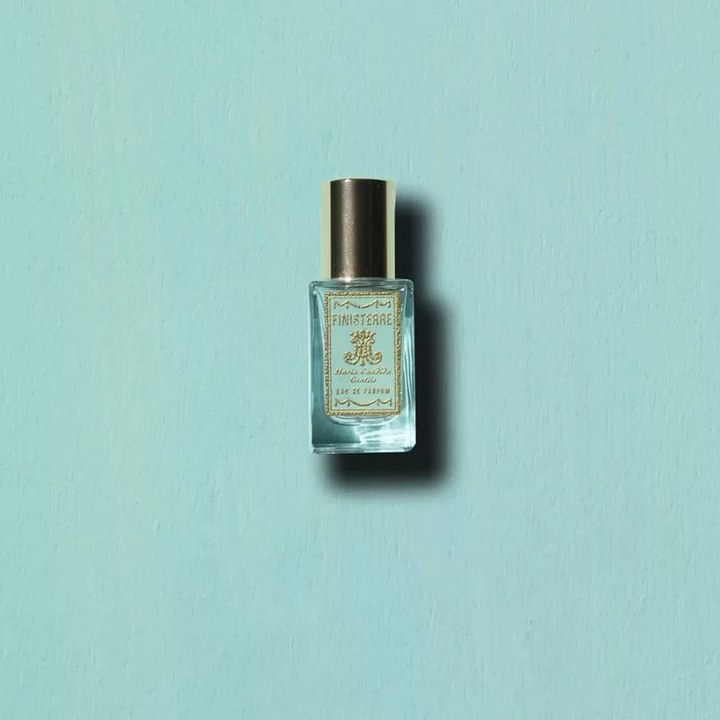
The base ties the marine to the amber: ambergris, saline and warm, and balsamic sandalwood close the trail on warm, luminous skin. The house in fact files Finisterre as both amber and marine. One format note: a 15 ml bottle is marked "Profumo," yet Finisterre is an eau de parfum.
Fragrance notes
Finisterre reads in three movements, from the marine spray up top to the amber sandalwood in the base.
The through-line is open water: a saline marine anchored in a woody, amber base, warm as skin after a swim.
Scent profile
Finisterre opens on a frank, saline marine accord, weighted at once by wet woods. This is far from a sweet or fruity marine: here the sea smells of salt, foam and wet wood cast up by the waves, with that Posidonia material giving an almost vegetal grain.
The heart shades the picture. Helichrysum brings its honey-and-curry facet, warm and a touch bitter, while pine raises a green, resinous vertical that recalls a seaside pinewood. This is the moment the shoreline takes shape, between beach and forest.
The base soothes and extends. Saline ambergris weds balsamic sandalwood to lay down a warm, luminous trail where the marine turns to skin. That base explains the fragrance's honest staying power and the medium intensity the house claims: a marine with character, deeper than it is refreshing.
Key characteristics
When and where to wear
Finisterre is a daytime marine that reaches well beyond summer. Its saline freshness suits spring and summer, but its ambergris and sandalwood base let it hold into the shoulder seasons, even in cool weather. The trail stays measured, in line with its medium intensity.
How to wear it
Seasonal fit
| Season | Fit | Critical notes |
|---|---|---|
| Spring | ★★★★ | The season suits it perfectly. |
| Summer | ★★★★ | The salt comes alive. |
| Autumn | ★★★☆ | The woody base takes over. |
| Winter | ★★☆☆ | A touch cool in the cold. |
Context fit
| Setting | Fit | Usage recommendation |
|---|---|---|
| Everyday | ★★★★ | Its reference use. |
| Office | ★★★★ | Clean and discreet. |
| Vacations | ★★★★ | Its natural terrain, by the water. |
| Evening | ★★★☆ | In its quieter mood. |
| Sport | ★★★☆ | Fresh and bracing. |
Similar perfumes
The great saline marine has its classics; a few share its salt or its wet wood.
| Perfume | House · year | Why it is close |
|---|---|---|
| Kitrea | Maria Candida Gentile · 2014 | The house's solar marine, on the same Posidonia accord; more honeyed and summery, where Finisterre stays oceanic and woody. |
| Sel Marin | James Heeley · 2007 | A marine of salt, seaweed and wood; a clear kinship of spray and shoreline, without Finisterre's amber base. |
| Eau des Merveilles | Hermès · 2004 | Saline, woody gray amber in a luminous key; the same taste for warm skin at the sea's edge. |
Frequently asked questions
See also
Sources
- Official Maria Candida Gentile site, Finisterre page (Italian and English editions)
- Official Maria Candida Gentile site, Finisterre collection and Posidonia note
- Official Maria Candida Gentile presentation, master perfumer
- Maria Candida Gentile, official Finisterre page
- Maria Candida Gentile, official Finisterre page, Italian edition