Quick answers
History
The Scandola peninsula sits on the west coast of Corsica (France), between Galéria and Porto. A UNESCO World Heritage nature reserve since 1983, its red porphyry cliffs drop straight into translucent water, and the rock is carpeted with juniper and immortelle. The reserve can only be reached by boat, which is part of its hold on the imagination.
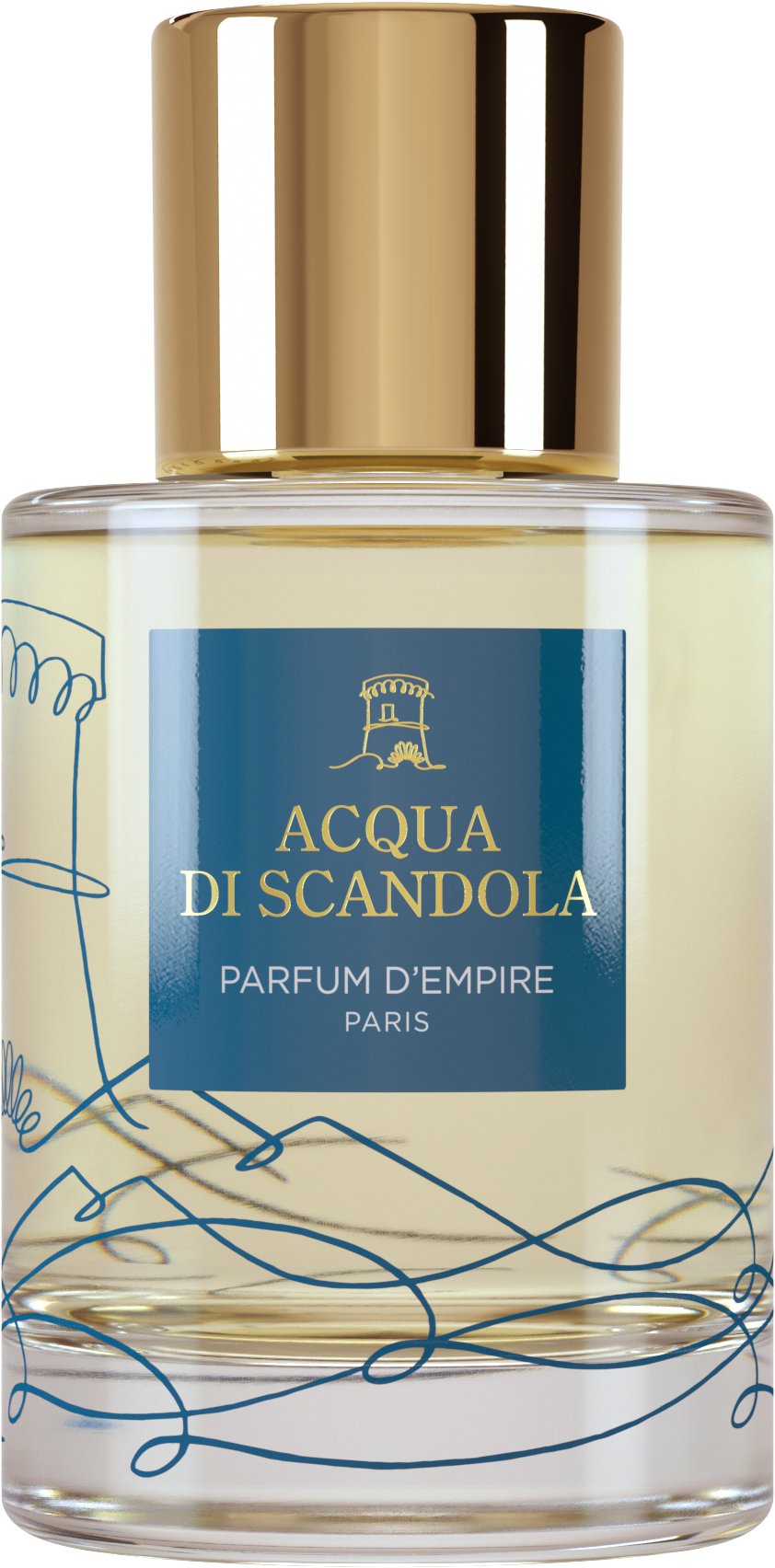
Acqua di Scandola was released in 2018 by Parfum d’Empire, the French niche house founded in 2003 in Paris (France) by Marc-Antoine Corticchiato. Corticchiato is a perfumer of Corsican descent who holds a doctorate in chemistry and trained at ISIPCA in Versailles (France). Scandola is a Corsican landscape, and the perfume is his attempt to carry it off the island intact.
The brief was explicit. Corticchiato set out to offer a different expression of the sea: iodic, aromatic and mineral, purely Mediterranean and, in his own framing, exclusively Corsican. Rather than reach for the synthetic aquatic molecules that have defined mainstream marine perfumery since the 1990s, he built the marine accord around a custom algae extract reworked specifically for this composition. The result rests on three elements: the sea, captured in that algae extract with facets as clear and salty as turquoise water; untamed nature, carried by the aromatic snap of juniper and the spicy warmth of immortelle; and the moss-covered rocks, as ochre as warm sand or sea-salted skin.
The perfume is sold as an eau de parfum in 50 ml and 100 ml flacons. It belongs to the Corsican-rooted strand of Corticchiato’s catalog, alongside the imperial and Mediterranean compositions that established Parfum d’Empire as one of the defining author-driven voices in contemporary French niche perfumery.
Fragrance notes
Acqua di Scandola rests on a handful of materials, true to Marc-Antoine Corticchiato’s pared-down approach: juniper on top, the algae heart and magnolia at the heart, moss, algae absolute and immortelle in the base.
On skin the composition reads as a single continuous picture rather than a dramatic three-act evolution. The aromatic juniper carries the opening for roughly the first half hour. The saline algae heart and magnolia hold the heart over the following hours, and moss, algae absolute and the spicy immortelle anchor the drydown, staying close to the skin. Longevity is moderate and the sillage is soft, which suits the streamlined, transparent character Corticchiato was after.
Scent profile
The olfactory profile of Acqua di Scandola is a marine woody, and its signature decision is structural. The marine accord is not the familiar melon-sweet aquatic of 1990s designer perfumery; it is built on an algae extract that reads saline, clear and faintly iodic, closer to wet rock and seawater than to a calone breeze. That choice is the spine of the composition and the reason it stands apart in a crowded category.
Around that spine, juniper supplies an aromatic green vibrancy, immortelle brings a spicy, sun-warmed depth, and moss grounds everything in a mineral, mossy base. The overall effect is transparent rather than loud: a Mediterranean coastline rendered with restraint, which is exactly the naturality and clarity the perfumer set as his goal.
Saline and solar: the sea, differently.Parfum d’Empire
Key characteristics
When and where to wear
Acqua di Scandola is a warm-weather composition above all. Its saline clarity and soft projection make it most at home in heat and bright light, where many heavier fragrances collapse.
How to wear it
Seasonal fit
| Season | Fit | Critical notes |
|---|---|---|
| Spring | ★★★★ | Excellent in mild spring air, the aromatic facets read fresh and green. |
| Summer | ★★★★ | Reference season, the saline marine accord is built for heat and sun. |
| Autumn | ★★★☆ | Works on milder days, the mossy base gains presence as it cools. |
| Winter | ★★☆☆ | Can read thin in cold air, where its transparency loses impact. |
Context fit
| Context | Fit | Recommended use |
|---|---|---|
| Daytime, outdoors | ★★★★ | Natural home for a saline marine woody, two to three sprays. |
| Office | ★★★★ | Clean and unobtrusive, the soft sillage stays polite in shared space. |
| Travel and vacation | ★★★★ | A coastal scent for coastal settings, especially Mediterranean ones. |
| Dressed-up evening | ★★☆☆ | Light for formal evenings, better layered or reserved for warm nights. |
Similar perfumes
The closest relatives sit inside Parfum d’Empire itself, where Corticchiato applies the same author-driven, place-led method. The link is the writing rather than a shared marine accord.
| Perfume | House · year | Why related |
|---|---|---|
| Ambre Russe | Parfum d’Empire · 2005 | Another Corticchiato composition built around one cultural landscape, same narrative method. |
| Cuir Ottoman | Parfum d’Empire · 2006 | The house leather-floral signature, same author authority and precision. |
| Wazamba | Parfum d’Empire · 2009 | The resinous woody reference of the catalog, same Mediterranean sensibility. |
Frequently asked questions
See also
Sources
- Parfum d’Empire: official product page for Acqua di Scandola (accessed June 13, 2026)
- Parfum d’Empire: Acqua di Scandola press kit (olfactory pyramid verified September 11, 2026)
- Çafleurebon: review of Acqua di Scandola (accessed June 13, 2026)
- trucsdemec.fr: longevity and sillage reading