Quick answers
History
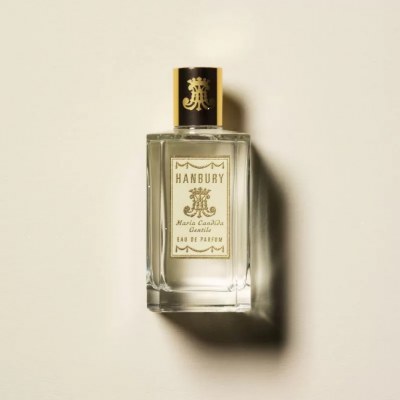
Hanbury is a place name before it is a fragrance. These are the Giardini Botanici Hanbury at La Mortola, on the Ligurian coast between Ventimiglia and the French border. Sir Thomas Hanbury, a British merchant, acquired an estate there in 1867 and, with the help of his botanist brother, turned it into one of the finest acclimatization gardens in Europe. It is to his daughter-in-law, Lady Dorothy Hanbury, who carried the work forward and received many notable guests, that Maria Candida Gentile dedicated this 2010 fragrance.
The intent is descriptive: to capture the air of a Mediterranean garden in spring, when the essences mingle and are stirred by the warm wind off the sea. The perfumer, Grasse-trained and devoted to a perfumery of naturalness, starts from a largely Sicilian citrus top, lemon, Brazilian bitter orange and Sicilian sweet orange, which sets the coastal light at once. True to her method, she works by slow maceration, in a vegan, cruelty-free formula free of phthalates and synthetic colorants.
The heart gives the fragrance its singular character. The lead note is calycanthus, a shrub whose flowers are at once fruity and spicy and seldom used in perfumery, paired here with honey and acacia. It is a floral, honeyed heart, a little wild, halfway between orchard and hedgerow flower. It gives Hanbury the “rebel” quality the house claims: a graceful bouquet, but one that does not seek to behave.
The base grounds the whole in noble greenery. Oakmoss brings a woody, faintly chypre depth, while Siam benzoin, a balsamic resin sometimes called Java incense, warms the trail. The house files Hanbury as floral, sometimes amber, and gives it as feminine. The composition, a citrusy floral over an oakmoss-benzoin base, allows both readings.
Fragrance notes
Hanbury reads like a walk through a garden, from the freshness of the citrus top to the mossy wood of the base.
The through-line is the Mediterranean garden: a citrusy floral that keeps its clarity even inside a woody, resinous base.
Scent profile
Hanbury opens on a bright, sunlit citrus top. Lemon and the two oranges give a coastal flash, rounder than sharp thanks to the sweet orange, which sets the light of the garden rather than a plain cologne freshness.
The heart makes the fragrance’s personality. Calycanthus, fruity, floral and faintly spicy, blends with honey and acacia into a honeyed, warm, slightly wild bouquet. It is an unconventional heart that owes its originality to this rare flower and gives Hanbury its grain of character.
The base signs the anchor. Oakmoss brings a woody depth and a discreet chypre thread, while Siam benzoin warms the foundation with a resinous softness. That footing explains the fragrance’s staying power and medium intensity, along with the “amber” reading the house sometimes gives it. The whole stays luminous, floral and clean.
Key characteristics
When and where to wear
Hanbury is a warm-season, daytime fragrance. Its citrus top and floral heart suit spring and summer, while the oakmoss and benzoin base let it hold into the shoulder seasons. The trail stays measured, in line with its medium intensity, luminous and floral.
How to wear it
Seasonal fit
| Season | Fit | Critical notes |
|---|---|---|
| Spring | ★★★★ | Its prime season. |
| Summer | ★★★★ | The citrus comes alive. |
| Autumn | ★★★☆ | The moss-benzoin base takes over. |
| Winter | ★★☆☆ | A touch bright in the cold. |
Context fit
| Setting | Fit | Usage recommendation |
|---|---|---|
| Everyday | ★★★★ | Its reference use. |
| Office | ★★★★ | Luminous and clean. |
| Garden | ★★★★ | Its natural terrain. |
| Evening | ★★★☆ | In mild weather. |
| Outings | ★★★★ | Fresh and floral. |
Similar perfumes
The citrusy floral over a mossy base has its neighbors; a few share its garden imagination.
| Perfume | House · year | Why it is close |
|---|---|---|
| Le Chèvrefeuille | Goutal · 2004 | A floral of citrus and hedgerow flower, springlike and luminous; a kinship of garden atmosphere, without the calycanthus or the mossy base. |
| Cristalle | Chanel · 1974 | A classic citrus chypre, oakmoss and citrus; the same hesperidic-chypre backbone, sterner than Hanbury’s honeyed heart. |
| Ninfeo Mio | Goutal · 2013 | A Mediterranean garden of citrus and fig tree; the same island clarity, in a greener register. |
Frequently asked questions
See also
Sources
- Official Maria Candida Gentile site, Hanbury page (Italian and English editions)
- Maria Candida Gentile training dossier, olfactory notes and maceration method
- Giardini Botanici Hanbury documentation (La Mortola, Ventimiglia), garden history
- Maria Candida Gentile, official Hanbury page
- Maria Candida Gentile, official Hanbury page, Italian edition (“Limone di Sicilia” on top)