Quick answers
History
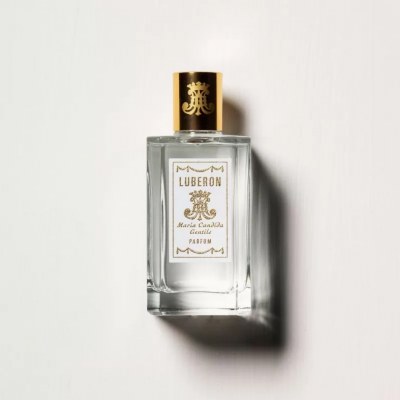
Luberon takes its name from the Provence range whose lavender fields have become an emblem. Launched in 2012 the fragrance is above all a tribute to Grasse, where Maria Candida Gentile trained as a master perfumer. The house presents it as an exercise in style: taking one of the most symbolic flowers of artistic perfumery, lavender, and reinventing it in an ultra-modern version, pure and bright.
The house, founded in 2009, practices an Italian niche perfumery attached to natural materials. Luberon gives a pared-down reading of it. Where lavender can slide into the cliché of a masculine cologne or a Provençal sachet, the perfumer draws from it an almost abstract floral clarity that she calls avant-garde, absolute and divergent. This is lavender revisited, dusted off, carried toward the light.
The lead material is lavender, set out in a spare pyramid: lavender absolute on top, May rose at the heart, oak moss in the base. Grasse-trained and faithful to naturalness, Maria Candida Gentile macerates her materials in alcohol, in a vegan formula free of phthalates, parabens and synthetic colorants.
One point deserves note: the house files Luberon under the fougère family, consistent with its lavender and oak moss axis, while describing it as a “delectable floral”. This double reading is not a contradiction but an editorial choice: the classic fougère, masculine and aromatic, is pulled here toward a floral purity. Luberon comes as a parfum, a high concentration, which explains its presence and its staying power.
Fragrance notes
Luberon reads in three movements, from the brightness of lavender to the mossy, woody depth of oak moss.
The through-line is lavender: an aromatic flower pulled toward floral purity, then anchored in a fougère oak moss.
Scent profile
Luberon is a daylight lavender rather than a sachet lavender. The opening is direct, aromatic and floral, without the camphor bitterness that weighs down so many lavenders. The clarity is dazzling: a lavender washed of its dust, carried toward the light.
The heart brings in May rose, which softens and feminizes the aromatic. This is where Luberon parts from the classic masculine fougère: the flower gives lavender a floral roundness, an absolute purity. The whole stays clean, transparent, unsweetened.
The base returns the composition to the fougère. Oak moss lays a woody, mossy floor, a little earthy, that anchors the lavender and gives it its hold. That structure explains the fragrance’s high intensity: a lavender bright on the surface, but with a foundation that makes it last.
Key characteristics
When and where to wear
Luberon is a daytime, warm-season fragrance, at ease in the shoulder seasons. Its bright lavender opens up in spring and summer, while the oak moss base gives it hold in cooler weather. Concentrated as a parfum, it calls for a light hand.
How to wear it
Seasonal fit
| Season | Fit | Critical notes |
|---|---|---|
| Spring | ★★★★ | Its prime season. |
| Summer | ★★★★ | The bright lavender opens up. |
| Autumn | ★★★☆ | The oak moss takes over. |
| Winter | ★★★☆ | Stays clean in the cold. |
Context fit
| Setting | Fit | Usage recommendation |
|---|---|---|
| Everyday | ★★★★ | Its reference use. |
| Office | ★★★★ | Clean and luminous. |
| Vacations | ★★★★ | Provence in a bottle. |
| Evening | ★★★☆ | In mild weather. |
| Sport | ★★★☆ | Fresh and clean. |
Similar perfumes
The author’s lavender has its neighbors; a few share the wish to lift the flower out of cliché.
| Perfume | House · year | Why it is close |
|---|---|---|
| Jicky | Guerlain · 1889 | The historic matrix of lavender in perfumery, aromatic and powdery; an obligatory reference of which Luberon offers a pared-down, contemporary reading. |
| Pour un Homme | Caron · 1934 | The classic masculine lavender-vanilla; Luberon takes the opposite tack, unsweetened and pulled toward the floral. |
| Fougère Royale | Houbigant · 1882 | The founding fougère, lavender and oak moss; a direct kinship of structure that Luberon modernizes toward purity. |
Frequently asked questions
See also
Sources
- Official Maria Candida Gentile site, Luberon page (Italian and English editions)
- Official Maria Candida Gentile presentation, master perfumer
- Maria Candida Gentile, official Luberon page
- Maria Candida Gentile, official Luberon page, Italian edition