Quick answers
History
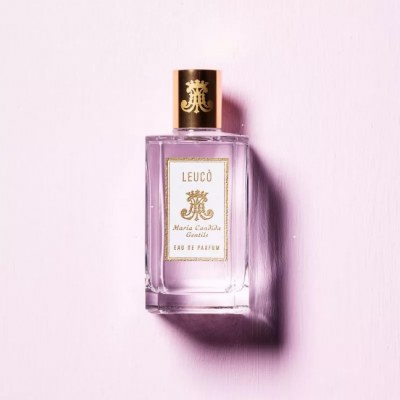
Leucò speaks of white, of light: the Greek leukos haunts the name, as it does the title of Cesare Pavese's Dialogues with Leucò. In 2014 Maria Candida Gentile makes it a white floral she describes as a call to transcendence, mystical and hypnotic. Leucò is part of the Calabroni triptych, alongside Syconium and Kitrea, each opening on a different honey, a tribute to the fragility of bees and insects and the ecosystem they sustain.
The perfumer trained in Grasse at the Ecole de Rure under Professor Carol André. She works only with natural molecules and macerates her raw materials in alcohol or olive oil, following the rhythm of the seasons. Leucò shows that naturalness through a complex white floral, where honey is no simple sugar but the keystone: a French ivy honey, green and faintly animalic, that gives the bouquet its depth and density.
On top, that ivy honey lays down a vegetal, almost waxy softness. The heart unfolds the white flowers: a lily accord, upright and powdery, and a tuberose absolute, carnal, heady, bewitching. The base leads to the sacred: Siam benzoin, a resinous balm, blends with frankincense for a warm, smoky, almost liturgical trail. Note that some enthusiast databases list a May rose; the official site does not, preferring the lily-tuberose pair, which we follow here.
Leucò belongs to the neuro-perfumery work the house developed with Professor Joachim Mensing of the University of Freiburg. On that reading, this floral relaxes the hippocampus, a brain area vulnerable to stress, and honey adds a sweet caress, a sense of a natural cocoon and total relaxation. The house lists it as feminine, of medium intensity, and holds it to a vegan formula, free of phthalates, parabens and synthetic colorants.
Olfactory pyramid
Leucò reads in three movements, from the green honey on top to the white flowers at the heart, and on to the frankincense and benzoin of the base.
The through-line is white light: a honeyed, carnal floral that rises toward a trail of frankincense and resin.
Olfactory profile
Leucò opens on a honey that is not sweet in the expected way. Ivy honey is green, waxy, faintly animalic: it lays down a vegetal depth rather than a gourmand note, and sets the stage for the flowers. It is a singular opening that signals a white floral with character from the first breath.
The heart is the peak of the fragrance. Lily, upright and powdery, brings the clarity; tuberose absolute, carnal and heady, brings the flesh and the spell. Together they draw a complex white, neither prim nor loud, whose honeyed density sets it apart from the more solar tuberoses on the market.
The base signs the sacred. Siam benzoin, resinous and balmy, blends with frankincense for a warm, smoky, almost liturgical trail that extends the flowers without weighing them down. That base explains the staying power and medium intensity of the fragrance, as well as its feminine listing, though the frankincense makes it less strictly gendered than it seems.
There are flowers with far more than a nice scent: they relax the hippocampus, an area vulnerable to stress. The fabulously complex Leucò is the most relaxing of them all; honey gives it an extra sweet caress, a sensation of being naturally cocooned, a dimension of total relaxation.Joachim Mensing, PhD
Key characteristics
When and where to wear
Leucò is a white-flower fragrance, at ease in the shoulder seasons and the evening. The honeyed lily and tuberose come alive in spring and autumn; the benzoin and frankincense in the base give it a warmth that also carries in cool weather and on dressed-up occasions.
Wear references
Seasonal fit
| Season | Fit | Critical notes |
|---|---|---|
| Spring | ★★★★ | The white flowers come alive. |
| Summer | ★★★☆ | Heady in full heat. |
| Autumn | ★★★★ | Honey and frankincense warm it up. |
| Winter | ★★★☆ | The resinous base carries it. |
Context fit
| Setting | Fit | Usage recommendation |
|---|---|---|
| Everyday | ★★★☆ | When you want flowers. |
| Office | ★★☆☆ | Sillage runs a bit present. |
| Evening | ★★★★ | Its natural terrain. |
| Occasions | ★★★★ | Dressed-up and elegant. |
| Intimate moment | ★★★★ | Carnal and bewitching. |
Similar perfumes
Honeyed tuberose and frankincense have their neighbors; a few share the white flesh or the resinous depth.
| Perfume | House · year | Why it is close |
|---|---|---|
| Carnal Flower | Frédéric Malle · 2005 | The great contemporary tuberose by Dominique Ropion; the same white flesh, greener and more solar, without Leucò's ivy honey or frankincense. |
| Tubéreuse Criminelle | Serge Lutens · 1999 | The mentholated, medicinal tuberose by Christopher Sheldrake; a kinship of heady white, in a harsher, more mineral register. |
| Passage d'Enfer | L'Artisan Parfumeur · 1999 | A milky frankincense and lily by Olivia Giacobetti; a neighbor through the white-flower-and-incense pairing, more transparent and diaphanous. |
Common questions
See also
Sources
- Official Maria Candida Gentile site, Leucò page (Italian and English editions)
- Official Maria Candida Gentile presentation, master perfumer (Grasse training, neuro-perfumery with Professor Joachim Mensing)
- Neuro-olfactory quote from Professor Joachim Mensing (University of Freiburg) for Leucò
- Maria Candida Gentile, official Leucò page
- Fragrantica, Leucò entry (2014)
- Parfumo, Leucò entry