Quick answers
History
Palissandre d'Or arrived in 2015, Alberto Morillas's interpretation of precious woods for Aedes de Venustas. The idea grew from a rosewood tree, Dalbergia sissoo, historically the primary rosewood species of northern India; the French word palissandre, redolent of intricate carvings and serene Asian groves, gave the perfume both its name and its direction. Morillas works in abstraction by choice: as he puts it, he cannot make overly figurative fragrances, because to him a perfume is a melody.
His reading is a milky light glowing through wood so polished it turns to silk. In his own view, it is the quintessence of his style, which he defines in three words: fluidity, transparency and power. Crystal-clear ambrette, a natural musk with rose, pear and iris facets, brightens cool spices of pink pepper, coriander and nutmeg; an intense heat of cinnamon then opens the heart to its secret, a rare sandalwood extract from Sri Lanka, made richer by copahu balm and a silken patchouli extract, with ambrox lending a warm, skin-like bark facet.
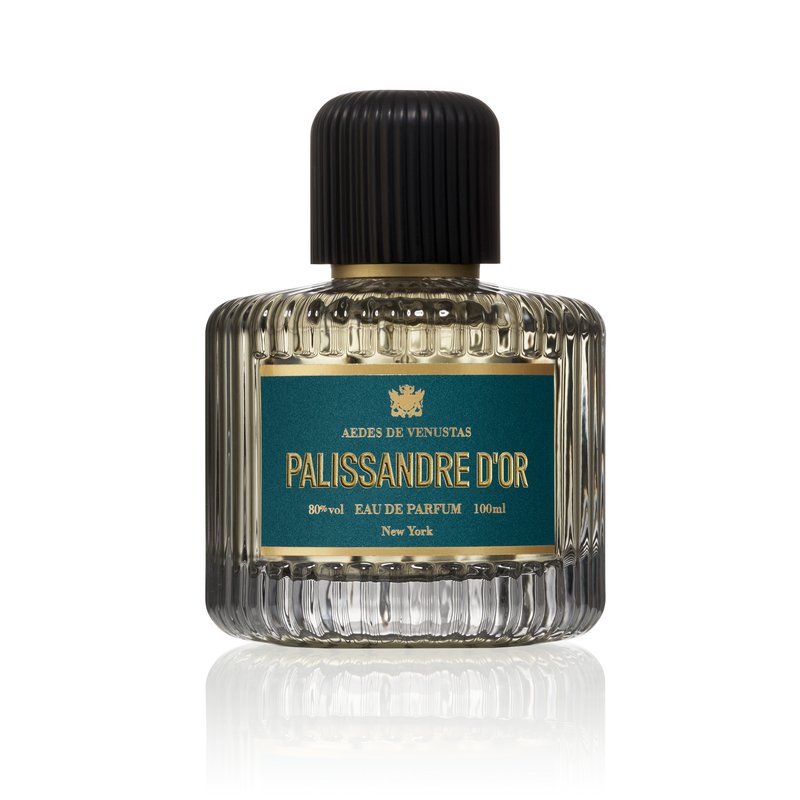
A bold trio of cedars adds structure: clean Virginian cedar for vigor, the Lapsang Souchong facet of Chinese cedar for subtlety, and Alaskan cedar for a Russian-leather smokiness. For the relaunch, Palissandre d'Or was transferred into the shared fluted bottle with peacock-blue accents and a matte black insignia cap.
Fragrance notes
The palette of Palissandre d’Or is a study in wood: a creamy, smoky, rose-tinged Sri Lankan sandalwood at the centre, a trio of Virginian, Chinese and Alaskan cedars for density, cool spice and a crystalline musk for clarity.
The palette brings together sandalwood, Virginian, Chinese and Alaskan cedar, coriander, copahu, ambrette, pink pepper, patchouli, nutmeg and cinnamon. The drydown stays creamy and tenacious.
Scent profile
Palissandre d'Or is a polished woody composition in the sandalwood register, abstract rather than literal. It belongs to the modern, transparent sandalwood school that Morillas helped define, closer to a luminous, creamy wood than to the old oily Mysore profile, and built so the facets shift from one skin to another.
The distinctive trait is the contrast Morillas describes as a monochrome: a single golden color and a dense, silken texture, lifted by the cedar trio so it never turns flat. It is wood as melody, smooth and full at once.
Key characteristics
When and where to wear
The creamy, polished woods of Palissandre d'Or carry across seasons, but they sit most comfortably in cooler weather and considered settings, where the sandalwood and cedar have room to bloom. It is an easy office-to-evening wood with enough signature to avoid blandness.
How to wear it
Seasonal fit
| Season | Fit | Critical notes |
|---|---|---|
| Spring | ★★★☆ | Cold spices and ambrette come through. |
| Summer | ★★☆☆ | The dense woods can feel heavy in real heat. |
| Autumn | ★★★★ | Ideal season for the sandalwood and cedars. |
| Winter | ★★★★ | The warm, spicy base carries perfectly. |
Similar perfumes
Palissandre d'Or sits in the modern transparent-sandalwood register, with neighbours among both house siblings and wider niche woods.
| Perfume | House · year | Why close |
|---|---|---|
| Grenadille d'Afrique | Aedes de Venustas · 2016 | House sibling, also signed by Morillas, in a darker woody key. |
| Santal 33 | Le Labo · 2011 | A reference point for the modern, transparent sandalwood that wearers cross-shop. |
| Oud Wood | Tom Ford · 2007 | A smooth, polished woods neighbour for the office-to-evening wearer. |
Frequently asked questions
See also
Sources
- Official Aedes de Venustas press kit (June 2026) · Document available on editorial request
- Now Smell This: Aedes de Venustas Palissandre d'Or coverage (accessed June 27, 2026)