Why Mitsouko matters in the perfumery canon
For American niche collectors, Mitsouko has never quite settled into a single category. It is at once a Belle Epoque relic and an industry milestone for the fruity chypre. The release came in 1919 under Jacques Guerlain, third in line at the family house after Pierre-Francois-Pascal and Aime Guerlain. Postwar Paris was rebuilding its perfumery export network, and the house at 68 avenue des Champs-Elysees was once again shipping abroad, as confirmed by the reference page.
The American press picked up on Mitsouko relatively quickly. By the mid 1920s, Guerlain had a presence in upscale Manhattan department stores, and the perfume began appearing in society columns as a signature scent for women who traveled to Paris. The transatlantic distribution gave Guerlain an early US foothold that few other Parisian houses could match.
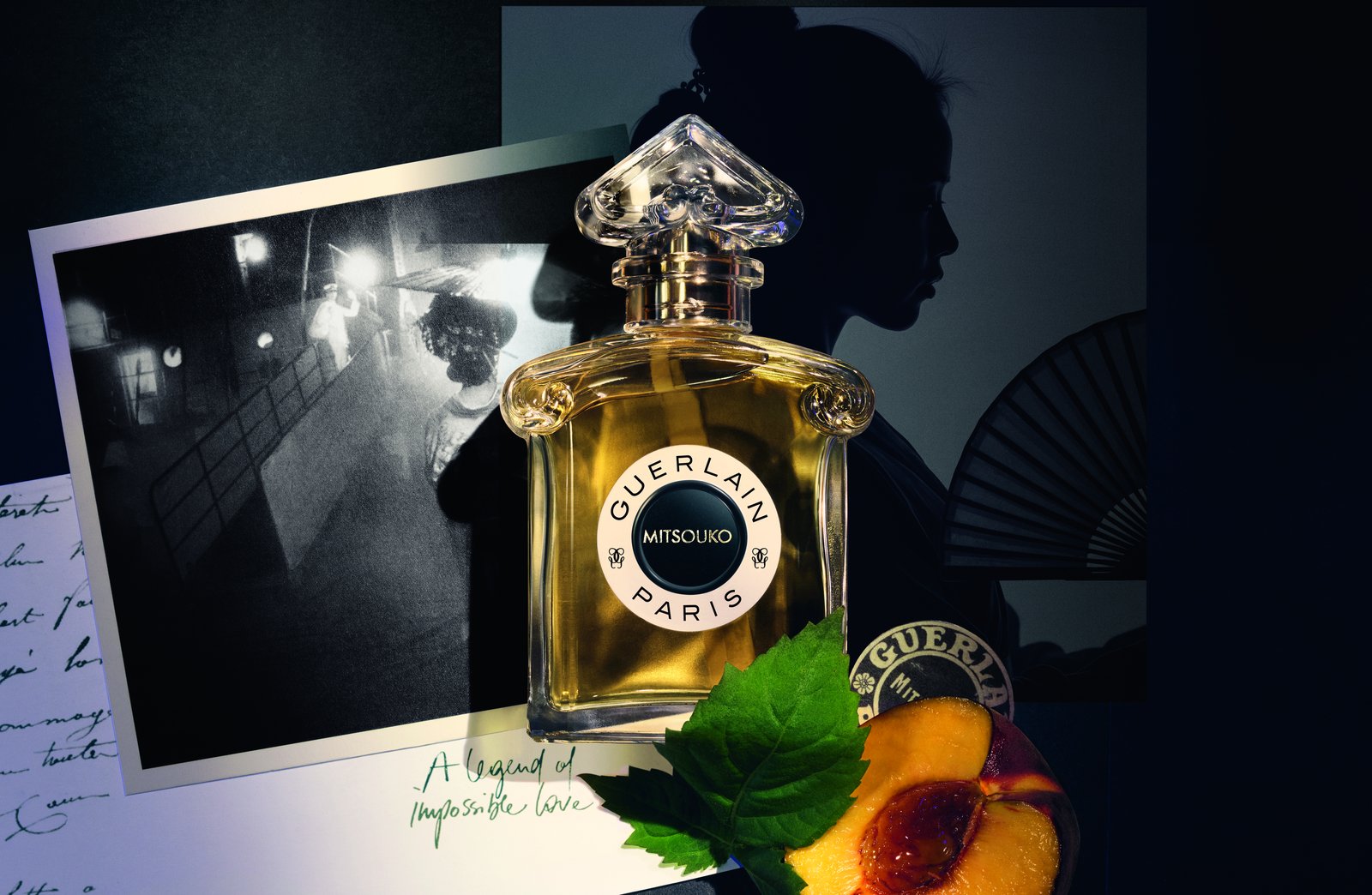
The name comes from a 1909 French novel, La Bataille, by Claude Farrere, a naval officer who happened to be a close friend of Jacques Guerlain. The story unfolds in Nagasaki during the Russo-Japanese War, with a Japanese admiral's wife named Mitsouko caught in a quiet, doomed attraction to a British officer. The book placed second at the 1909 Prix Goncourt and stayed in print long enough to keep the name familiar when the perfume launched ten years later.
The name itself carries a quiet linguistic puzzle that perfume writers have circled for decades. Mitsouko is the French romanization of the Japanese given name Mitsuko, usually written 光子 and meaning child of light, per the Behind the Name etymology record. Guerlain has long preferred the reading of mystery, tied to the alternate spelling 密子. Elena Vosnaki, on Perfume Shrine, treats the mystery reading as a marketing decision rather than a strict translation, and most US niche commentary follows that view.
How Jacques Guerlain rewrote Coty's chypre matrix
Mitsouko did not introduce the chypre family. That credit goes to Francois Coty, who released his eponymous Chypre in 1917 and codified the architecture US perfumery schools still teach today: bergamot up top, jasmine and rose at the heart, oakmoss and patchouli at the base, cistus-labdanum binding the whole thing. The Coty release was the industry milestone, and Mitsouko was the answer to it, two years later, from a competing Paris house that wanted to take the new category somewhere richer.
Jacques Guerlain reshaped the Coty template with two precise moves. First, he muted the animalic edge of the 1917 reference. Peach, jasmine and rose were added in proportions that draped over the moss instead of standing apart from it. Second, and this is the move that earned Mitsouko its place in every history of the genre, he installed a lactonic fruity note where the heart meets the base. That single insertion created the subcategory of the fruity chypre, the lineage that would later run through Femme by Rochas, Diorella by Christian Dior, and on into a generation of US-perception fragrances such as Tom Ford Black Orchid or Frederic Malle's later chypre experiments.
The published pyramid on a specialist site lists bergamot at the top, then peach, rose, jasmine and ylang-ylang at the heart, with vetiver, oakmoss, labdanum and spices at the base. Guerlain has never released the official formula, so the pyramids in les sites communautaires and un forum spécialisé are consensus reconstructions built from independent olfactory analysis. The structure on the skin tells the same story regardless of which database you read: bright citrus, warm fruit, then a long mossy fade.
What makes the architecture work is the absence of a hard seam between the three tiers. The peach extends the bergamot's brightness, and the moss starts speaking under the fruit instead of after it. American critics writing in the 1990s described the effect as a soft handoff rather than a stacked pyramid, which is part of why Mitsouko still reads as a turning point composition.
Gamma-undecalactone, the lactone that built a genre
The peach in Mitsouko is not extracted from any fruit. Natural peach essence is industrially unviable and would not survive a perfumery formula even if it were. The note comes instead from gamma-undecalactone, a synthetic material first prepared in 1908 by the Russian chemists Zhukov and Schestakow, as documented by Scentspiracy. The molecule was originally sold under the commercial label aldehyde C-14, a misnomer that has persisted in trade catalogs and US perfumery handbooks. Chemically it is a lactone, not an aldehyde, and the name confusion still shows up in some American training materials.
Mitsouko was not the first perfume to use the material. That credit belongs to Nuit de Chine, launched in 1913 by Maurice Schaller for Paul Poiret's Les Parfums de Rosine. What separated Jacques Guerlain's approach was the dosage and the framing. He used the lactone in a quantity loud enough to color the entire formula, then folded it inside a chypre base that softened the lactonic edge. American perfumery writers covering the centennial in 2019 described the effect as a fruit you wear rather than a fruit you smell.
The note delivers several facets at once: a lactonic warmth suggesting sun-warmed peach skin, a creamy quality close to dried coconut, a faint apricot acidity, and a long sustain. The combination links the citrus opening to the mossy base and gives Mitsouko a distinct tempo. Sylvaine Delacourte, formerly Guerlain's creative director, has discussed treating the lactone as a precious raw material rather than a synthetic shortcut.
The downstream lineage cements the molecule's status as a culturally pivotal scent technology. Edmond Roudnitska brought it forward in Femme by Rochas in 1944 and again in Diorella for Christian Dior in 1972. Later releases such as Yves Saint Laurent's Yvresse carry traces of the same lactonic decision.
The Bouchon Coeur flacon and US collectors
The original bottle for Mitsouko was not designed for it. The Bouchon Coeur flacon was drawn in 1911 by Raymond Guerlain together with Baccarat, originally intended for L'Heure Bleue in 1912 and the now-discontinued Fol Arome. Mitsouko inherited it from 1919 onward, as listed by the Guerlain historical flacon list. The prismatic glass body and the stylized heart-shaped stopper made the bottle one of the first Art Nouveau pieces of perfume packaging to reach Manhattan store displays in the 1920s.
Reusing the Bouchon Coeur for Mitsouko had a quiet symbolic logic. The heart sat at the center of Farrere's novel, which turned on a fidelity that could never be acted on. The flacon let Guerlain place that motif in plain view without making it explicit on the packaging. The bottle was produced over the years by Baccarat, then Pochet et du Courval, Verreries Brosse, Cristalleries de Nancy and Cristal Romesnil.
For American collectors, the Bouchon Coeur is now one of the most actively traded Guerlain pieces on the secondary market. Vintage extrait flacons from the 1920s through the 1960s appear regularly at Bonhams and Christie's, usually listed under 20th-century decorative arts rather than perfumery. Sealed prewar examples reach the highest prices.
The juice itself has a recognizable visual signature. In both extrait and eau de parfum versions, Mitsouko displays an amber tone with a green-yellow cast sometimes called chartreuse. The color comes from the natural absolutes and the cistus-labdanum used at relatively high concentration. The chromatic signature still helps the eau de parfum stand out on a Bergdorf or Bloomingdale's shelf today.
Transatlantic reception, from Saks to Luca Turin
Mitsouko reached US shelves through the standard Guerlain export channel of the 1920s. By the middle of the decade it was stocked at Saks Fifth Avenue and at other Manhattan luxury counters, and the American fashion press treated it as a Parisian import with a quiet, intellectual reputation. The Mata Hari rumor that often surfaces in centennial coverage, the claim that the dancer and convicted spy wore Mitsouko at her execution, is chronologically impossible since she was executed in 1917 and the perfume launched in 1919. The story still circulates anyway and tells us more about the perfume's mystique than about its actual history.
The critical reputation of Mitsouko in the English-speaking world rests heavily on the work of Luca Turin, a biophysicist who has written about the perfume since the 1990s. In Perfumes: The Guide, the 2008 book co-authored with Tania Sanchez, Mitsouko received a five-star rating and was described as one of the greatest compositions ever made. Turin has stated more than once that it is the single perfume he would take to a desert island, a line that has appeared in everything from The New York Times to British style magazines.
The institutional standing of Mitsouko is equally strong. The perfume is part of the teaching catalog at ISIPCA in Versailles, the school where many French and a number of US-based perfumers receive their formal training. It is also preserved at the Osmotheque, the international perfume conservatory founded in 1990 in Versailles, which holds the original formula as a piece of 20th-century olfactory heritage. Few perfumes have a comparable level of formal study and conservation behind them, and the combination matters for American collectors who want documented provenance.
The creative influence on modern perfumers is well documented. Octavian Coifan, on his blog 1000 Fragrances, regularly cites Mitsouko among the three or four matrix compositions any serious 20th-century perfumery student should be able to break down by ear. Sylvaine Delacourte has called it the fragrance that defines the house's chypre identity.
Reformulations, IFRA and the oakmoss question
No heritage perfume of this vintage avoids the reformulation discussion, and Mitsouko has become a teaching case for the way IFRA restrictions reshape a classic. The International Fragrance Association, the industry self-regulatory body founded in 1973, has issued successive amendments restricting allergens and sensitizers. American niche buyers tend to encounter this debate first through US blogs such as NowSmellThis or Bois de Jasmin, where the practical question is always the same: how much of the original 1919 character survives in the bottle you can buy at a Guerlain boutique today.
Oakmoss is the material most directly affected. The 43rd IFRA Amendment, published in 2008 and applied starting in 2009, kept the existing ceiling on oakmoss at 0.1 percent of the finished product but added a purity rule. The oakmoss used had to contain less than 100 ppm of atranol and chloroatranol, two molecules flagged as contact sensitizers. For Guerlain, that meant either purified moss extracts or partial substitution with treemoss, the same tradeoff every classical chypre on the US market has had to make.
Several reformulations of Mitsouko have happened across the 20th and 21st centuries. The 2006 reworking, discussed publicly by Sylvaine Delacourte in the perfume press, addressed the new European purity standards for oakmoss. Additional adjustments followed during the 2010s as the IFRA framework continued to evolve. Each pass attempted to keep the moss-and-peach signature intact while staying within the allergen ceilings used across the EU and the US.
The reception of these reformulations in the US niche community has been mixed. Vintage extrait bottles from the 1950s through the 1970s, with their richer moss base, command premium prices on the American secondary market. The current eau de parfum reads as more peach-forward and lighter on the moss, which some collectors call a softened version of the original architecture rather than a betrayal of it.
Mitsouko in the contemporary Guerlain catalog
Mitsouko now sits inside Guerlain's heritage range, Les Legendaires, alongside Jicky from 1889, L'Heure Bleue from 1912 and Shalimar from 1925. The grouping is meaningful for US niche buyers because it draws a clean line between Guerlain's century-old industry milestones and the seasonal releases that share retail space with them.
Three concentrations are available depending on the market: eau de toilette, eau de parfum, and extrait. The extrait, sold in the historical Bouchon Coeur flacon, holds the closest fidelity to the 1919 formula and is priced at the rare-piece tier. The eau de parfum is the most widely stocked format in the US and is the version most American buyers will encounter first. Pricing falls within the upper bracket of classical haute parfumerie, well above the everyday lines such as Aqua Allegoria.
The US distribution is intentionally narrow. Mitsouko is sold at Guerlain's standalone boutiques, at select Saks Fifth Avenue and Bergdorf Goodman counters, and through the official US e-commerce site. The perfume has stayed in continuous production since 1919, which puts it in a very small group of fragrances that crossed a full century without ever being discontinued. The peers in that group are equally narrow: L'Origan by Coty from 1905, Quelques Fleurs by Houbigant from 1912, and Jicky from 1889. Few American perfume buyers realize how short that list actually is.
Keeping Mitsouko in active production rather than treating it as an archive piece is part of what makes Guerlain different from peer houses that shelved their founding compositions during corporate consolidations. The same logic drives the L'Art et la Matiere collection launched in 2005. For American niche enthusiasts, Mitsouko functions as both a working perfume you can wear today and a benchmark in the perfumery canon.
Related
Sources
- Wikipedia: Mitsouko Guerlain, reference page (accessed June 5, 2026)
- Fragrantica: Mitsouko Eau de Parfum reference entry
- Fragrantica: Mitsouko Eau de Toilette 1919
- Parfumo: Mitsouko Extrait, detailed entry
- Guerlain: official Les Legendaires Mitsouko page
- Wikipedia: Claude Farrere, biography and works
- Bois de Jasmin: etymology of the name Mitsouko
- Behind the Name: Mitsuko, Japanese etymology
- Perfume Shrine: Guerlain Mitsouko review and history (Elena Vosnaki)
- Fragrantica: Mitsouko Centennial 1919-2019
- CaFleureBon: Mitsouko Centennial 1919-2019
- Scentspiracy: Gamma-undecalactone material profile
- Now Smell This: RIP, IFRA 43rd Amendment 2009
- Basenotes: timeline of IFRA oakmoss restrictions
- Nez Magazine: oakmoss, an exemplary case of IFRA's role
- Guerlain Perfumes Blog: list of historical bottles
- Sylvaine Delacourte: Jacques Guerlain, biography