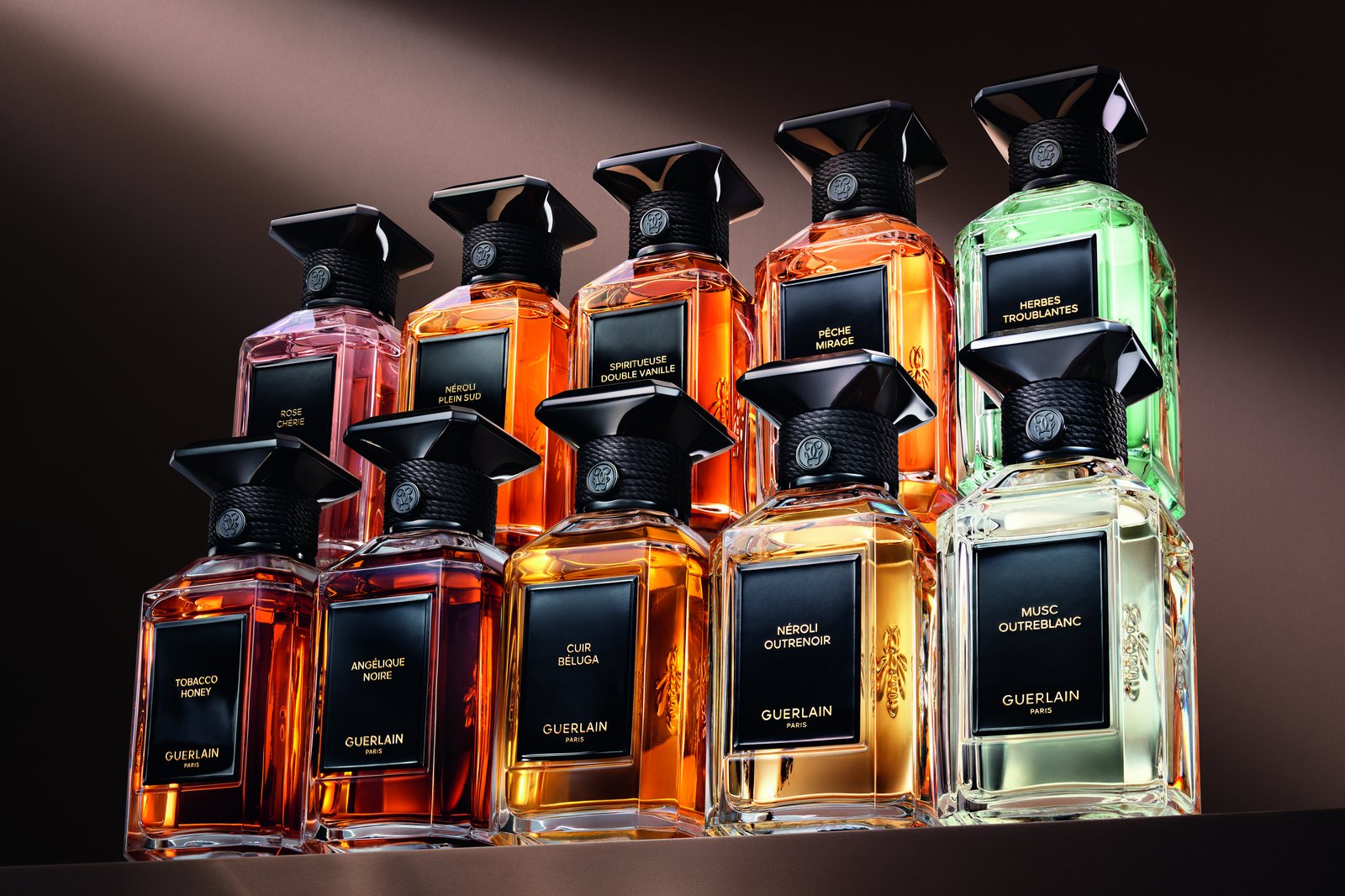
Genesis of the collection in 2005
In June 2005, Guerlain reopened its historical boutique at 68 avenue des Champs-Elysees in Paris (France) after a long renovation. The address is meaningful. The Guerlain family built the townhouse in 1914 with the architect Charles Mewes, who also designed the Ritz in Paris and the Carlton in London, and the building has served since then as the maison's flagship store, head office, beauty institute and museum. The reopening was also the moment the house chose to mark a creative rupture with its own mainstream catalog.
That rupture took the name L'Art et la Matiere. The new collection, launched together with the June 2005 reopening, was conceived as a haute perfumery line that would exist alongside the mainstream Guerlain offer. It explicitly borrowed the visual and editorial codes of what the trade had begun to call niche perfumery, a category occupied by houses such as Frederic Malle, Serge Lutens, By Kilian and Diptyque since the late 1990s. For Guerlain, whose last fully canonical rupture dates back to Shalimar in 1925 or to Vetiver in 1959, the goal was to colonize this territory without abandoning the Guerlinade identity that has structured the maison since 1921.
The artistic direction of the project went to Sylvaine Delacourte, who had been Guerlain's fragrance creation director since 2000. Delacourte is not herself a perfumer, but she assumed the role of curator. She selected the raw materials, drafted the briefs, invited the noses and held the editorial coherence of the project. In a 2009 interview with Perfume Shrine, she described the collection as a celebration of Guerlain's passion for the most precious raw materials, capturing the Guerlain essence in a resolutely modern way.
Three perfumes opened the collection in June 2005: Cuir Beluga signed by Olivier Polge, Rose Barbare signed by Francis Kurkdjian and Angelique Noire signed by Daniela Andrier. The choice of noses was deliberately external. Olivier Polge and Daniela Andrier were both working at independent composition houses; Francis Kurkdjian was already operating as a free-lance creator before he co-founded his eponymous house in 2009. It was the first time in modern Guerlain history that a haute perfumery project opened the studio to signatures from outside the family dynasty.
The principle of the single material
The intellectual architecture of L'Art et la Matiere rests on a principle that is simple to state and demanding to honor: each perfume is built around a single raw material, identified and claimed directly in the name. Cuir Beluga is a study of leather. Angelique Noire is a study of angelica. Rose Barbare is a study of the rose. Bois d'Armenie is a study of benzoin and the Armenian incense paper tradition. Spiritueuse Double Vanille is a study of Madagascan vanilla planifolia. The title is itself the brief, and the perfumer's task is to push the announced material into a personal, recognizable expression.
This principle places the collection inside a tradition that contemporary niche perfumery had popularized starting in the late 1990s. Serge Lutens had opened the path with Feminite du Bois at Shiseido in 1992, then with his eponymous house from 2000 onward, organizing each composition around a single dominant material. Frederic Malle had codified the perfumer's brief model when he launched Editions de Parfums in 2000, with the nose's name printed in large type on the bottle. L'Art et la Matiere borrows that grammar and translates it into the historical vocabulary of Guerlain. The material is not an authorial argument but an object of study.
The aesthetic consequence is visible in the compositions themselves. The pyramids of the collection often carry fewer notes than the mainstream Guerlain offer. The announced material occupies the center, supported by a minimal frame of secondary materials that extend it without masking it. This formal restraint is one of the distinctive markers of the collection, and it separates the eaux de parfum of L'Art et la Matiere from the opulent architectures signed Shalimar or Mitsouko in the classical catalog.
The single-material principle extends to the flacon and the presentation. The collection adopts the so-called bee bottle, a direct reference to the historical flacon designed in 1853 for Eau de Cologne Imperiale destined for Empress Eugenie. The bottle, decorated with the bees that have signed the maison since the Second Empire, signals belonging to Guerlain while visually isolating the collection from the rest of the catalog. The typographic gesture on the label, where the material name appears in sober serif, prolongs this editorial restraint that distinguishes haute perfumery from mainstream commercial fragrance.
The founding fragrances (2005-2007)
The inaugural trio of June 2005 immediately defined the tone. Cuir Beluga, signed by Olivier Polge, proposes a velvet leather organized around mandarin, immortelle, heliotrope and vanilla. It is a white leather, free of the assertive animal facets typical of the leather tradition, breaking with the masculine codes that had governed the category since the 1930s. The composition is documented on a specialist perfume site and on un forum spécialisé, both of which note the singularity of a gourmand-vanilla leather that anticipated an aesthetic that would later flood the 2010s niche market. Olivier Polge would later join Chanel as in-house perfumer in 2013, succeeding his father Jacques Polge.
Angelique Noire, signed by Daniela Andrier, is probably the most radical gesture of the inaugural trio. The perfumer, already recognized for her Prada Infusion d'Iris (2007), built around angelica a contrasted woody oriental: a touch of pear and pink pepper at the top, jasmine and caraway at the heart, vanilla, angelica and cedar at the base. The result is a dance of contrasts between the herbal bitterness of angelica and the lactic warmth of vanilla. The fragrance is regularly cited as one of Daniela Andrier's most accomplished haute perfumery works of the 2000s, and the composition is documented on a specialist perfume site.
Rose Barbare, signed by Francis Kurkdjian, is the most floral of the trio. The composition organizes the Damascena rose in a vertical orchestration, free of the sugar that characterizes mainstream oriental roses. Francis Kurkdjian, still working as a free-lance composer in 2005 before co-founding Maison Francis Kurkdjian with Marc Chaya in 2009, signs here a transitional piece between the classical rose of the maison and the refined aesthetic that would later define his own brand. The fragrance has remained available in the L'Art et la Matiere catalog as an eau de parfum.
In 2006, Bois d'Armenie, signed by Annick Menardo, joined the collection. The perfumer, known for Bulgari Black (1998) and later Lolita Lempicka, constructs a smoked woody fragrance that pays homage to papier d'Armenie, the strips of paper impregnated with benzoin that are burned to scent interiors in the Mediterranean tradition. The pyramid combines incense, iris and pink pepper at the top, benzoin, guaiac wood and coriander at the heart, copaiba balm, patchouli and white musk at the base, as documented on its a specialist perfume site record. The piece has since been discontinued in the main catalog.
In 2007, Spiritueuse Double Vanille marked a family return. The composition was signed by Jean-Paul Guerlain, the last active perfumer of the dynasty, who returned to the vanillic material that he had carried at the maison for fifty years. The pyramid combines incense, pink pepper and bergamot at the top, cedar, ylang-ylang, Bulgarian rose and jasmine at the heart, vanilla and benzoin at the base. The Madagascan planifolia vanilla is prepared through a cold-soaked tincture process of eighteen months, a Guerlain technique transmitted within the maison, and the formulation is documented on a specialist perfume site. It is the perfect realization of the single-material principle pushed to incandescence.
The evolution under Thierry Wasser from 2008
In 2008, Thierry Wasser became Guerlain's in-house perfumer, succeeding Jean-Paul Guerlain who stepped down after more than fifty years in the role. The transition was historically singular: for the first time since 1828, the chief perfumer of Guerlain did not carry the Guerlain name. Wasser, trained at Givaudan-Roure and later at Firmenich, arrived with fifteen years of experience at the major composition houses and a reputation as a rigorous technician and a passionate sourcing traveler.
For L'Art et la Matiere, Wasser's arrival shifted the operating paradigm. Artistic direction remained with Sylvaine Delacourte until her departure in 2016, but the new compositions of the collection were now mostly signed by the in-house perfumer rather than by invited noses. This internalization reflected an economic logic (royalty payments to outside noses are substantial) and a logic of identity (the maison wanted to consolidate its signature around a single recognizable author).
In 2010, Wasser signed Tonka Imperiale, the seventh fragrance of the collection, with its composition fully documented on a specialist perfume site. The pyramid combines bitter almond, rosemary and bergamot at the top, tonka bean, tobacco and jasmine at the heart, incense, cedar and pine at the base. It is a gourmand oriental built around the tonka bean of French Guiana, a historical Guerlain material that has belonged to the Guerlinade accord since 1921. The fragrance has since been discontinued in the main catalog though it remains available in selected distribution channels.
Other pieces were added during the 2010s, several of which have remained more confidential or were progressively withdrawn. The collection evolves through a rotation logic where some references are pulled to make room for new releases, distinguishing L'Art et la Matiere from the permanent collections of the mainstream Guerlain catalog where historic perfumes have remained in continuous production for decades. This rotation keeps the collection as an experimentation ground and avoids the museum-vitrine effect that sometimes freezes the haute perfumery lines of other historical houses.
The Outre series, 2016-2022
From 2016 onward, the collection expanded with a sub-series identified by the Outre prefix, which marked an aesthetic turn toward more monolithic and more contemporary compositions. Neroli Outrenoir, signed by Thierry Wasser and Delphine Jelk, was launched in 2016. The pyramid combines petitgrain, bergamot, mandarin, lemon and grapefruit at the top, tea, neroli, orange blossom, smoke and earthy notes at the heart, vanilla, myrrh, oakmoss, benzoin and ambrette at the base. The composition is formally inspired by the monochromes of the painter Pierre Soulages, whose work on the textures of black and reflected light structures the imaginary of the piece.
The Outre prefix functions as an identity marker within the collection. It signals that the announced material is pushed toward its olfactory reverse, toward its hidden or contrasted face. Neroli Outrenoir is not a solar classical neroli but a smoked neroli, soiled, captured in the dense matter of black tea and myrrh. This semantic inversion places the collection inside a recognizable signature grammar that would later be extended with new Outre releases.
In 2022, Musc Outreblanc joined the collection. The composition is signed by Delphine Jelk, the in-house Guerlain perfumer who thus consolidated her creative role within the maison. The pyramid combines white musk, neroli and ambrette at the top, iris, orange blossom and Bulgarian rose at the heart, milk, sandalwood and white amber at the base, as documented on its a specialist perfume site record. The perfume extends the Outre logic initiated by Neroli Outrenoir but inverts it: where Outrenoir pushed the material toward dark density, Outreblanc pushes it toward lactic transparency. This Outrenoir/Outreblanc polarity becomes an identity pivot of the collection.
The rise of Delphine Jelk as the principal signatory of the Outre prefix marks the consolidation of an in-house creative team. Alongside Thierry Wasser, she represents the new generation of Guerlain perfumers trained within the maison, in the continuity of a master-and-apprentice transmission that has structured French perfumery since the nineteenth century. This internal structure distinguishes Guerlain from niche houses operating through systematic external briefs and brings the collection closer to the model of historical houses with an internal school, such as Caron or Patou in their founding periods.
Positioning and distribution
L'Art et la Matiere occupies a singular position in the contemporary haute perfumery landscape. On the side of pricing, packaging and marketing, the collection aligns with the standards of haute perfumery. The eaux de parfum exist in 75 ml and 125 ml formats, and several pieces have been declined in extrait concentrations. The presentation remains sober, faithful to the Guerlain visual grammar, free of the visual escalation that characterizes some contemporary luxury collections.
On the side of distribution, the collection is deliberately restricted. The 68 Champs-Elysees remains the historical and exclusive showcase. Distribution then extends to a selection of Guerlain boutiques in global capitals (Paris, New York, Tokyo, London, Dubai, Shanghai), to certain corners in high-end department stores, and to the official Guerlain online boutique. This selectivity distinguishes L'Art et la Matiere from the rest of the Guerlain catalog, which is present across broad selective fragrance distribution throughout Europe and North America.
The logic of exclusivity prolongs what the trade calls house exclusives, as opposed to broad distribution collections. The collection thus belongs to a family that includes Les Exclusifs of Chanel (launched 2007), Le Vestiaire des Parfums of Yves Saint Laurent (launched 2015) and La Collection Particuliere of Dior, all haute perfumery lines carried by mainstream luxury houses that reserve themselves a freer, more refined creative space under restricted distribution.
The positioning also serves a strategic function for Guerlain. It allows the maison to claim presence on the territory of niche perfumery, whose market share moved from approximately 4% to approximately 12% of the Western fine fragrance market between 2005 and 2020, according to industry estimates. By colonizing this segment as early as 2005, Guerlain anticipated a movement that would later generalize across all the major historical houses. The collection is cited today as one of the first successful experiments of a classical maison on the territory of author-driven haute perfumery.
Twenty years after its launch, L'Art et la Matiere has preserved what made its originality in 2005: the creative freedom granted to the perfumers, the formal restraint of the compositions, the strict respect for the announced material. The catalog losses (Bois d'Armenie, Tonka Imperiale, Iris Ganache) are sometimes regretted by enthusiasts, but the rotating format is part of the project's DNA. The founding pieces such as Cuir Beluga, Angelique Noire, Rose Barbare and Spiritueuse Double Vanille remain in the catalog, and the Outre series extends the collection into the olfactory vocabulary of the 2020s. In this regard, the collection is one of the rare niche-style experiments carried by a historical house that has lasted two decades without losing its founding editorial coherence.
See also
Sources
- Guerlain: official L'Art et la Matiere collection page (accessed 5 June 2026)
- Guerlain: 110 years of 68 Champs-Elysees (accessed 5 June 2026)
- Perfume Shrine: interview with Sylvaine Delacourte, art director of Parfums Guerlain (2009)
- Sylvaine Delacourte: L'Art et la Matiere, sublimating rare essences
- Fragrantica: Cuir Beluga 2005, Olivier Polge
- Fragrantica: Angelique Noire 2005, Daniela Andrier
- Fragrantica: Bois d'Armenie 2006, Annick Menardo
- Fragrantica: Spiritueuse Double Vanille 2007, Jean-Paul Guerlain
- Fragrantica: Tonka Imperiale 2010, Thierry Wasser
- Fragrantica: Neroli Outrenoir 2016, Thierry Wasser and Delphine Jelk
- Fragrantica: Musc Outreblanc 2022, Delphine Jelk
- Basenotes: Angelique Noire 2005 entry
- Parfumo: Angelique Noire 2005 entry
- CaFleureBon: Cuir Beluga review by Olivier Polge