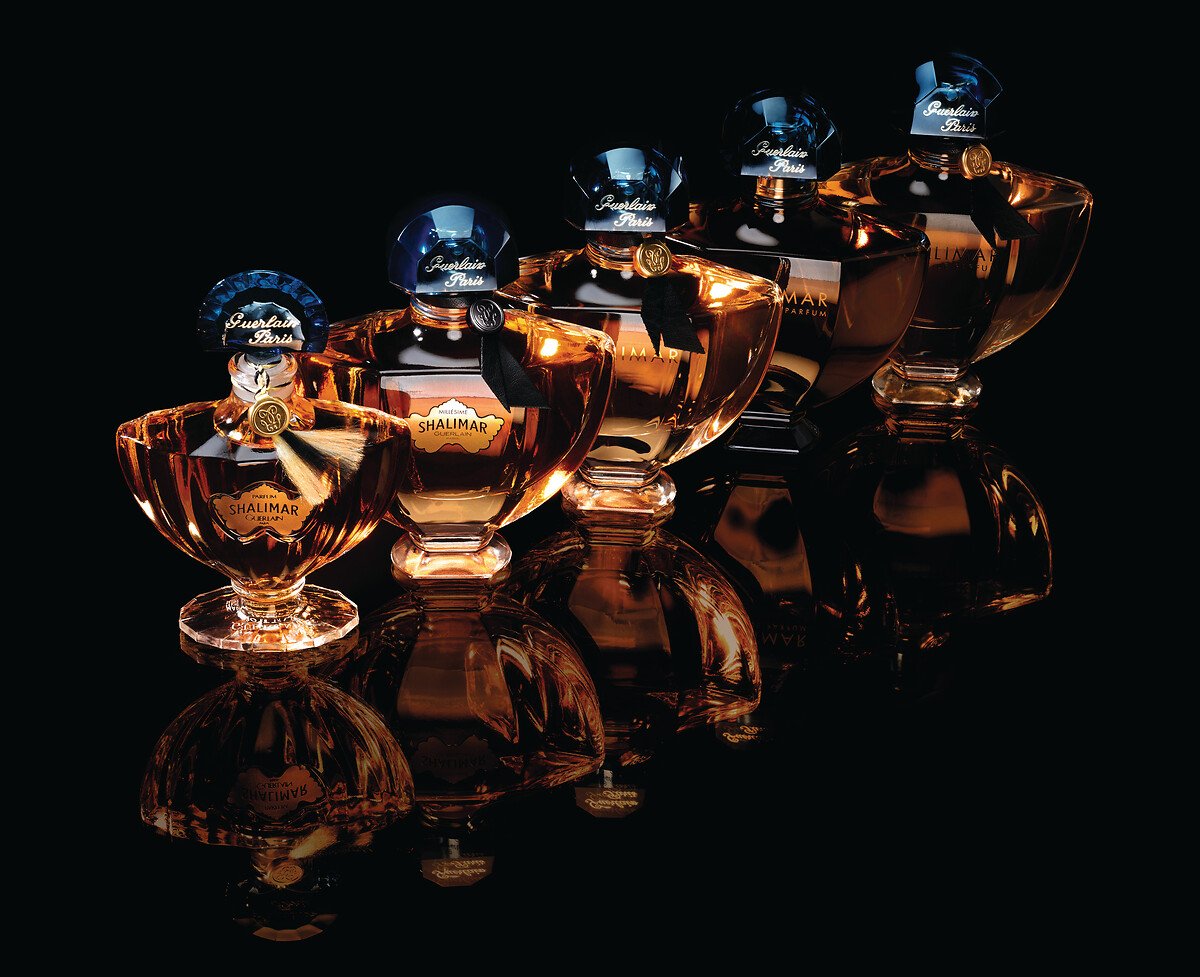
A debut at the Paris Art Deco fair
The Paris exhibition that ran from April through October 1925 was the trade fair that gave the world Art Deco as a label. American visitors crossed the Atlantic by the thousands for it, and the US fashion press treated the event as a survey of European luxury craft. Inside the perfumery pavilion, Guerlain presented Shalimar for the first time, even though Jacques Guerlain had completed the composition four years earlier in 1921.
The launch context shaped the perfume's early American reception. Visitors at the fair could see Raymond Guerlain's bottle on display next to other haute parfumerie pieces and could buy a flacon to bring home. American buyers who attended that summer carried Shalimar back to New York and Chicago, where it began appearing in upscale department stores within months. The perfume entered the US market with the unusual advantage of being already endorsed by a high-profile international jury.
To understand why Jacques Guerlain went this direction, US readers need the Guerlain backstory. Aimé Guerlain had released Jicky in 1889, generally credited as the first perfume to put synthetic molecules into a pyramidal structure. His nephew Jacques absorbed that toolkit and pushed it further with Mitsouko in 1919, then took the next leap with Shalimar.
The origin story Guerlain has told for a century, repeated in nearly every English-language profile, is that Jacques was working with a sample of Jicky in his Courbevoie lab and on impulse added a large dose of ethyl vanillin, then a recent synthetic. The result startled him enough to develop it as a standalone perfume. The story appears in Guerlain's own communications and in long-form English coverage on Perfume Shrine by Helg Kotsopoulos.
Mughal source material and the name decision
The name points to a real place: the Shalimar Gardens in Lahore, a Mughal-period Persian garden complex built in 1641 under the emperor Shah Jahan and listed by UNESCO since 1981. American readers usually encounter the gardens first through the Taj Mahal connection, since both monuments belong to the same imperial project. Guerlain's house story has Jacques meeting a maharajah in Paris who described the gardens and the emperor's grief, an account preserved in the house archives and on the official Guerlain Shalimar page.
The historical layer behind the perfume is worth pinning down. Shah Jahan was the fifth Mughal emperor, ruling the subcontinent from 1628 to 1658. His favorite wife, Arjumand Banu Begum, known as Mumtaz Mahal, died in childbirth in 1631. He commissioned the Taj Mahal in Agra to hold her tomb. The Shalimar Gardens were laid out a decade later in Lahore as a paradise garden organized into four quadrants, the classical Persian chahar bagh form.
The decision to name the perfume Shalimar rather than Taj Mahal is the kind of editorial move that gets quoted in US niche columns. Jacques Guerlain reportedly preferred the garden over the tomb because the gardens stood for living love rather than mourning. American writers covering the centennial in 2025 leaned heavily on this distinction, which fits the way US niche buyers tend to read heritage fragrances as biographical artifacts.
The Mughal reference is not limited to the name. Raymond Guerlain anchored his bottle design in the reflecting pools of the Lahore gardens, with the sapphire stopper standing in for nocturnal water and the flared body echoing the curves of the basins. The result is one of the most narratively coherent perfume objects of the 1920s, where composition, name and packaging all point in the same direction. That coherence is part of why Shalimar still gets cited as a benchmark in the perfumery canon by US niche critics today.
Ethyl vanillin as a turning point composition
The chemistry behind Shalimar starts well before 1925. Vanillin had been isolated in 1858 by the French pharmacist Nicolas-Theodore Gobley and then industrially synthesized in 1874 by the German chemists Wilhelm Haarmann and Ferdinand Tiemann from coniferin, a glucoside found in conifer bark. The Haarmann factory in Holzminden, Germany, was scaling vanillin production by 1875, which is one reason American perfume historians treat the late 19th century as the real starting point of synthetic perfumery.
Ethyl vanillin is a separate molecule, first synthesized in 1894. The relevant fact for US niche readers is potency. At the same concentration, ethyl vanillin reads three to four times stronger than natural vanillin, with a creamier and longer-lasting character. American flavor and fragrance manuals still treat it as the high-impact analog of choice. The Sylvaine Delacourte English-language overview remains a useful reference for US readers who want the numbers.
Jacques Guerlain's decision was to use ethyl vanillin not as a seasoning, which was the standard 1920s practice, but as the backbone of the perfume. Shalimar uses ethyl vanillin at a dose no perfumer had risked before. The molecule carries most of the sillage on its own, which is why English-speaking critics still call the formula a turning point composition. Before Shalimar, vanilla was a trace accent; after Shalimar, it could carry an entire formula.
The Jicky connection is the part of the story American niche readers tend to enjoy most. The 1889 release already combined bergamot, lavender and vanillin with synthetic coumarin. Jacques Guerlain extended the same syntax with a larger ethyl vanillin dosage, which is exactly the kind of incremental, family-internal evolution the house would later formalize as the Guerlinade, the identity accord that runs through every Guerlain composition.
How the modern oriental family was codified
The pyramid Jacques Guerlain landed on for Shalimar is the structural blueprint US perfumery courses still teach as the amber oriental archetype. The top runs heavy on Calabrian bergamot, with lemon and mandarin reinforcing the citrus cocktail, which puts the opening in stark contrast with the floral and aldehydic launches of the same period. That contrast between bright top and warm base is what perfumers describe as a polarized structure, and it remains a default model for the genre.
The heart layers Grasse jasmine, May rose and iris over the first base notes. Iris brings the powdery dimension that has been part of Guerlain's house signature since Jicky. Jasmine and rose keep the heart breathable and stop the base from feeling heavy. That transition zone between citrus and vanilla is where the formula's balance lives, which is also why reformulating Shalimar under modern allergen rules is technically harder than it looks.
The base carries the oriental identity on five main materials: ethyl vanillin, tonka bean, opoponax, an amber accord, and animalic notes that originally included civet and animal musk. Ethyl vanillin runs the show in dose. Tonka contributes its coumarin almond-and-hay nuance. Opoponax, a Commiphora gum-resin, brings the balsamic and slightly smoky element US niche reviewers tend to flag first. The amber is a reconstituted accord built on benzoin, labdanum and vanilla. The animalic side, originally responsible for the perfume's sensual reputation, has been swapped for synthetic musks across the reformulation cycles.
The result is the structural template the industry now calls the modern oriental or amber oriental. Before 1925, the category did not exist as a working label. Perfumers made opulent compositions and isolated vanilla studies, but no codified family. Shalimar provided the template: bright citrus top, floral heart, balsamic vanilla base, with built-in contrast between light and dark. That template carried through Habanita by Molinard in 1921 to Opium by Yves Saint Laurent in 1977, and it still shows up in US-perception releases such as Tom Ford's Tobacco Vanille.
The Baccarat bat bottle and US collectors
The Shalimar bottle is the work of Raymond Guerlain, Jacques's nephew. Baccarat manufactured the original run in 1925 under internal reference design #597. The shape, nicknamed the bat bottle in American perfume circles because of the flared stopper that resembles spread wings, draws its lines from the reflecting basins of Persian gardens, specifically those at Lahore. The reference is documented by Guerlain and by the design archive Design is Fine.
Two innovations made the bottle stand out at the 1925 fair and continue to make it stand out on American auction floors today. The first is the colored stopper. The sapphire blue is the first colored stopper on a major-house perfume bottle, in an industry that had standardized clear crystal. The blue worked as instant brand recognition on a counter and still does in any Bergdorf or Saks display today.
The second innovation is the shape itself. The body sits on a narrow base and opens into wide shoulders, a profile that broke with the cylindrical flacons and coffret bottles of 1920s luxury perfumery. American Art Deco collectors recognized the silhouette as a signature design within months of the 1925 launch. The bottle won the first prize of the perfumery class at the International Exhibition of Decorative Arts, which secured its standing as a design object rather than mere packaging.
Manufacturing has moved across several glassmakers. Baccarat handled the original production in 1925, then Cristal Romesnil and later Pochet et du Courval took over at different points through the end of the 1970s. Original Baccarat bottles engraved with the cristallerie mark are now among the most sought-after Guerlain pieces in US vintage perfume auctions, often listed alongside Lalique flacons under decorative arts categories.
A century of reformulations under IFRA
A century in, Shalimar is still one of the highest-volume luxury fragrances in the world and a central asset for the Guerlain catalog. That longevity comes with a technical cost. To stay compliant with EU and US allergen rules, the perfume has been reformulated several times since the 1960s, and US niche commentary has tracked each pass closely.
Bergamot is the first pressure point. The IFRA, the industry self-regulatory body, began restricting unrectified bergamot in the 1990s because of bergapten, a furocoumarin that causes photosensitization. The bergamots now used in fine perfumery are decolorized and dearomatized to remove bergapten, and the change is audible. When the top of a perfume is built on bergamot at a heavy dose, like Shalimar, a quieter bergamot reads as a quieter perfume.
Oakmoss is the second pressure point. IFRA started restricting oakmoss in 1988 because of atranol and chloroatranol, two allergens that can trigger contact dermatitis. By 2001 the ceiling sat at 0.1 percent. Shalimar's base originally leaned on a quiet chypre tonality where vanilla, amber and oakmoss met, and that velvety depth has thinned considerably.
Animal-derived materials are the third pressure point. Civet and animal musk, both in the original formula, have left the contemporary composition under a combination of IFRA rules, US import restrictions and animal welfare standards. Synthetic musks now stand in for the original animal notes, which softens the base that gave the perfume its sensual reputation. Birch tar, which used to bring a smoky thread to the base, has also been pulled for toxicity reasons.
Even with these changes, Shalimar still reads as Shalimar. Guerlain has run each reformulation through the in-house master perfumer of the moment, Jean-Paul Guerlain until 2008 and Thierry Wasser since, with a strict brief to keep the original silhouette recognizable. Vintage hunters work the US secondary market for the older versions, but the current eau de parfum is still considered by most American niche reviewers as one of the strongest available expressions of the amber oriental family.
Shalimar in the US market today
The current Shalimar lineup carries three main concentrations: the parfum extract in the historical bat bottle, the eau de parfum in a contemporary urn bottle, and the eau de toilette. Around them sit the flankers Guerlain has released over the last two decades, including Shalimar Souffle de Parfum, Shalimar Cologne, and the Philtre de Parfum collection. The flanker strategy targets younger American buyers without thinning the archetype, a balance very few mass-luxury houses pull off this consistently.
Critical standing in the English-speaking world is unusually solid. Shalimar shows up as a reference in nearly every American perfumery education text, from Perfumes: The Guide by Luca Turin and Tania Sanchez to the academic work of Elisabeth de Feydeau translated for US readers. It functions as the comparison point for any new amber oriental review, and its influence is audible in compositions as distant as Habit Rouge by Jean-Paul Guerlain in 1965, Opium by Yves Saint Laurent in 1977, and Tobacco Vanille by Tom Ford in 2007.
For Guerlain, Shalimar is a load-bearing asset. Together with Mitsouko, Jicky, and L’Heure Bleue, it forms the quartet that anchors the house's historical standing. The Guerlain perfumes collection on Osmetheca documents this lineage, and the detail page sits at the Shalimar profile.
A hundred years on, Shalimar still holds the archetype slot for the amber oriental family. Its bergamot-iris-ethyl-vanillin structure runs through every later release in the category. Very few perfumes can claim heritage status, century-long commercial success, and a structuring influence on a whole olfactory family. Shalimar is one of them.
See also
Sources
- Guerlain: official Shalimar page (accessed June 5, 2026)
- Wikipedia: Shalimar (perfume) entry
- The Fragrance Foundation France: history of a mythical perfume, Shalimar by Guerlain
- Fragrantica: Shalimar Guerlain, a 100-year-old legend
- Perfume Shrine: Shalimar by Guerlain, review and history
- Sylvaine Delacourte: Shalimar, the history of a legend
- Sylvaine Delacourte: vanilla and vanillin in perfumery
- ChemistryViews: Wilhelm Haarmann (1847-1931) and the vanillin synthesis
- Wikipedia: Ferdinand Tiemann, co-synthesis of vanillin
- Design is Fine: Raymond Guerlain and Baccarat, the 1925 Shalimar bottle
- Kafkaesque: vintage Shalimar parfum guide (1950-1980)
- Kafkaesque: vintage Shalimar guide, bottles
- Delacey Place: IFRA reformulations and oakmoss
- India.com: Mughal inspiration of Shalimar, Shah Jahan and Mumtaz Mahal
- Elisabeth de Feydeau: Guerlain Shalimar 1925