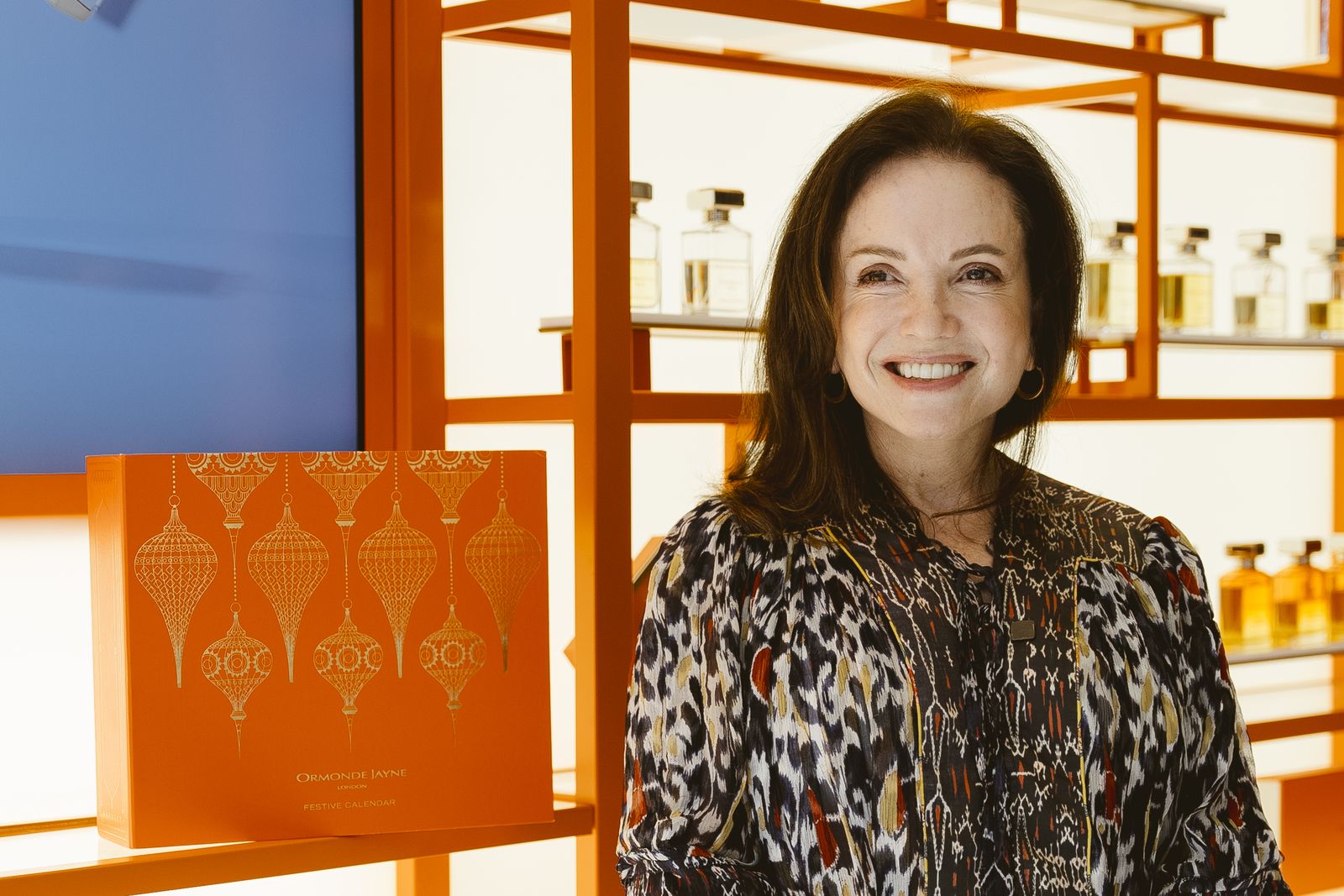
Twenty-five years, from making candles for Chanel to an independent house sold around the world: looking back, what surprised you most?
I wouldn't call it surprise so much as gratitude. I'm grateful that the world of perfume is open today. In the past you needed a big investment, but above all you needed connections, or some tie to a house in Grasse. A lot of the perfumers there are related. The trade passes down from one generation to the next, and nepotism is common. I had none of those contacts, and I was able to get into that world and become part of it, without too much difficulty. I'd never have been able to do any of this without the internet.
I had lots of books, the ones you study perfumery from, starting with Poucher. The formulas were full of molecules and synthetic ingredients I knew nothing about. I had another book, fortunately, that gave the long list of those materials and told you, for each one, what it was. Everything was broken down.
Then I had to get hold of them, and I had nobody to ask for samples. Calling the houses in Grasse was out of the question. They weren't going to start sending me bottles. I was nobody in this trade. It was through the internet that I found people in Paris who actually had some of these materials. They charged a lot and never sold less than a hundred millilitres, but at least they sold them to me.
Everything else still had to be done: a studio, an alcohol licence, filtering machines, and understanding what it means to be a manufacturer yourself. That was quite complicated, because it was very time-consuming. Then, by luck, one day a man came into my boutique. He wanted to use my alcohol licence and my studio. That was Geza Schoen, a perfumer, who had studied at Haarmann & Reimer. He had left because he wanted to create something himself and they wouldn't allow him. He lived five minutes from my studio, and he asked whether he could come and work there. Of course I said yes.
Each of us brought what the other didn't have. Mine was the technical side of the trade, which I'd taught myself: how you filter a perfume, where you get the bottles, how you organise a crimp machine. He came to the party with formulations. When I put my idea to him, working with materials nobody else was using, he wondered why I wanted to make it more complicated. I told him this was what felt right for me.
Geza and I helped each other for two years, and ultimately he introduced me to Expressions Parfumées. They invited me out to show them what I'd been doing, and they agreed to back me because they were a family-run business too. I've been with them for twenty-five years. Every year they send me new oils, and every year they come to see me at the studio. I've had five studios since the beginning. The last one is in Kent, enormous, the sort of place where you park aeroplanes.
I've managed to do this journey over twenty-five years and stay independent. And I was very lucky that the niche movement started to take off just then. Before that it was very difficult to find a place if you weren't connected, or from Grasse, or French.
Ormonde Jayne is known for using materials the perfume industry hardly ever uses. How does a perfume take shape in your mind?
I did a lot of travelling, and I ended up with an ice cream shop where you wouldn't find strawberry, chocolate or vanilla. It was always cardamom, or nutmeg. This was a long, long time ago. I won't tell you how long, because then you'd guess my age.
When I went into perfumery, I wanted to use the same philosophy. From my travels I still had little oils, things like oud, different attars, Ta'if oils. I also had a bottle of champaca oil. Nobody really had a perfume built on it, and I saw a good point of difference there. Christian Dior had the tiniest amount in one of theirs, whereas I wanted to use it as the main ingredient.
When I got to Expressions Parfumées, they said to me: this philosophy of yours, using unusual ingredients, has a name, we call them specialty oils. They keep a list of them. Big houses can't use them because not enough oil is produced, but somebody my size can. They sent me their list straight away, by fax, as you did in those days.
The first one on the list was black hemlock, which I thought marvellous. I love the idea of it, because of the connotation: Socrates drinks hemlock and dies. I used it to launch Ormonde Woman, our signature scent, and Champaca, Tolu and Frangipani followed. Expressions Parfumées and Geza Schoen were brilliant at helping me.
Because nobody was working with these materials, people began to talk about us. They came into the boutique to ask me what oud was, or champaca. I'd show them pure oud, which is really not very nice, even though I like it myself. They also wanted to know how I had used it, and where I had found it. It was a very exciting time, having that idea and finally being able to make it.
In twenty-five years, which perfume was the hardest to get right?
There are perfumes we've never launched because they're not good enough. Our Casablanca Lily candle is very successful, but every time I tried to make it into a perfume, within two or three minutes it smelled of nothing but lilies, and I don't want a perfume that smells of a single flower. That's one I never managed to bring to market.
Others were hard to compose, and some even became impossible to carry on with. Tiaré, my Tahitian gardenia, was very difficult, and today I can't even make it: the one man who grew those gardenias has stopped. Black Gold was no easier, and it would have to be restructured now that lilac and other materials are no longer allowed. We don't sell them any more. We tried to bring them back, but the smell had changed.
If a perfume no longer smells as it did, I won't put it back on the market. Too many clients say it's not the same, and I don't want to upset them. I'd rather take the formula, let it go in a different direction and give it a new name, and tell clients it's different and they may well like it. We never keep the original name, because that's what upsets everyone the most.
Of the perfumes still on sale, the hardest to get right was probably Ormonde Woman, our signature scent. Making it the centrepiece of the house took a long time, but we got there. It's considered a classic now, and it has won accolades, including one saying it has stood the test of time. I'm very proud of it. That's my proudest moment, along with Ormonde Man.
You have just launched the Four Corners of the Earth Reimagined collection. How did it come about?
For five or six years we brought out limited editions at the start of every year, for our top clients and our top partners around the world. It was called the Montabaco series, after one of our best sellers, and we composed several variations, notably Montabaco Cuba, Montabaco Aruba, Montabaco Rio and Montabaco Flor. It became hugely successful, but if you do the same thing over and over you end up wanting to change and do something new.
When I told my team that I was going to stop, they took it very badly. They told me the series was in great demand, and they couldn't see how to make up for losing it. I promised them I'd find something else. That was easier said than done. Reimagined came out of that, out of the gap I had to fill.
Coming out of your own habits isn't so simple. You always end up composing the way you usually compose, and falling back into the style of the house, the one you know and love.
Then one morning on the radio I heard David Bowie talking about how he writes a song. He cuts up sentences, film titles, everything he loves, he puts them on the table, he picks a few out and builds the song around them. I thought that was a good idea and that I'd do the same. I made up two boxes. In the first, the things that mean something to me: films, places, things close to my heart. In the second, some thirty materials available to me that I happen to like. I'd draw a slip of paper, then three materials, write them down, and stick to it. After that, of course, I had to look for the other materials that go nicely with those.
Oud Liaisons came off the film Dangerous Liaisons, which I like very much. I could have taken the whole title, but I prefer the word liaison. The materials that came out were the oud, then liquorice, lemon and rose. It gave me a foundation to work from, and that was essential. Once I knew how to do it, I could use the same format for the other perfumes in Reimagined.
You worked with three different perfumers for this collection. How do you choose a perfumer?
They are all perfumers from Expressions Parfumées, which is owned by Givaudan now, and their way of working has changed a great deal. In the past the perfumer worked alone at his perfumer's organ, in a room of his own. There, everything now happens in one great big room, where people walk from one desk to another to talk. The spirit is very open-minded.
When I go to see them in Grasse, the whole team is sitting around the table. I discuss the idea, the notes, how I want it to smell. One of the perfumers may say they have an idea, that they would like to take it on and will send me samples.
Because we've been with Expressions Parfumées for twenty-five years, they know the palette and the style without my having to describe them. Our repertoire isn't that big: something between a hundred and seventy and two hundred and twenty materials, which we use all the time. It's not thousands. We don't publish them all, but some of them make up what I call the Ormonde Jayne accord, the one that makes a perfume smell of the house: freesia, magnolia bud, hedione. They are in nearly every formula, and these three perfumers know it perfectly well.
I'm not looking for new perfumers. A lot come to me, but they don't understand the palette: they recommend magnificent perfumes that aren't mine. I no longer waste their time. I tell them I'm very happy where I am.
Do your materials come from Expressions Parfumées, or do you look for them yourself as well?
Both. I look for my own materials, but I compose only with Expressions Parfumées. I did work for a time with IFF (International Flavors & Fragrances). We still buy existing materials there, but we create nothing new with them.
Since Expressions Parfumées became part of Givaudan, I have access to the Givaudan library and to materials they hold as an exclusivity, such as akigalawood. That's a good thing for me.
Has niche perfumery changed since you started?
Gosh, a lot. Twenty-five years ago I'd spend my evenings in my kitchen making little perfumes with Geza Schoen. When I liked one, I'd leave it to sit for a few days. Then I'd go to the studio, put it in alcohol, let it mature, filter it, bottle it, and take it to the shop. There was no paperwork to fill in, nobody questioned anything, not even the quantities of naturals or absolutes. It was great.
Now it's getting more and more complicated. We're audited, and we have to show all our paperwork. In perfumery you have to be very transparent: if I write Madagascar vanilla on my website, the auditor who comes to the studio wants to see the tin and the paperwork that proves it. You can't make false claims. Some people write it anyway, when their vanilla is only an ordinary bean, at a quarter of the price. Because we're independent, every one of our materials is scrutinised more closely. So whatever we publish online is true and correct, because they come to inspect it. That's a good thing, but it's far more complicated than it was. When an audit is coming, we all have a little mini nervous breakdown waiting for that day.
What happens, in practice, between the idea of a perfume and the bottle?
I often explain the process to people, so they can have a very clear picture. There's indeed a white room with people in white coats, but there's no James Bond sort of laboratory: IFRA (the International Fragrance Association) and the regulations have made that whole world disappear.
Today you can't make your perfume at home, put it in a bottle, sell it and export it. It has to be checked so that it's IFRA compliant, corrected, then made, and the allergens and the actual formula have to be uploaded onto an American portal and a European portal. All of that takes software and costs that are too big. Unless you have them yourself, you go through the big composition houses, like IFF, Firmenich or Givaudan. The whole trade has changed.
At the start, I have the idea. I go to Grasse, or they come to me, and we talk about it around a table. They then make samples along several lines, and sometimes we start again from scratch. Eventually we have the perfume. They then make it compliant and send me twenty-five litres of the perfume, still in the form of oil. My team take that oil and put it into denatured alcohol. We never dilute all of it, only enough to last six months. The dilution goes into big drums. The provenance, the day, the time, the name of the person who prepared it, everything is recorded. The drums then go to the maceration room, with their label. Then we check that it's matured, and we have to make sure it's smelling exactly how it's supposed to smell. We filter, and we decide which day we are going to pour. We pour quickly, because there's dust in the air and no particles must get into the bottle. Five or six people set to it, with a semi-automated machine that fills six bottles at a time. Each bottle gets its spray pump straight away, then we crimp and put the overcap on. The bottles go through to another room, where the team checks that everything is perfect and puts them in the box. Each box gets its traceability stamp, which can be looked up online, and the buyer's code. So we know, for every bottle, who we sold it to and on what date. The box is finally cellophane wrapped and goes into storage, from where it will be shipped.
Your house has been independent for twenty-five years. What is your strength?
Our clients. We have a database of fifty to sixty thousand people we've been selling to for twenty-five years. When I first opened, people from America, from all over the world, came to my little boutique, and those same clients are still buying today.
Some houses start out with a large investment and pull off a considerable launch. After that, nobody comes back to buy a second bottle. That's the whole difference, and it's this loyalty of our clients that lets me stay independent.
Reading notes
Poucher · Poucher's Perfumes, Cosmetics and Soaps, the reference manual of perfumery, published since 1923.
Specialty oils · materials whose world production is too small to supply a large house.
Diluting in batches · in a sealed drum the concentrate meets almost no air, so it oxidises very little. Diluted in alcohol, a perfume becomes less stable and ages faster, which is why an extrait keeps longer than an eau de toilette. Only what will be sold in the short term is diluted. But the concentrate has a shelf life of its own, and the studio holds both clocks together.
The three perfumers of Reimagined · Anne-Louise Gautier signs Oud Liaisons, Céline Ripert Patchouli d'Atlas, Élodie Bernard Bijou Zafran and Vanilla Aube. All three work at Expressions Parfumées, in Grasse.
Before perfume · by the house's own account, Linda Pilkington travels through the Middle East and Asia, gathering spices, oils and fabrics, settles in South America and opens an ice cream shop there, then returns to London, where Chanel Joaillerie commissions her first scented candles.
See also
Sources
- Original interview by Sabrina Carlier with Linda Pilkington, founder of Ormonde Jayne, conducted by video call on 1 September 2026, timestamped transcript. The interview was conducted in English. The answers were reviewed by the interviewee.
- Ormonde Jayne, official website of the house
- Direct correspondence with the Ormonde Jayne team, June 2026, for the founding and production facts.